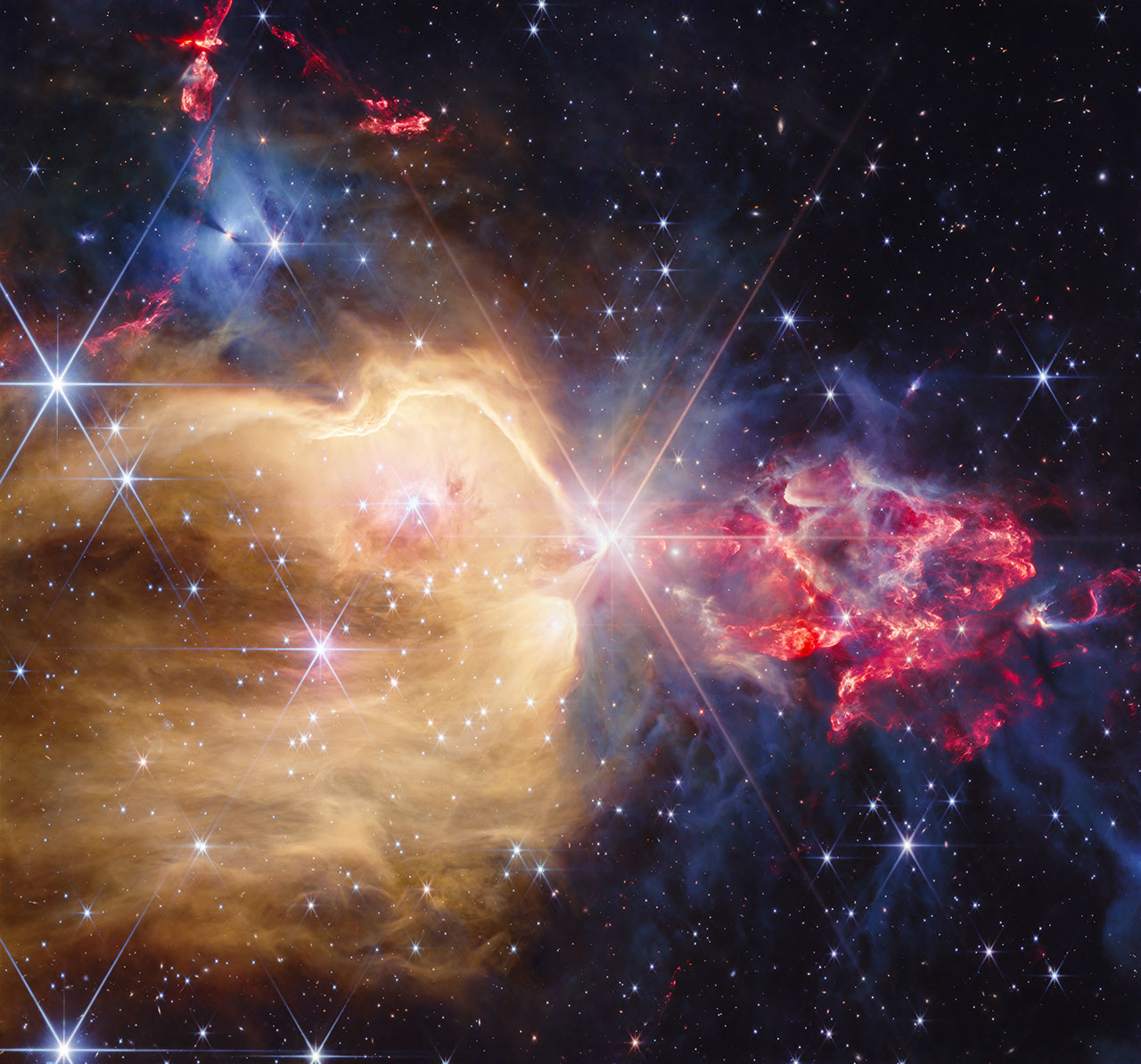
James Webb’s infrared view of NGC 7129 pierces thick dust to reveal scores of young stars and outflow-carved cavities, offering a sharper look at star formation.
NASA’s James Webb Space Telescope has delivered a dramatic new look into NGC 7129, a busy stellar nursery roughly 3,300 light-years from Earth, exposing scores of young stars that had been largely concealed behind thick interstellar dust.
Stars begin life inside molecular clouds—frigid, dense mixtures of gas and dust where gravity gathers material into compact clumps. Those dusty envelopes absorb visible light, which is why newborn stars can be difficult or impossible to spot with many observatories. Webb’s strength is infrared vision: it can detect longer wavelengths that slip through dust, giving astronomers a clearer view of star formation in progress and allowing them to track how different objects evolve inside the same cloud.
In Webb’s image, NGC 7129 is populated by stars at multiple developmental stages. That diversity reflects a basic rule of stellar evolution: heavier stars form and mature more quickly. The most massive—and apparently most evolved—object in the scene is the bright central star known as LkHα 234 (pronounced “Lick-H-alpha”), recognizable by the image’s most striking diffraction spikes. Researchers classify it as a pre-main-sequence star with an estimated mass of about five to eight Suns. At this stage, the star has nearly completed its growth by accretion and is now contracting under gravity, heating up as it approaches the point when hydrogen fusion ignites in its core.
Webb also reveals how strongly such a star can reshape its environment. To the left of LkHα 234 lies a prominent golden cavity spanning about 3.5 light-years across—evidence of powerful outflows launched earlier in the star’s life that excavated the surrounding hydrogen-rich cloud. Ultraviolet radiation from the star, along with lingering energy from those outflows, stimulates the gas so it glows. While much of the hydrogen has been dispersed, some of it has been squeezed into denser pockets, potentially priming the region for additional star formation. A number of young stars can be seen embedded inside this cavity; several are also pre-main-sequence objects driving stellar winds. Where those winds collide with surrounding gas, they produce curved “bow shocks”—compressed arcs that mark smaller, wind-blown hollows. The combined illumination from the central star and its neighbors also sculpts a crisp ridge along the cavity’s upper edge. There, hot irradiated gas presses against colder, denser material beyond the cavity, forming a boundary called a photodissociation region where molecular hydrogen is broken into individual atoms. Tracking such regions helps astronomers understand how massive young stars alter the chemistry and temperature of their birth clouds, gradually wearing them down over millions of years.
To the right of the central star, the story looks younger and more turbulent. Webb shows clumpy red material that conceals protostars—objects still earlier in development than pre-main-sequence stars. Protostars emerge after parts of the molecular cloud collapse and fragment; as they grow by pulling in surrounding material, they also launch jets and outflows of extremely hot gas. When those outflows slam into the dense, grayish cocoon around them, shock fronts form, producing a rough, textured appearance and contributing to the red glow. From Earth’s perspective, multiple outflows overlap, making the area appear especially chaotic.
Additional protostellar activity is visible near the image’s upper left, close to a bluish patch of nebula. At its center sits a protostar encircled by a thick, doughnut-like disk. That disk casts a distinct shadow across the surrounding gas, echoing a similar “Bat Shadow” structure previously spotted by the Hubble Space Telescope.
With its fine spatial resolution, Webb is capturing intricate filaments and shock features that extend earlier work by NASA’s now-retired Spitzer Space Telescope. Astronomers plan to mine these data to better measure how young stars and protostars—through light, winds, and jets—feed back into their natal clouds and influence what forms next.
Why it matters
Star-forming regions like NGC 7129 are laboratories for understanding how suns and planetary systems begin, and how massive young stars can both trigger and suppress further star birth nearby. Webb’s infrared view is uncovering objects and structures that were previously hidden, offering a more complete timeline of early stellar evolution. What researchers learn here will inform models of how molecular clouds erode and recycle material into future generations of stars.