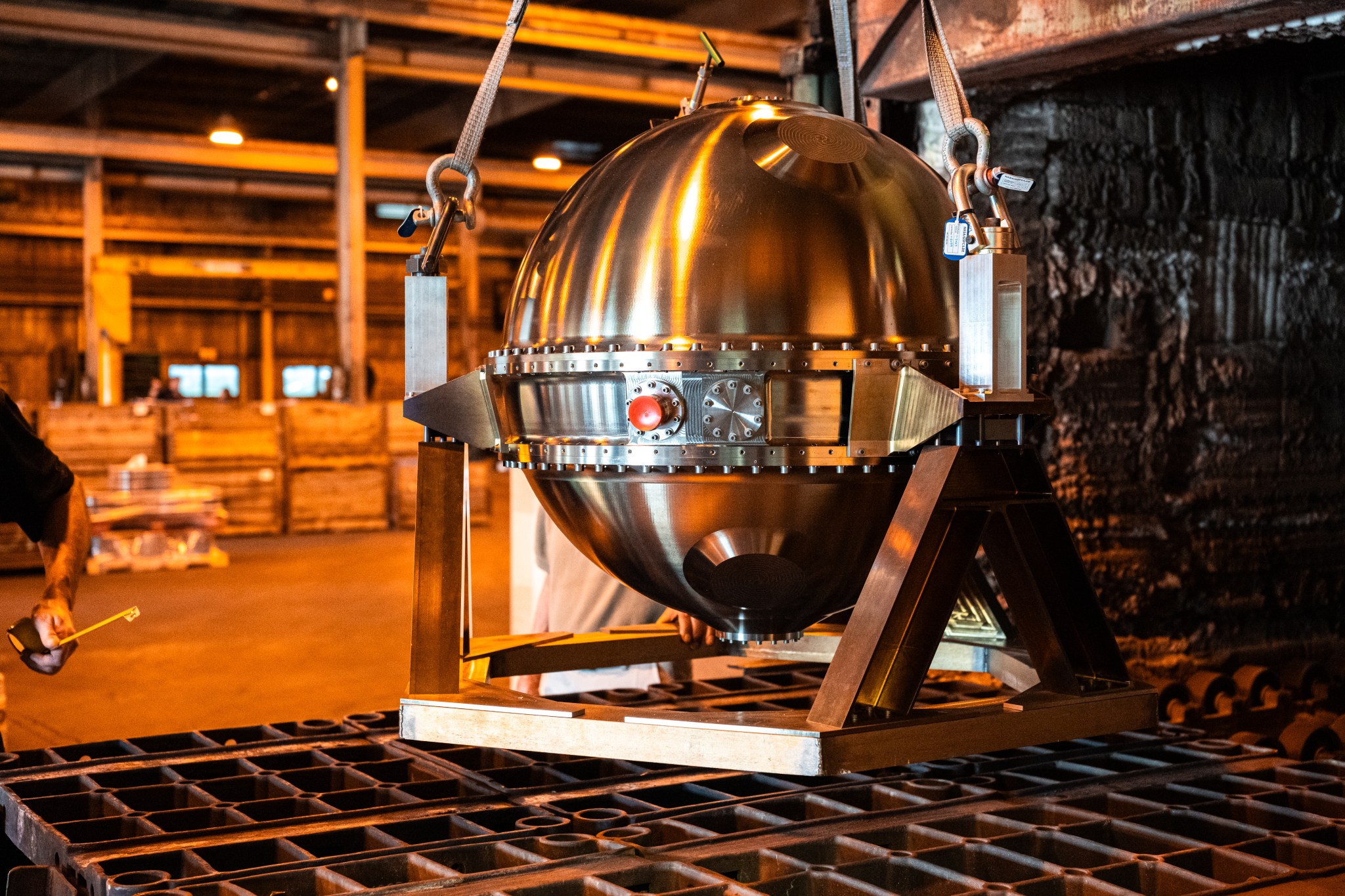
NASA engineers have pushed a key test version of the DAVINCI Venus probe through punishing conditions designed to mimic the planet’s searing lower atmosphere, a critical…
NASA engineers have pushed a key test version of the DAVINCI Venus probe through punishing conditions designed to mimic the planet’s searing lower atmosphere, a critical milestone as the mission moves toward flight hardware.
The spacecraft component put through its paces was the mission’s engineering development unit—an early, nonflight article built to validate designs and procedures for the actual probe. Roughly the size of a yoga ball, the vessel was placed inside a ceramic-lined thermal chamber whose walls are visibly scorched from repeated high-temperature trials. Once sealed in the facility, the team steadily increased the heat to 869 degrees Fahrenheit (465 degrees Celsius) over about an hour.
That heating schedule wasn’t arbitrary. It was chosen to match the rate at which the probe is expected to warm during its rapid plunge through Venus’s atmosphere on the way to the surface. Demonstrating that the structure and systems can tolerate both the peak temperature and the ramp-up profile is essential for ensuring the probe can protect its instruments long enough to return data.
DAVINCI—short for Deep Atmosphere Venus Investigation of Noble gases, Chemistry, and Imaging—is a NASA mission aimed at answering some of the biggest questions about Earth’s nearest planetary neighbor. By sampling the atmosphere as it descends and collecting key chemical measurements, the probe is designed to reveal new details about how Venus formed, how it changed over time, and what its environment is like today.
Scientists are particularly interested in whether Venus may once have been far more Earthlike. Evidence suggests the planet could have had water in the distant past, raising the possibility that it might once have supported more temperate—and potentially habitable—conditions before evolving into the extreme world seen now. DAVINCI’s measurements are intended to provide an unprecedentedly detailed look at the planet’s atmospheric composition and history, helping researchers evaluate the idea that Venus was once wet and habitable like Earth.
The recent thermal evaluation underscores the engineering challenge of exploring Venus directly. Temperatures near the surface are high enough to test the limits of conventional spacecraft materials and electronics. By successfully running a probe-scale test unit through a Venus-like heat profile, the DAVINCI team is building confidence that the mission’s protective design can endure the descent environment long enough to complete its scientific objectives.