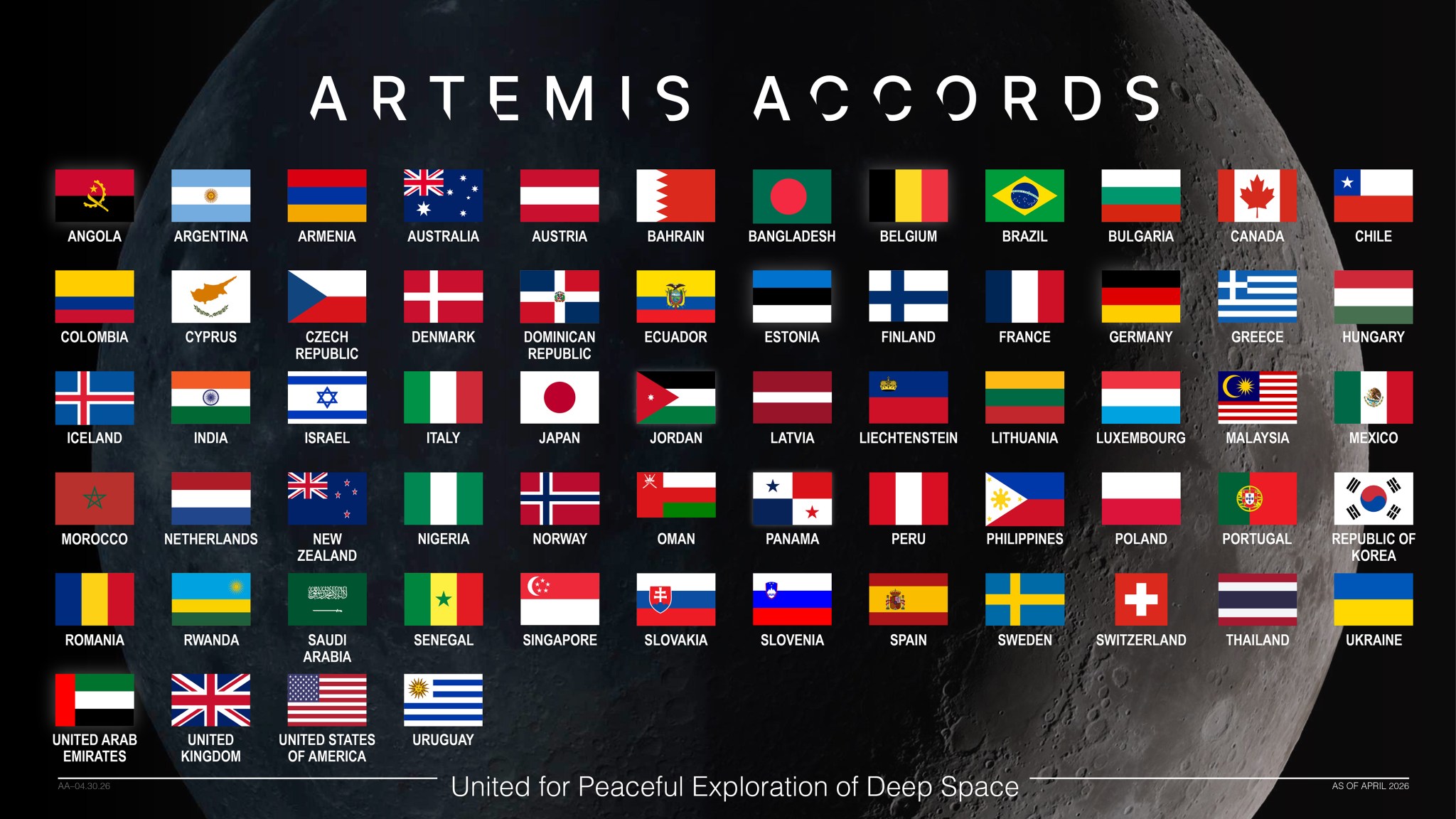
Morocco has joined NASA’s Artemis Accords, signing the international agreement on April 29 in a ceremony held in Rabat.
Morocco has joined NASA’s Artemis Accords, signing the international agreement on April 29 in a ceremony held in Rabat. With its decision, the Kingdom becomes the 64th nation to endorse the set of principles meant to guide responsible exploration of the Moon, Mars, and deeper space.
In recorded remarks released for the occasion, NASA Administrator Jared Isaacman said Morocco’s signature adds momentum to a coalition originally formed to help “like-minded nations” work together in space for peaceful purposes. He tied the accords to President Donald Trump’s goal of establishing a long-term human presence on the Moon, arguing that partner countries will be positioned to contribute in practical ways to that broader effort. Isaacman also emphasized the role that people across participating nations could play in what he described as a defining human undertaking.
Morocco’s Foreign Minister, Nasser Bourita, signed on behalf of the country. During the event, Bourita highlighted Morocco’s commitment to shared values that, in his view, extend across multiple critical domains. The signing took place as part of an official visit to Morocco by U.S. Deputy Secretary of State Christopher Landau. The U.S. Ambassador to Morocco, Duke Buchan III, also took part in the ceremony.
The Artemis Accords were first created in 2020, during the first Trump administration, amid accelerating interest in lunar activity from national space programs and private industry. Led by NASA in partnership with the U.S. Department of State, the United States and seven additional founding countries established the accords to set expectations for how governments would operate as exploration expanded beyond low Earth orbit.
Rather than serving as a broad political declaration, the accords lay out a practical framework intended to improve safety and coordination between nations pursuing similar objectives. The principles include commitments to conduct exploration in a peaceful manner and to be transparent about policies and plans. Signatories agree to provide assistance to astronauts in distress, share scientific information so that discoveries can benefit everyone, and carry out operations in ways that avoid harmful interference with the activities of others.
The accords also address stewardship and preservation, calling on nations to protect sites and items of historical significance—an issue expected to grow in importance as more missions target the lunar surface and other destinations. Signatories commit to developing and using best practices meant to ensure that exploration is carried out responsibly and in ways that serve broader human interests.
NASA expects additional countries to join in the months and years ahead. The agency has framed the expanding list of signatories as part of its wider push to foster a future in space that is secure, peaceful, and economically sustainable, as international partnerships play a growing role in the next phase of lunar and planetary exploration.