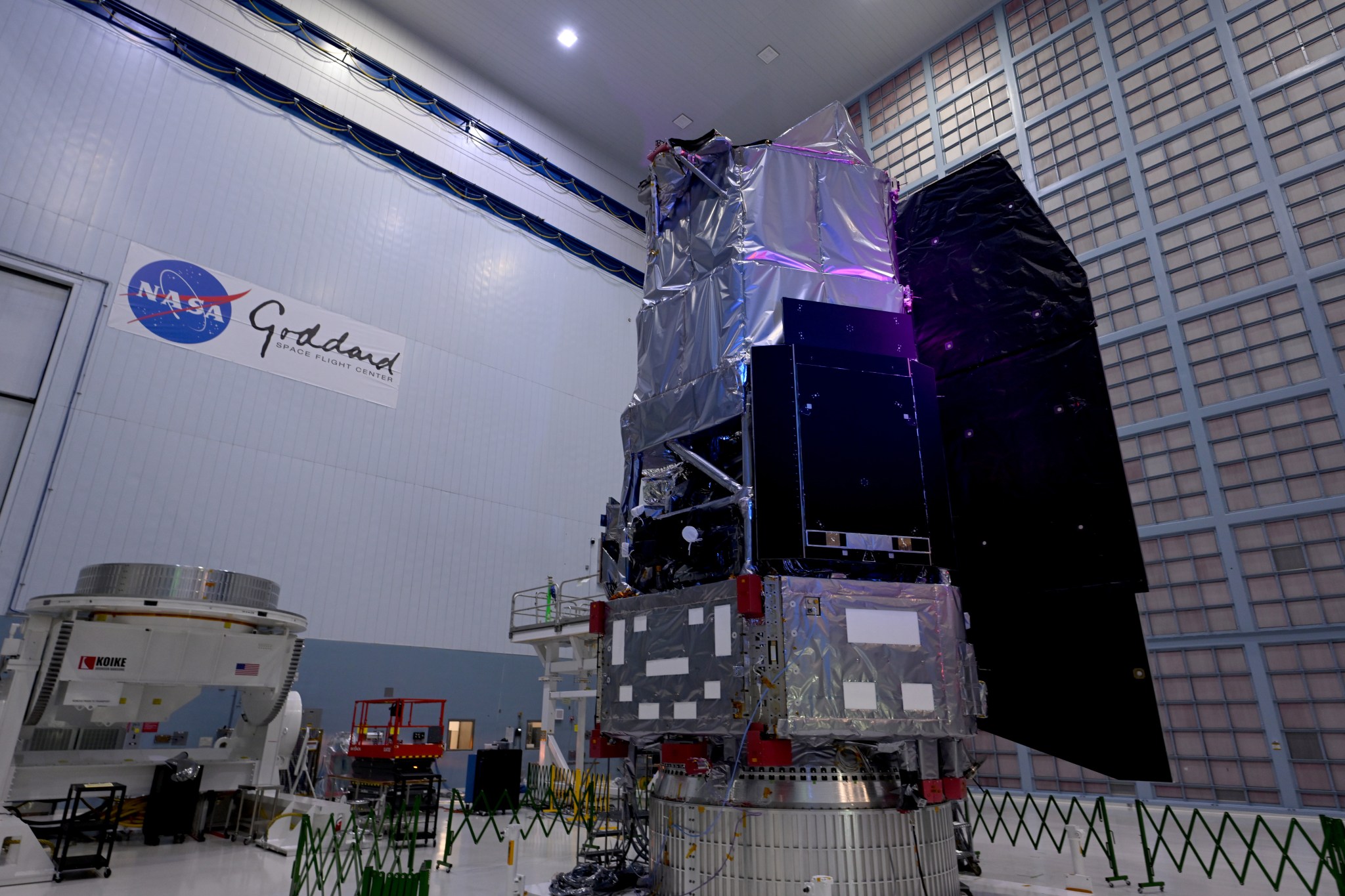
NASA is opening registration for journalists who want to cover a major milestone for the Nancy Grace Roman Space Telescope: its upcoming arrival at the agency’s Kennedy Space Center in Florida.
NASA is opening registration for journalists who want to cover a major milestone for the Nancy Grace Roman Space Telescope: its upcoming arrival at the agency’s Kennedy Space Center in Florida.
In the coming weeks, the newly completed observatory is set to travel from NASA’s Goddard Space Flight Center in Greenbelt, Maryland—where teams finished building, assembling, and testing the spacecraft—to Kennedy aboard NASA’s Pegasus barge. Credentialed members of the media will be able to watch as the telescope is delivered and offloaded in its transport container at Kennedy’s turn basin. After unloading, technicians will transfer the Roman telescope to the Payload Hazardous Servicing Facility, where it will begin launch preparations.
NASA says subject matter experts will be on site during the arrival activities to answer questions about the spacecraft and the next steps toward launch.
Media who want to attend must apply for credentials no later than 11:59 p.m. EDT on Thursday, June 4. The opportunity is limited to U.S. citizens. Approved applicants will receive confirmation by email, and NASA will provide additional details— including the specific schedule for arrival and unloading—after credentials are granted. NASA’s media accreditation policy is available online. Questions about accreditation can be directed to ksc-media-accreditat@mail.nasa.gov, while Kennedy’s newsroom can be reached at 321-867-2468.
Named in honor of NASA’s first chief astronomer, the Nancy Grace Roman Space Telescope is designed to capture deep, wide-field views of the universe. NASA expects its panoramic surveys to produce unprecedented images and datasets that could reshape understanding of how the cosmos evolved. Roman’s sweeping observations are intended to reveal vast numbers of celestial objects and help address some of astronomy’s most challenging questions, including elusive phenomena that cannot be observed directly.
In addition to its broad sky surveys, Roman will carry a technology demonstration aimed at directly imaging planets around nearby stars. NASA describes this as the most advanced technology the agency has yet flown for direct exoplanet imaging—an important step toward future missions seeking signs of life beyond Earth.
The mission is managed at NASA Goddard, with contributions from NASA’s Jet Propulsion Laboratory in Southern California; Caltech/IPAC in Pasadena, California; the Space Telescope Science Institute in Baltimore; and a science team spanning multiple research organizations. Key industry partners include BAE Systems Inc., L3Harris Technologies, and Teledyne Scientific & Imaging. International support and contributions also come from ESA (the European Space Agency), JAXA (Japan Aerospace Exploration Agency), France’s CNES (Centre National d’Études Spatiales), and the Max Planck Institute for Astronomy in Germany.
Launch services for the Roman Space Telescope are overseen by NASA’s Launch Services Program based at Kennedy. The agency currently anticipates liftoff as early as September, when Roman is scheduled to launch on a SpaceX Falcon Heavy rocket from Launch Complex 39A.