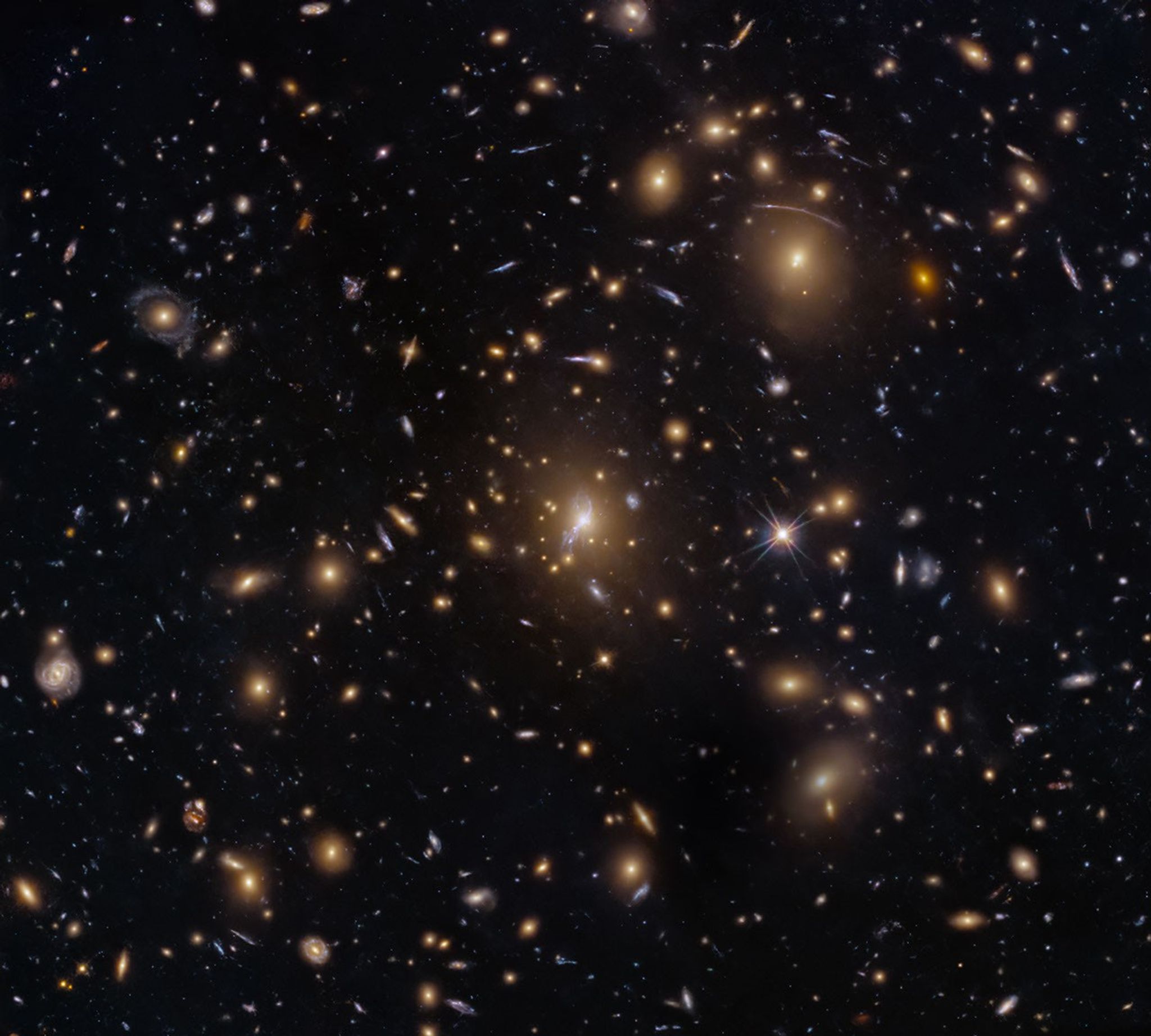
The NASA/ESA Hubble Space Telescope has captured a densely packed scene that resembles a cloud of insects converging on a nest: the galaxy cluster MACS0329-0211.
The NASA/ESA Hubble Space Telescope has captured a densely packed scene that resembles a cloud of insects converging on a nest: the galaxy cluster MACS0329-0211. Far from being a simple congregation of galaxies, clusters like this one are key markers in astronomers’ efforts to trace how the universe’s large-scale structure assembled over cosmic time.
In Hubble’s view, MACS0329-0211 is a rich mixture of galaxy types and orientations. Scattered throughout the cluster are prominent elliptical galaxies—large, smooth, oval systems that often dominate the cores of massive clusters. Intermingled with them are thinner spiral and lenticular galaxies seen edge-on, appearing as narrow slivers of light. Elsewhere in the frame, some spiral galaxies are oriented more face-on, allowing their winding arms to be seen more clearly. Together, these varied shapes provide a snapshot of the diverse galaxy population that thrives in a crowded cluster environment.
Beyond the cluster members themselves, the image showcases one of the most valuable roles galaxy clusters play in modern cosmology: acting as natural gravitational lenses. The enormous mass of a cluster warps the surrounding fabric of spacetime, bending and magnifying light from galaxies far behind it. In the upper-right portion of the Hubble image, several faint, curved streaks—arcs of background galaxies—appear where this lensing effect is strongest. The most prominent arc lies just above the bright oval glow of a giant elliptical galaxy, a sign that the foreground mass has stretched the distant source into an elongated curve.
A closer look toward the center reveals an even more striking feature: several bright, white arcs crossing one another in a pattern that resembles a distorted figure eight. Astronomers interpret this as another background galaxy whose light has been both amplified and heavily reshaped by the cluster’s gravity, producing multiple curved images and intersections that would not appear without the lensing effect.
Hubble observed MACS0329-0211 as part of a broader campaign targeting galaxy clusters that shine strongly in X-rays—an indicator of extremely hot gas trapped in the cluster’s gravitational well. To build a detailed picture, researchers used Hubble’s two primary imaging instruments: the Advanced Camera for Surveys and the Wide Field Camera 3. By collecting data in visible and infrared wavelengths, the observatory can probe both the cluster’s own galaxies and the more distant, lensed systems beyond it. This wide spectral reach helps scientists study the composition, distribution, and influence of matter within clusters, and improves the ability to use lensing as a tool for peering into the early universe.
Since its launch in 1990, the Hubble Space Telescope has repeatedly transformed astronomers’ understanding of the cosmos, and images like this one underline how a single cluster can serve as both a record of cosmic evolution and a powerful window onto the distant past.