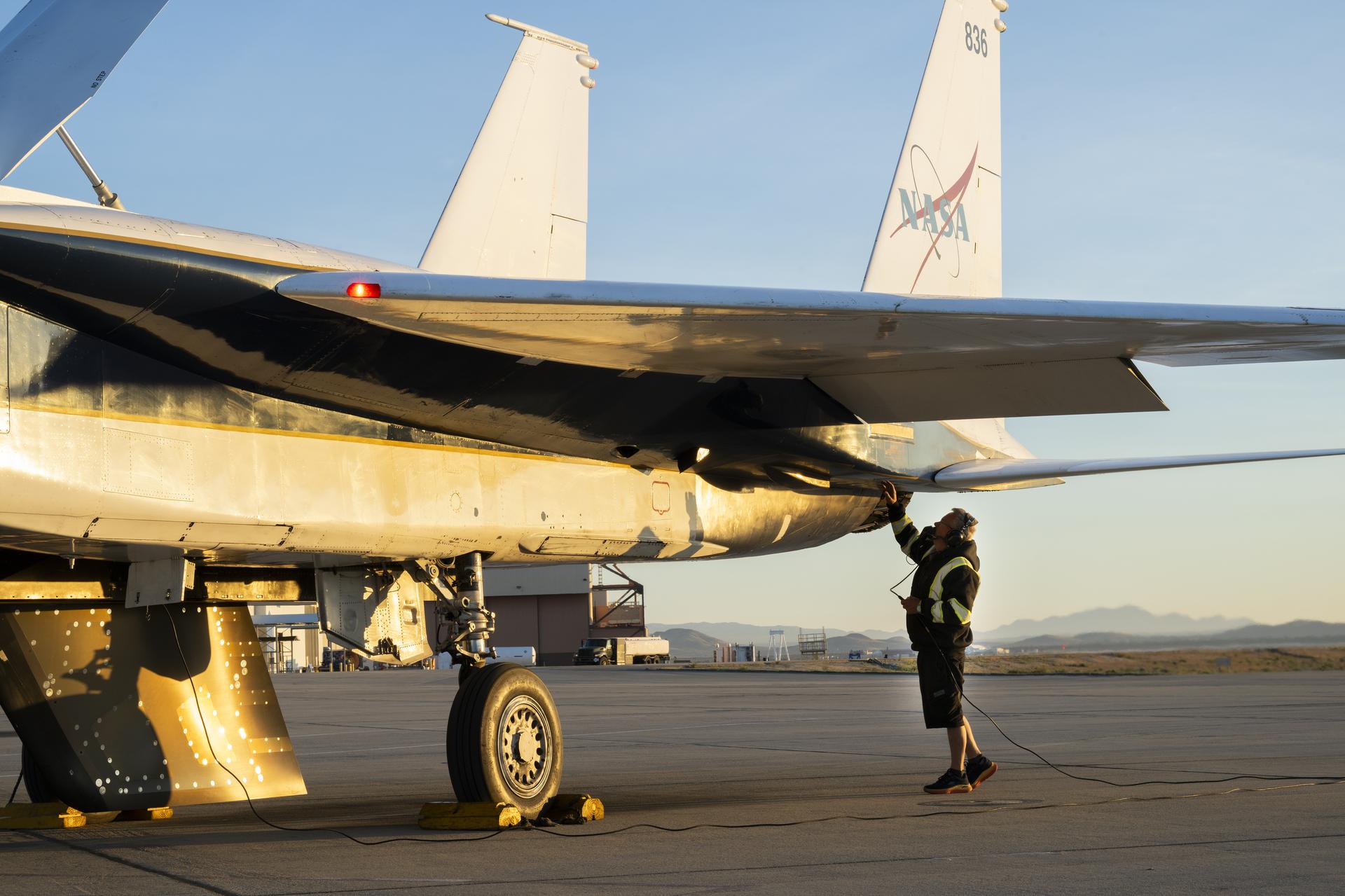
From supersonic research sorties to high-altitude science expeditions, NASA’s airborne missions rely on more than pilots and engineers.
From supersonic research sorties to high-altitude science expeditions, NASA’s airborne missions rely on more than pilots and engineers. Behind every takeoff is a maintenance workforce that keeps a diverse fleet safe, reliable, and ready to fly at a moment’s notice.
At NASA’s Armstrong Flight Research Center in Edwards, California, specially trained ground crews shoulder that responsibility across an expanding lineup of aircraft. This year the center added two F-15s and a Pilatus PC-12, broadening a collection that already spans platforms with very different roles and performance envelopes—among them the high-altitude ER-2s and NASA’s newest X-plane, the X-59.
Keeping such a mix mission-ready requires constant flexibility. Jose “Manny” Rodriguez, crew chief for NASA Armstrong’s Gulfstream G‑IV, says the work rarely follows a predictable script. On one shift, technicians may be installing or swapping scientific instruments; on another, they may be reconfiguring an aircraft while troubleshooting unrelated system issues. The common requirement is to respond quickly as mission needs change and aircraft conditions evolve.
Each airplane at Armstrong is tailored to specific tasks. Some conduct science research, others fly as chase or support aircraft, and some assist with NASA rocket launches. They operate at different speeds, carry specialized hardware, and face unique stressors that can wear down components with every flight. To keep operations safe and on schedule, maintenance personnel work continuously—inspecting ejection seats, refueling, and routinely replacing or servicing brakes, wheels, wiring, and other hardware that degrades over time.
On any given day, an aircraft may be cleared for immediate operations, undergoing scheduled upkeep or modifications, or receiving longer-term care. It’s also common for multiple Armstrong aircraft to be airborne in a single day, creating a fast-moving maintenance rhythm on the ground.
That tempo is visible in current deployments and test activity. Armstrong’s C‑20A is operating in Peru and Panama. The X‑59 often flies twice daily, typically accompanied by a chase plane. Meanwhile, an ER‑2 is flying in Colorado in support of the Geological Earth Mapping Experiment (GEMx). All of these efforts can unfold simultaneously, with maintenance teams preparing, repairing, and turning aircraft for the next sortie as requirements shift.
The workforce itself reflects a blend of expertise. Mechanics come from both military and civilian aviation backgrounds, and much of the proficiency is built through extensive hands-on training. Once the team has brought an aircraft to peak condition for its next assignment, it is towed to the flightline for operations. Before launch, the pilot and the aircraft’s crew chief perform a final walk-around inspection.
A key part of the system is accountability. Each aircraft has an assigned crew chief responsible for its overall integrity, Rodriguez explains, and the aircraft is cleared for flight only when both the crew chief and the pilot sign off together.
Even after wheels-up, the job continues. Crews track flights with the aim of helping missions run to completion without an early return. If a plane does come back ahead of schedule, maintainers are positioned to meet it on landing, diagnose issues, and restore readiness so the research or test program can keep moving.
The work can be demanding, Rodriguez notes, particularly when shifting between aircraft rooted in both civilian and military design traditions. But, he adds, the payoff is seeing the breadth of capability and skill that allows NASA’s aircraft—old, new, and newly arrived—to stay in the air supporting discovery and innovation.