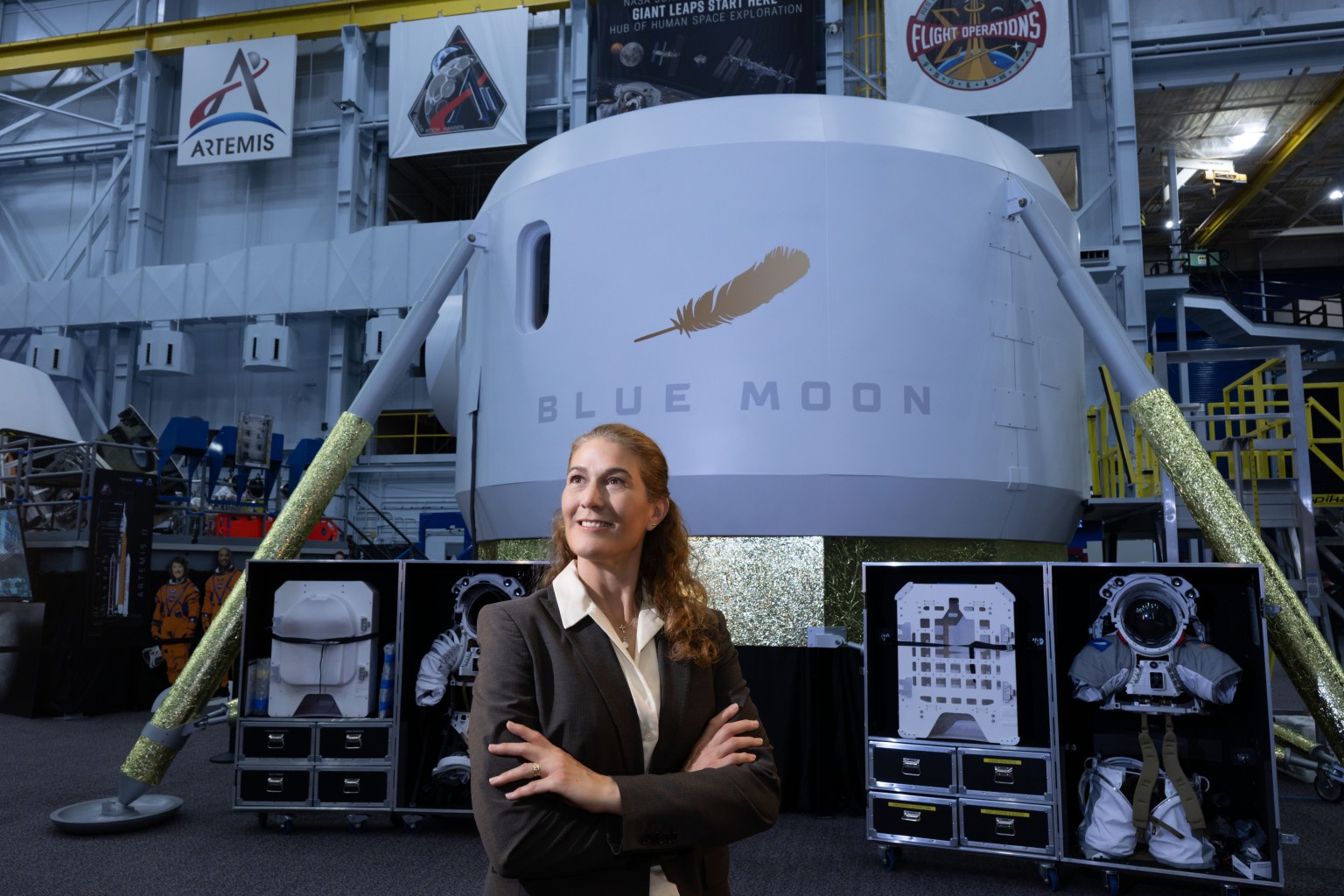
NASA’s Katie Spicer is guiding integration of Blue Origin’s Blue Moon Mark 2 lunar lander, scrutinizing crew interfaces and safety details to support Artemis missions.
For Katie Spicer, a willingness to take on unfamiliar roles—and to master the fine print that keeps crews safe—has shaped a NASA career that now intersects directly with the agency’s return to the Moon.
Spicer serves as NASA’s lander integration lead for Blue Origin’s Blue Moon Mark 2 lunar lander, one of the commercially supplied human landing systems being developed for NASA’s Artemis program. From the Flight Operations Directorate at NASA’s Johnson Space Center in Houston, she tracks and assesses the spacecraft’s design and development, working alongside counterparts at both NASA and Blue Origin.
Her focus is practical and crew-centered: ensuring that what astronauts must touch, operate, and rely on will work as intended in the unforgiving environment of space. That means looking beyond whether a component meets a written requirement and interrogating how it will function in real operations. Spicer reviews everything from handholds and rail placements to the usability of push-button displays in microgravity. She also examines whether hygiene and habitability systems are workable in tight quarters, and whether procedures and training will enable astronauts to use those systems safely and efficiently.
The Blue Moon lander itself is in flux. Blue Origin is refining a streamlined test article intended to support Artemis III rendezvous and docking activities in low Earth orbit, while also advancing plans for a fully capable lunar lander designed to carry crews to the Moon in 2028. Spicer’s job is to help ensure the evolving design aligns with Artemis mission objectives as the spacecraft matures.
Her route to this role has been unconventional in a field dominated by engineers. Spicer earned a bachelor’s degree in microbiology from Pennsylvania State University in State College, then spent several years as a full-time homemaker raising three children. Her first NASA work came part-time in the historic Life Sciences Laboratory, where she handled foundational tasks—washing dishes, cleaning equipment, and running tests that supported researchers.
That laboratory carried its own legacy. It was the facility where Apollo astronauts were quarantined after returning from the Moon, and where lunar samples were stored. For Spicer, the transition from managing a household to supporting that storied lab marked the start of a steady climb into human spaceflight operations.
She later moved into International Space Station work, supporting science payloads and helping operate the Human Research Facility racks in the ISS National Laboratory. The role required close coordination with investigators and crew to make sure in-flight protocols were executed correctly—experience that sparked her interest in the pace and pressure of real-time mission operations.
In 2018, Spicer became a flight controller in Johnson’s Mission Control Center. The training pipeline was demanding: she spent five years studying and preparing to earn key instructor and flight controller certifications. Without an engineering degree, she taught herself engineering fundamentals, passed formal boards and exams, and learned to communicate in the language of spacecraft systems. She then spent five years in the ISS flight control room as an Operations and Support Officer—one of the core positions in the “front room” of U.S. human spaceflight.
Now, when she looks up at the Moon, Spicer says she feels both humbled and entrusted by the responsibility of returning astronauts to the lunar surface, mindful of Apollo’s legacy and the example Artemis aims to set for future explorers. NASA’s Artemis effort will push toward increasingly complex missions near the Moon’s south pole, seeking to expand lunar exploration while spurring innovation and scientific progress.
Why it matters
NASA’s Artemis program depends on commercial lunar landers that must be not only powerful, but operable by humans in high-stakes conditions. Spicer’s work highlights how mission success can hinge on human-factors decisions—interfaces, procedures, and training—as much as on propulsion or structure. As Blue Moon’s design evolves toward a 2028 crewed landing, the details being reviewed now will shape safety, efficiency, and how astronauts live and work on the Moon.