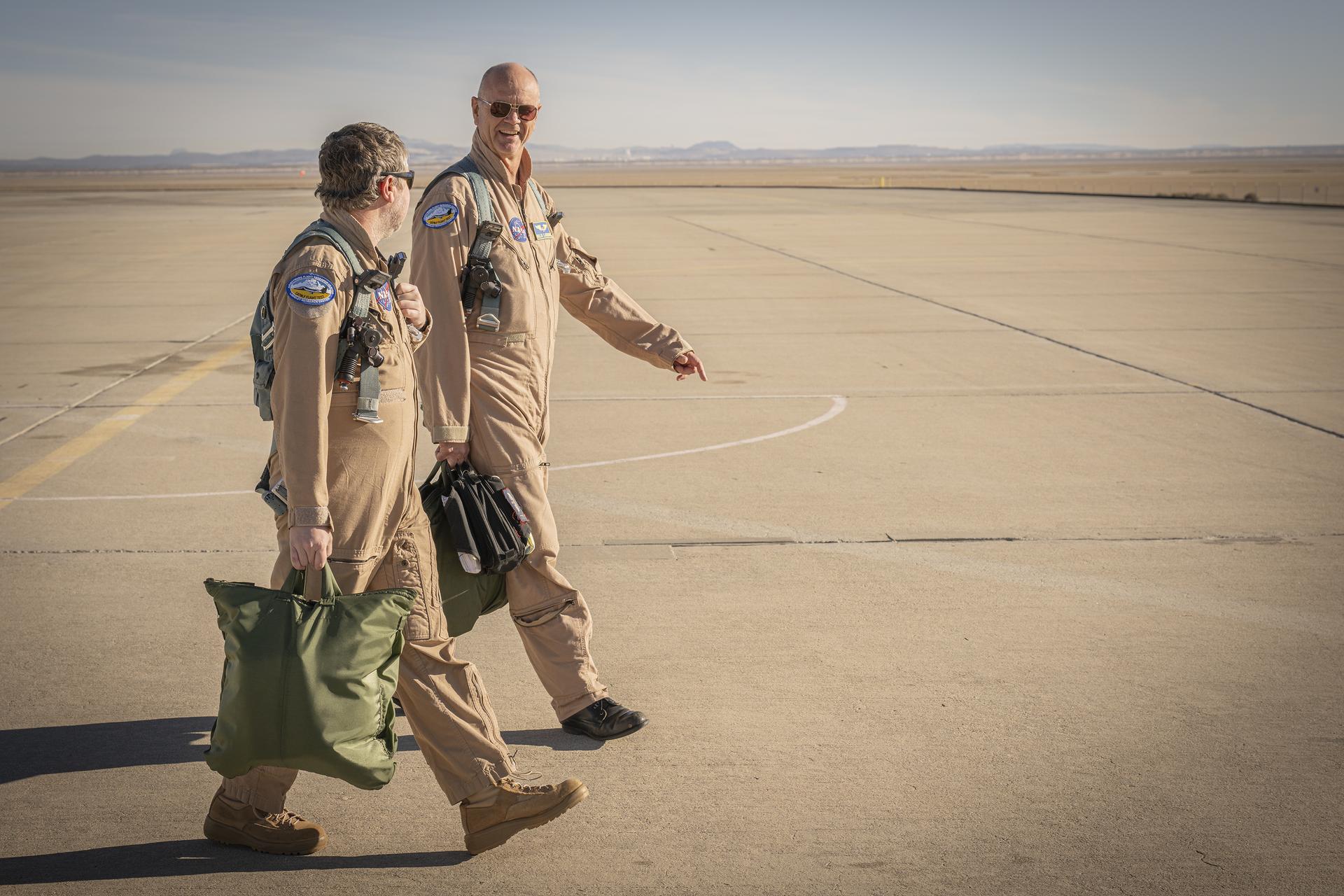
At NASA’s Armstrong Flight Research Center in Edwards, California, flight testing has long been a collaborative enterprise—one refined over nearly eight decades of work…
At NASA’s Armstrong Flight Research Center in Edwards, California, flight testing has long been a collaborative enterprise—one refined over nearly eight decades of work aimed at stretching the boundaries of aerodynamics and improving how aircraft fly. That team-centered approach was on display earlier this year during flights supporting NASA’s Crossflow Attenuated Natural Laminar Flow (CATNLF) initiative, which is investigating a wing design intended to preserve laminar flow—the smooth, orderly movement of air over a surface. Keeping more of that flow attached and undisturbed can reduce drag, a change that could translate into lower fuel burn and operating costs for future commercial airliners.
To evaluate the concept in real-world conditions, researchers mounted a scale-model CATNLF wing to the underside of a NASA F-15 and took the experiment into the sky. But the flying itself is only one part of a carefully choreographed day.
Work begins on the ground, where crews prepare the aircraft for the mission. If the flight requires a chase plane—an additional aircraft used to observe the test jet and help monitor the sortie—it, too, is readied along with its own team. Before anyone heads to the runway, the broader group convenes: pilots, engineers, maintenance technicians, project managers, researchers, and imaging specialists such as photographers and videographers. Together they review the plan for the day, go over weather information, and confirm the final objectives and constraints.
While those discussions wrap up, the control room team moves into position. They run through same-day checks to ensure communications links are solid and that displays and instruments needed to monitor the flight are working properly. Meanwhile, the aircrew prepares in life-support gear. Pilots don custom-fitted pressure suits along with harnesses, helmets, and oxygen masks. If a flight test engineer or a camera operator is riding in the back seat, that person suits up as well.
At the aircraft, the pilot performs preflight inspections and electrical system checks with the crew chief and technicians. Once the team is satisfied the jet is ready, the pilot and crew chief formally sign a flight preparedness report—an explicit confirmation that the aircraft is cleared to fly.
Inside mission control, the staff sets up to track the sortie using standardized test cards, which outline the flight profile as a sequence of step-by-step tasks. The crew climbs in, straps down, and secures any equipment needed for the test. After additional ground checks, the pilot contacts the control tower and taxis to the runway, with Armstrong’s control room monitoring by radio.
Takeoff marks the start of the airborne phase: the F-15 accelerates, lifts off at the appropriate speed, and then coordinates with air traffic control at Edwards Air Force Base and the NASA Armstrong team en route to the designated test area. Once on station, the pilot and ground team align on altitude, airspeed, and maneuvers. The test conductor calls out each point in the sequence, and the pilot executes them in order while both cockpit and control room monitor how the wing hardware, instruments, and aircraft systems perform.
After the planned test points are completed, the pilot heads back to base, lands, and taxis to the ramp where the crew chief meets the jet. The aircraft is then towed into a hangar for postflight maintenance. The day concludes with a return to the briefing room, where the pilot, project personnel, and mission control document lessons learned and flag issues for follow-up. Flight data is downloaded for analysis—and if a second sortie is scheduled, the cycle begins again almost immediately.