NASA has released Artemis II’s full lunar science dataset, including astronauts’ annotated images and audio noting five faint impact flashes seen from Orion.
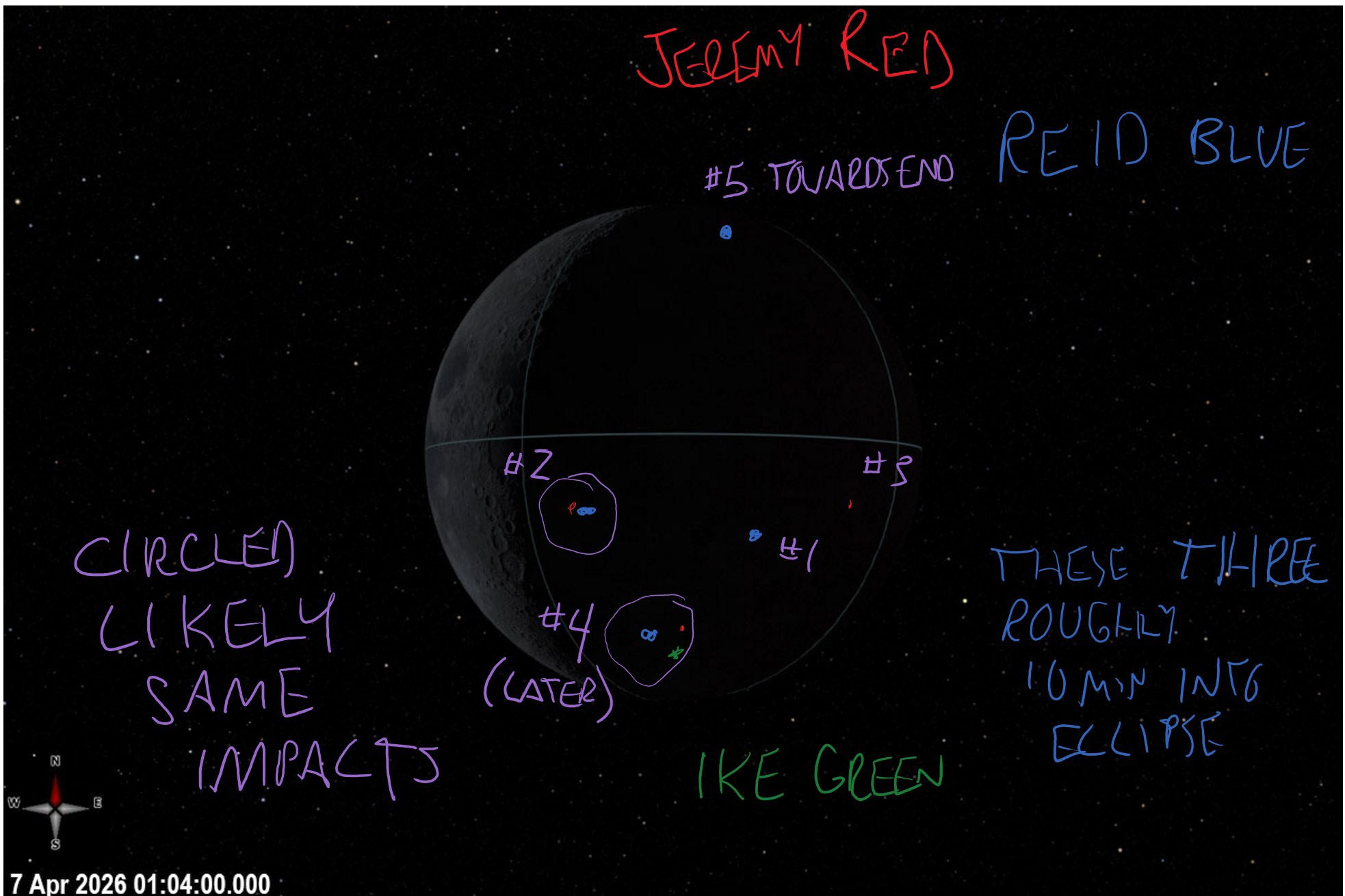
A screenshot taken April 6, 2026, from an Artemis II astronaut’s tablet shows a simulated view of the Moon passing in front of the Sun—an eclipse-like alignment—covered with handwritten annotations made during the mission. On the marked-up image, NASA astronauts Reid Wiseman and Victor “Ike” Glover, along with Canadian Space Agency astronaut Jeremy Hansen, recorded where they believed they saw brief flashes on the lunar surface.
The crew was watching for impact flashes: tiny bursts of light produced when small rocky fragments strike the Moon at high speed. From their vantage point inside NASA’s Orion spacecraft, the astronauts reported spotting five extremely faint “pinprick” flashes. At the time of the observation, Orion was about 46,000 miles from the Moon, underscoring both the subtlety of the events and the challenge of making visual detections across such distance.
Those notes—color-coded to track each observer (Wiseman in blue, Glover in green, and Hansen in red)—are part of a larger set of images and measurements gathered during Artemis II, NASA’s early crewed flight in the Artemis campaign. The mission ran from April 1 through April 10, 2026, taking the crew on a round trip to lunar distance and back to Earth. Along the way, the astronauts documented the Moon with photography and recorded scientific observations intended to complement instrument-based measurements with human eyewitness reports.
NASA has now released the complete lunar science dataset from the Artemis II journey. The agency says the material is available both to researchers worldwide and to members of the public interested in analyzing the mission’s observations. In addition to imagery and associated records, the release includes access to the mission report and audio clips capturing crew commentary as events unfolded, providing context for what the astronauts were seeing and when they saw it.
The newly available dataset gives scientists an opportunity to revisit the crew’s observations—such as the five reported impact flashes—compare them with other sources of lunar monitoring, and refine methods for identifying and locating transient light events on the Moon. It also opens the door for independent analysis by universities, amateur observers, and citizen scientists, who can examine the same materials used by mission teams.
Why it matters
Impact flashes are direct evidence of ongoing bombardment of the Moon by small debris, information that helps researchers understand the near-Earth environment and assess risks for future lunar missions. Making Artemis II’s lunar science records broadly available expands the pool of experts who can validate findings and extract additional insights. What comes next will be how well these reported flashes can be corroborated and whether follow-up studies can pinpoint their locations and frequencies.