Paul Krugman argues Wall Street’s AI-driven stock swings reflect hype and lax accountability, not real machine-learning milestones or lasting market gains.
Economist Paul Krugman is arguing that the stock market’s fixation on “AI” has become untethered from both accountability in the tech industry and from the actual technical milestones that have defined modern machine learning.
In a recent post, Krugman describes what he calls “Impunity Day”: a moment when, in his telling, political and corporate elites got what they wanted and the message to the public was clear—attempts to hold powerful technology leaders responsible would supposedly risk collapsing the broader sector. The implied bargain, he writes, is that tolerating misconduct or even national-security compromises is the price of preserving innovation and market value.
Krugman’s punchline is that markets didn’t even deliver the promised payoff. Instead of a sustained rally, he says the result was a fleeting bump—a classic “dead cat bounce”—that quickly faded.
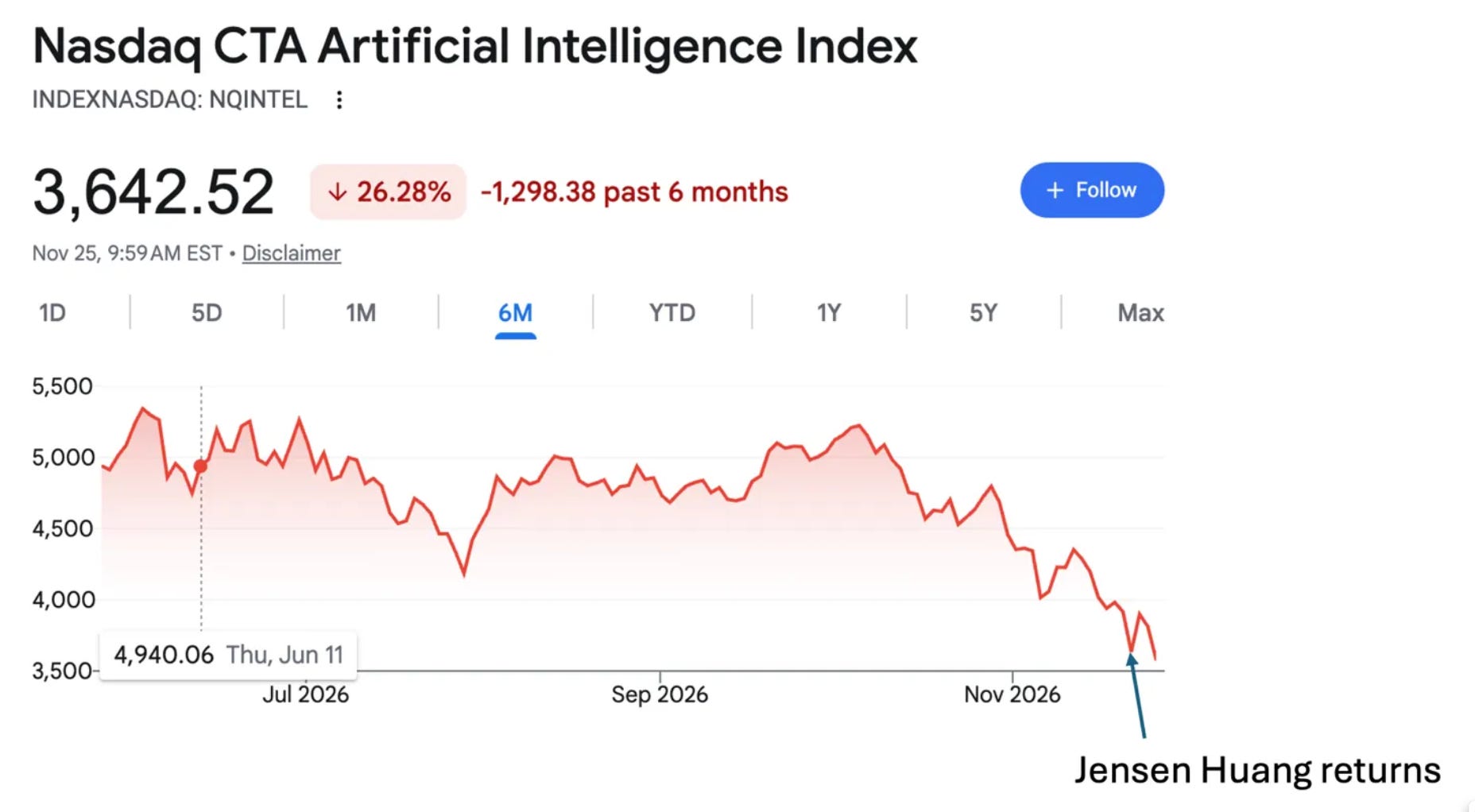
To make the case, he points to the jagged path of an “AI stock index” over the past several years. In his recounting, the index sat around 2,700 in January 2022 before sliding to roughly 1,700 by January 2023. It then rebounded to about 2,500 in January 2024 and rose again to 2,900 in January 2025. After a drop to around 2,300 in April 2025, it surged to 3,500 by October 2025 and remained near that level in March 2026. Then came a dramatic round trip: a leap to about 5,200 by June (around 5,100 in October) followed by a decline to 3,642.71.
What makes those fluctuations notable, Krugman suggests, is how weakly they line up with the developments that many AI researchers and industry observers would cite as the field’s true inflection points. He lists several moments that helped shape today’s generative-AI boom: OpenAI’s decision in February 2019 to limit the initial release of the GPT‑2 model; the June 2020 arrival of GPT‑3 and the recognition that large language models could perform “few-shot” prompting; the November 2022 debut of ChatGPT; OpenAI’s September 2024 release of its o1 work on “reasoning”; and, in November 2025, a period when Anthropic’s Claude Opus 4.5 was seen as making coding agents meaningfully useful. He adds a more recent event as well: Anthropic’s April 2026 decision to withhold a full release of its Mythos model.
With the possible exception of the last item, he contends, these landmark moments show little relationship to the market’s swings. That disconnect leads to his broader conclusion: Wall Street’s enthusiasm and fear around “AI” appear out of sync with the technology’s on-the-ground progress—what he characterizes as the distance between the financial world and “Cerebral Valley,” shorthand for the AI research and startup ecosystem.
Krugman anticipates the rebuttal from strong believers in efficient markets—economists such as Robert Merton or Eugene Fama—who might argue that prices nonetheless incorporate real information about bottlenecks, profitable applications, and likely returns. But his framing is that, whatever information the market is aggregating, it does not resemble the timeline of breakthroughs that the AI community itself uses to explain the field’s evolution.
Why it matters
If Krugman is right, investors and policymakers may be making high-stakes decisions based on narratives that don’t match either corporate governance realities or the technology’s actual trajectory. That gap can amplify bubbles, deepen volatility, and encourage a dangerous assumption that accountability is economically unaffordable. The next test will be whether future market moves begin tracking measurable deployment and productivity gains—or continue to trade mostly on hype, fear, and politics.