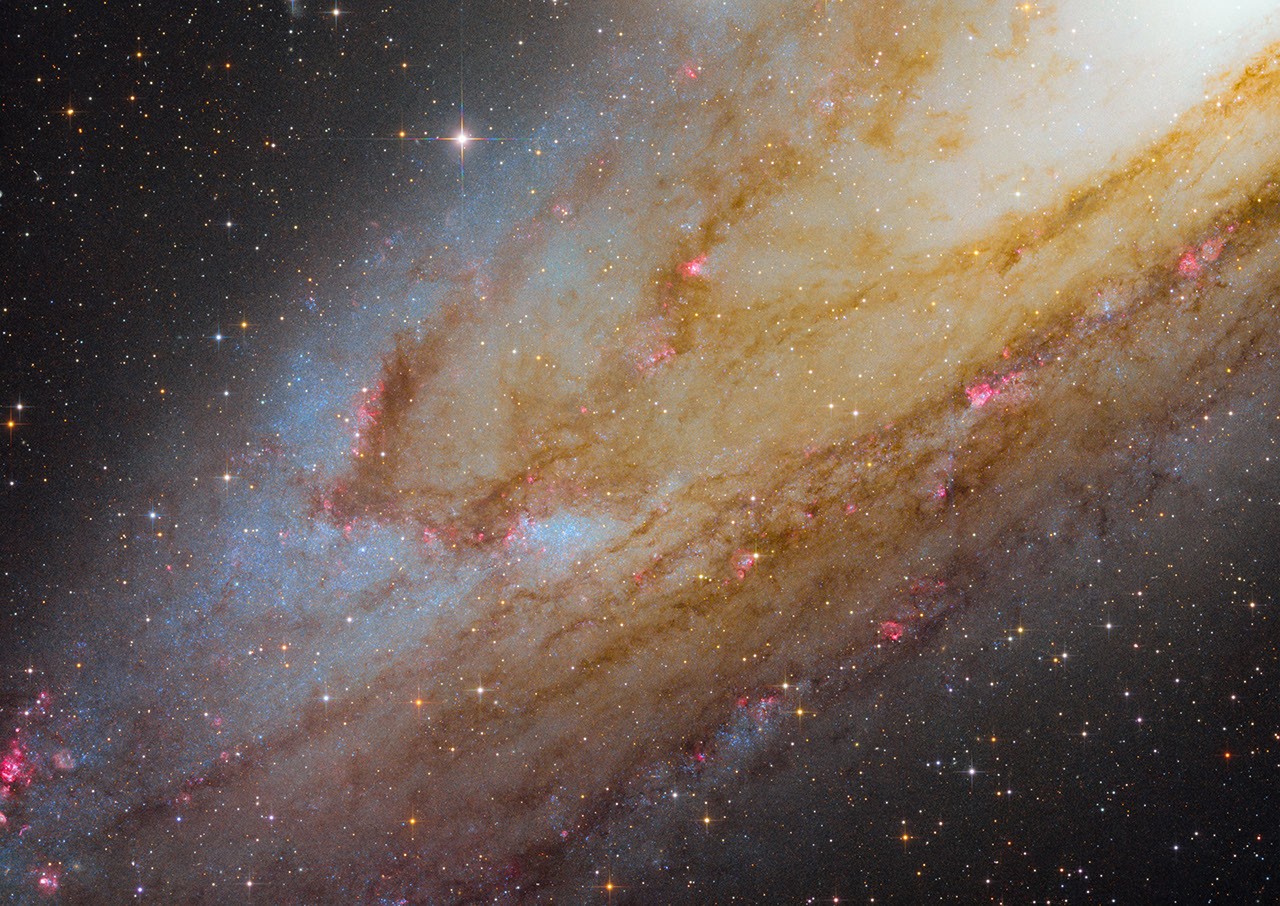
A close-up of Andromeda highlights NGC 206, a vast, loose association of bright blue stars and nearby pink star-forming regions embedded in dusty spiral arms.
A sprawling gathering of young stars known as NGC 206 stands out inside the Andromeda galaxy’s dusty spiral arms, sharing the scene with scattered, rosy patches where new stars are still being born. Andromeda—also cataloged as M31—is the Milky Way’s nearest large spiral neighbor, lying about 2.5 million light-years from Earth.
In a crisp close-up targeting the southwestern portion of Andromeda’s broad disk, NGC 206 sits near the center of the frame. Rather than being a compact star cluster, it is a large stellar association: a loose, extended concentration of stars that formed together relatively recently. Its most prominent members are bright, blue stars—an astronomical hallmark of youth, since massive blue stars burn hot and fast and don’t survive long on cosmic timescales.
Measurements of the association’s stellar population show just how recently this region lit up. The youngest of its massive stars are estimated to be under 10 million years old, making NGC 206 a striking example of ongoing galactic renewal in a neighboring system. These blue stars effectively act as signposts, tracing a recent burst of star formation embedded within Andromeda’s complex, dust-laced structure.
The scale of NGC 206 is what truly sets it apart. Spanning roughly 4,000 light-years, it dwarfs the typical young open clusters found in the Milky Way’s disk. That immense extent places it in the same league as some of the most famous stellar nurseries in nearby galaxies, including NGC 604 in the Triangulum Galaxy (M33) and the Tarantula Nebula in the Large Magellanic Cloud. In other words, this is not a small neighborhood of newborn stars, but a vast star-forming complex—an entire “cloud” of luminous young suns spread across a sizeable fraction of a galactic spiral arm.
Seen in context within Andromeda’s disk, NGC 206 helps illustrate how star formation proceeds in large spiral galaxies: concentrated in clumpy regions along spiral structure, often intermixed with dust lanes and surrounded by emission regions that glow with the characteristic pink light of energized hydrogen gas. The detailed view underscores that even in a galaxy as familiar as Andromeda, the engines of starbirth operate on grand scales—and can be studied in remarkable detail from millions of light-years away.
Why it matters
NGC 206 offers astronomers a nearby laboratory for understanding how massive stars form and shape their surroundings in spiral galaxies beyond the Milky Way. Because it is both enormous and very young, it can help refine models of star formation and stellar evolution under conditions similar to those in our own galaxy. Future observations that map its gas, dust, and stellar ages in more detail could reveal how such large associations ignite—and how long they remain coherent before dispersing into the galactic disk.