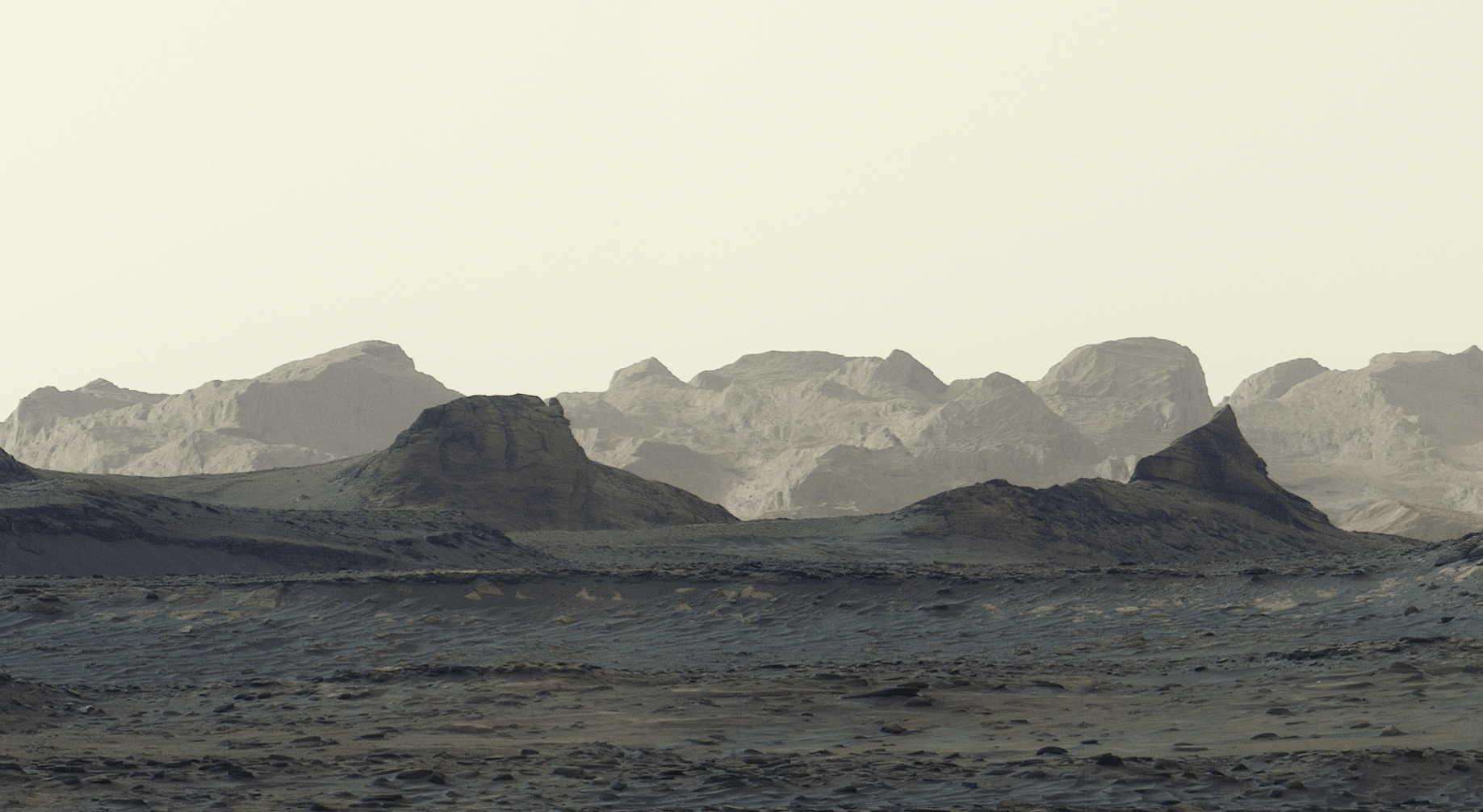
NASA’s Curiosity rover has captured its clearest panorama yet of Mars’ wind-carved “yardang” cliffs on Mount Sharp. Scientists hope the unusual layer will reveal clues to ancient environmental change.
A new panorama from NASA’s Curiosity rover is giving scientists their clearest look so far at a band of wind-sculpted cliffs on Mars that they have been eager to examine more closely for years. Taken at about 8:30 a.m. local time on the Red Planet, the scene captures the crisp light of early morning washing across the landscape, with cool blue tones lingering in the foreground while distant ridges and fins—known as yardangs—stand out along the horizon.
Curiosity recorded the view with its Mastcam on Aug. 11, during the mission’s 4,982nd Martian day, or sol. The panorama combines six separate frames that were transmitted to Earth and then assembled into a single wide view. Mission team members also processed the image differently than many Mastcam releases: rather than applying a white-balance correction, they left the colors closer to what the camera saw in the morning light, preserving the dawn-like appearance.
The target that dominates the far distance is the so-called yardang layer, a stretch of eroded rock formations spanning roughly 10 miles (16 kilometers) across the northwestern flank of Mount Sharp. Mount Sharp rises about 3 miles (5 kilometers) above Gale Crater and has been Curiosity’s long-term destination since the rover began climbing it in 2014. The rover has now reached about 0.6 miles (1 kilometer) in elevation—its highest climb and the greatest elevation gain achieved by any rover on Mars to date.
Researchers are especially interested in these cliffs because Mount Sharp is built from stacked layers that preserve a record of environmental change over enormous timescales. Curiosity’s investigations of lower strata have already helped scientists piece together evidence that this region once hosted lakes and streams billions of years ago. Over time, those wetter conditions ended; water disappeared and left behind salts and other minerals as it evaporated. Scientists suspect that after sediment accumulation ceased, winds may have removed large amounts of material, carving the landscape into the streamlined ridges seen today.
Yet the yardang layer does not fit neatly into the surrounding geology. “The yardang layer looks out of place,” said Ashwin Vasavada, Curiosity’s project scientist at NASA’s Jet Propulsion Laboratory in Southern California. He noted that its coloration differs from nearby deposits, its layers appear to tilt unusually, and it looks almost as if it was “plastered on.” That mismatch is part of the appeal: the team hopes that close-up measurements will reveal how the unit formed. One leading hypothesis is that it could represent ash laid down by ancient volcanic eruptions.
Curiosity is currently in the second year of its fifth extended mission. That extended campaign began with a study of “boxwork” formations—interlaced ridges that resemble spiderweb patterns. Over the next year or so, the rover is expected to continue traversing terrain rich in sulfate and carbonate minerals, chemical clues consistent with a drying Martian surface.
If progress continues as planned, scientists aim for Curiosity to arrive at the base of the yardangs sometime in 2027. From there, the rover can bring its robotic arm to bear, collecting close-range imagery and compositional readings that could finally explain what made this unusual layer and what it reveals about Mars’ shifting climate.
Curiosity was built at NASA’s Jet Propulsion Laboratory, managed by Caltech in Pasadena, and the mission is led by JPL for NASA’s Science Mission Directorate as part of the agency’s Mars Exploration Program. Mastcam was built and is operated by Malin Space Science Systems in San Diego.
Why it matters
Every new layer Curiosity climbs through is effectively a page from Mars’ environmental history, helping scientists reconstruct how a once wetter planet became the cold, arid world seen today. Understanding the origin of the yardang layer—possibly linked to wind erosion or volcanic ash—could sharpen timelines for climate change and habitability in Gale Crater. The next major milestone to watch is whether Curiosity reaches the yardangs by 2027 and what its close-up measurements reveal about this geologic outlier.