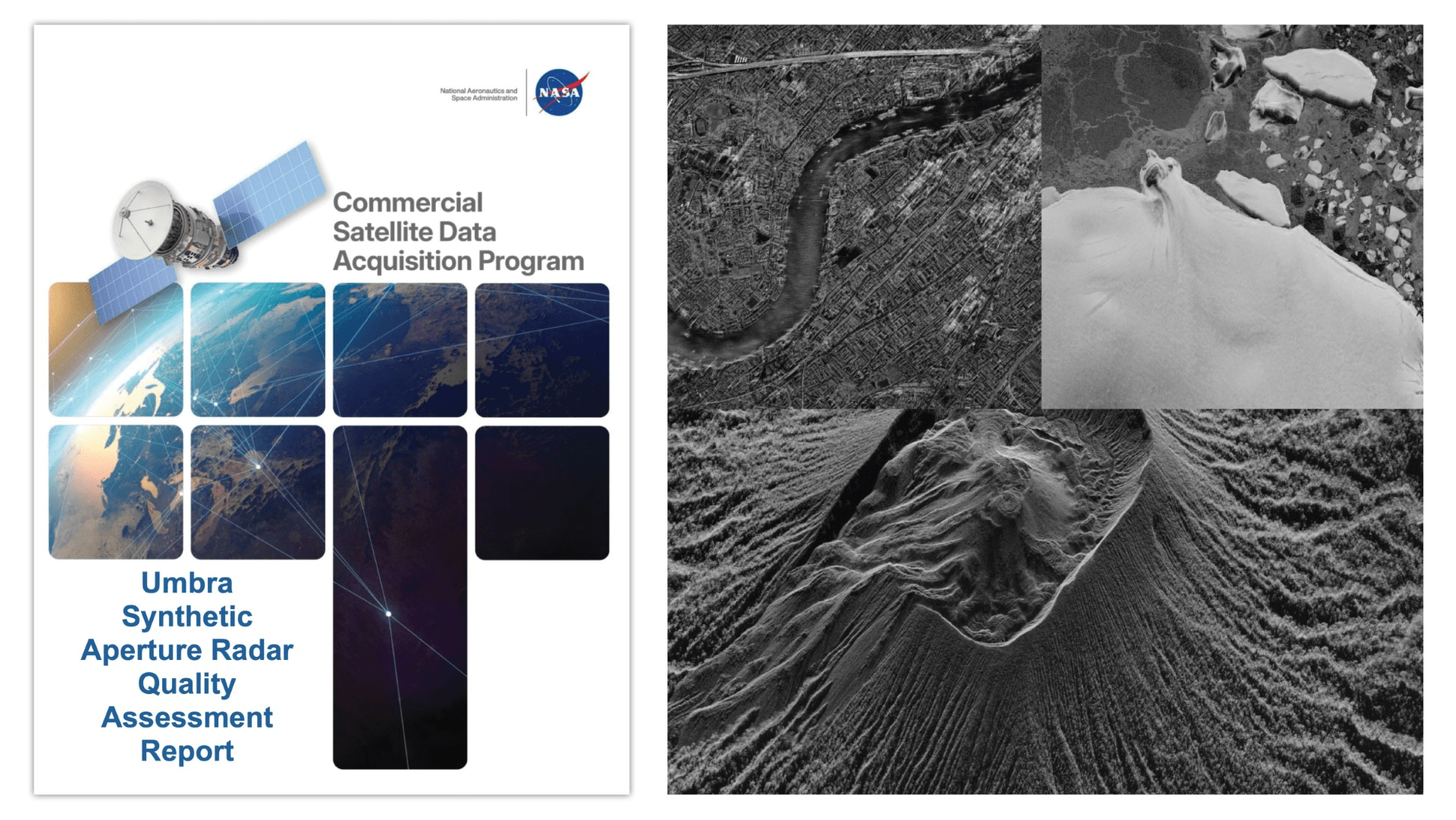
NASA’s Commercial Satellite Data Acquisition CSDA program has released two evaluations of X-band synthetic aperture radar SAR imagery from the commercial Umbra satellite…
NASA’s Commercial Satellite Data Acquisition (CSDA) program has released two evaluations of X-band synthetic aperture radar (SAR) imagery from the commercial Umbra satellite constellation, offering NASA researchers a detailed look at how well the data perform for Earth science studies and applications. Together, the reports are intended to guide both NASA program decisions and prospective users by clarifying where Umbra’s products are strong, where they fall short, and how closely they match the company’s stated specifications.
One document, the Umbra SAR Principal Investigator Evaluation Summary, compiles findings from NASA-led evaluation teams that were granted broad access to Umbra’s data holdings. In addition to working with the existing archive, the teams were able to request new collections—an important capability for testing whether the constellation can support time-sensitive science workflows. That on-demand tasking also enabled monitoring of fast-evolving events and environmental conditions, including situations such as harmful algal blooms, where timely repeat imaging can be critical.
Overall, the principal investigator teams concluded that Umbra SAR data can support NASA Earth science research and applications, but they also flagged notable limitations. Among the strengths, reviewers highlighted the availability of very high spatial resolution X-band SAR imagery from a constellation architecture, as well as the ability to request acquisitions with rapid turnaround and frequent revisits. They also cited imaging versatility, including access to a range of azimuth and incidence angles, and pointed to Umbra’s Open Data Program as a positive feature for the broader community.
At the same time, the teams reported weaknesses that could complicate scientific use and operational integration. These included geolocation challenges—ranging from relatively small to more substantial positioning errors—along with constraints related to software compatibility. Reviewers also noted shortcomings in metadata and identified gaps in technical documentation.
A second publication, the Umbra SAR Quality Assessment Report, focuses on fundamental data quality, presenting radiometric and geometric analyses conducted by NASA subject matter experts. This assessment followed the Joint NASA/European Space Agency evaluation guidelines referenced as ESA-NASA (2024). The technical review examined primarily Level 1 single-look complex (SLC) products delivered in Sensor Independent Complex Data (SICD) format, while also considering some Level 2 products that were used in separate science usability testing.
In this quality assessment, NASA experts found that Umbra’s delivered spatial resolution was consistent with the company’s specifications. However, the evaluation did not find the same level of agreement for geolocation accuracy. Based on the analyses, the reviewers concluded that overall positioning performance did not reach the expected accuracy, indicating a mismatch with specifications in at least some cases.
The radiometric evaluation—covering absolute accuracy, stability, and sensitivity—also raised concerns. According to the report, Umbra’s radiometric performance lagged behind that of well-calibrated reference SAR systems, suggesting limitations for applications that depend on tightly controlled calibration.
CSDA, NASA’s program for identifying, evaluating, and acquiring commercially sourced satellite observations, was created to help meet Earth science research and applications goals. NASA’s Earth Science Division has emphasized that commercial constellations could accelerate progress in Earth system science and deliver societal benefits, while also offering a potentially cost-effective way to complement observations from NASA missions, other U.S. agencies, and international partners. Full versions of both reports are available through the “Evaluation” section of CSDA’s Umbra commercial vendor webpage.