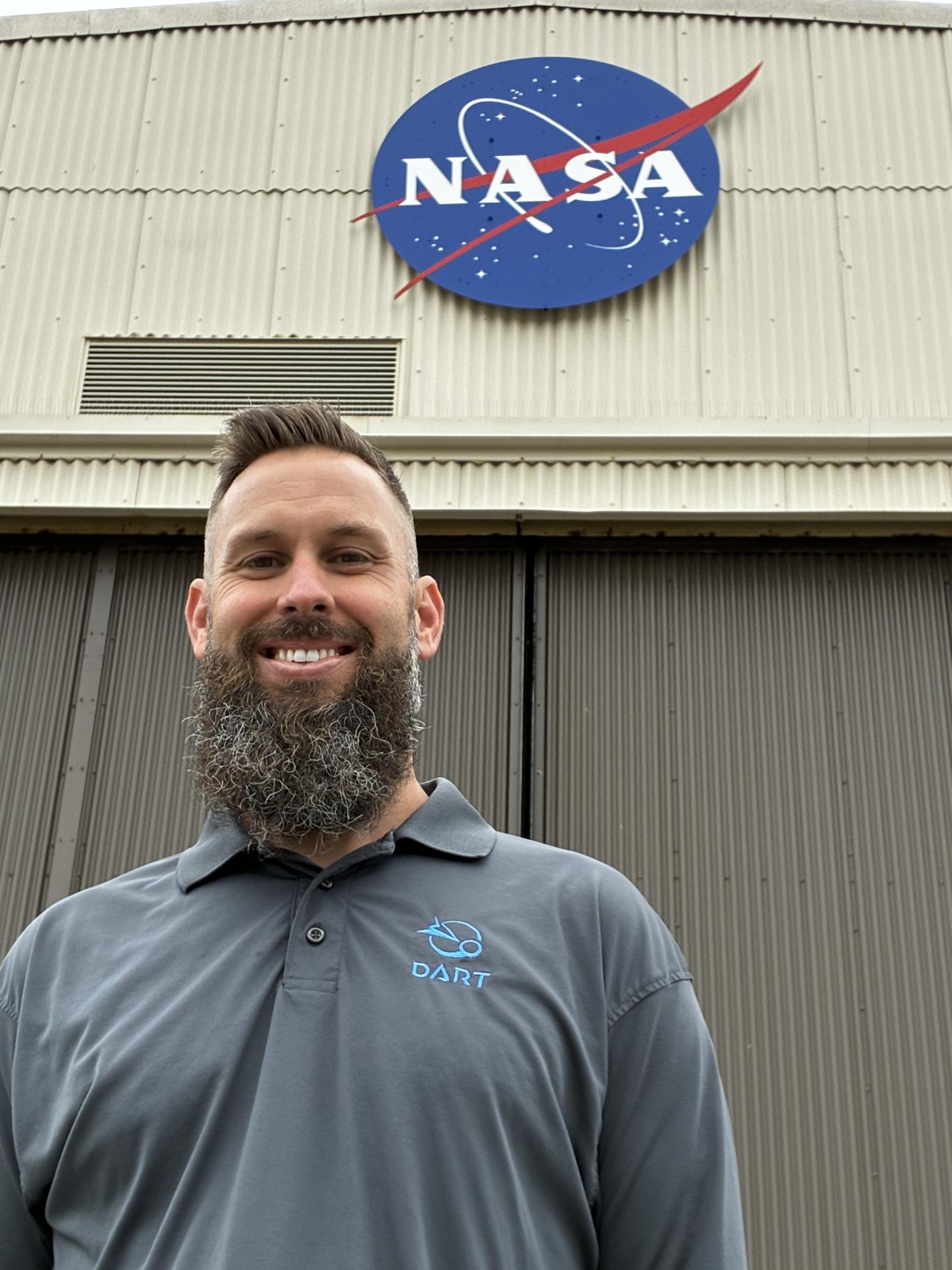
As a boy on California’s central coast, Eric Fernandez rarely missed a rocket launch.
As a boy on California’s central coast, Eric Fernandez rarely missed a rocket launch. He and his father would watch the vehicles rise from Vandenberg Air Force Base—now Vandenberg Space Force Base—close enough to feel like part of local life, yet distant in meaning. With both grandparents having worked at the installation, Fernandez grew up assuming the launches were strictly military business. NASA, he thought, belonged somewhere else—far from Orcutt, the small agricultural town of farms and vineyards where he lived.
His early working life also stayed close to home. After high school, Fernandez spent several years on a painting crew. The pay kept him afloat, but it wasn’t a long-term calling. He later found work he genuinely liked at his future father-in-law’s appliance store, building a reputation as a skilled technician who could install and repair equipment, track down stubborn problems, and handle electronics with confidence. He envisioned staying on that path and eventually running the small business.
Then a friend mentioned an opening in “telemetry.” Fernandez didn’t even know what the term meant, and he was content where he was. He nearly passed on the lead. But after some encouragement, he agreed to interview—inside a NASA building located on the military base.
The lab left an impression. Oscilloscopes, monitors filled with jagged traces, blinking indicators—an unfamiliar language of signals and diagnostics. Fernandez peppered the team with questions during the tour. The interviewers, in turn, saw something they could use: practical electronics experience, strong troubleshooting instincts, and soldering skills. Soon after, he was offered a technician job with a company supporting NASA through the Expendable Launch Vehicle Integrated Support (ELVIS) contract, working with the agency’s Launch Services Program.
Choosing between the secure family business plan and an unknown role tied to spaceflight became a turning point. Fernandez said he sought guidance through prayer and conversations with his father-in-law before deciding to change course. That decision set his career for the next 17 years. Over that time he supported 27 NASA launches for scientific and robotic exploration missions, and he also contributed to hundreds of launches for the U.S. military and commercial customers—part of NASA’s broader effort to understand and work alongside the evolving commercial rocket fleet. In 2019, he advanced to telemetry engineer.
This year brought another shift. NASA moved to reinforce key in-house expertise by converting certain mission-critical roles from contractor positions into civil service jobs. Fernandez applied. On June 15, he was sworn in at Vandenberg, formally joining an organization he said already felt like family.
Telemetry, Fernandez explained, is the stream of remote measurements that reveal a rocket’s condition—during fueling on the pad, through ascent, and as it delivers a spacecraft into its intended orbit. The stakes are immediate: leadership must base real-time decisions on trustworthy information, and bad data can’t be tolerated.
To ensure that reliability, his team draws on multiple pathways for data when a rocket is on the pad, including ground-based streams and radio-frequency links. Each route is vetted in advance with tests such as bit-error-rate tests (BERTs), which transmit pseudo-random patterns to assess network integrity. After reception, engineers validate the stream using elements like frame synchronization patterns and word counters—sequenced markers embedded in the data that confirm it is properly aligned and complete. Once the rocket lifts off, telemetry is carried back through ground tracking stations and dedicated satellites that relay the vehicle’s health and performance to the teams on the ground.