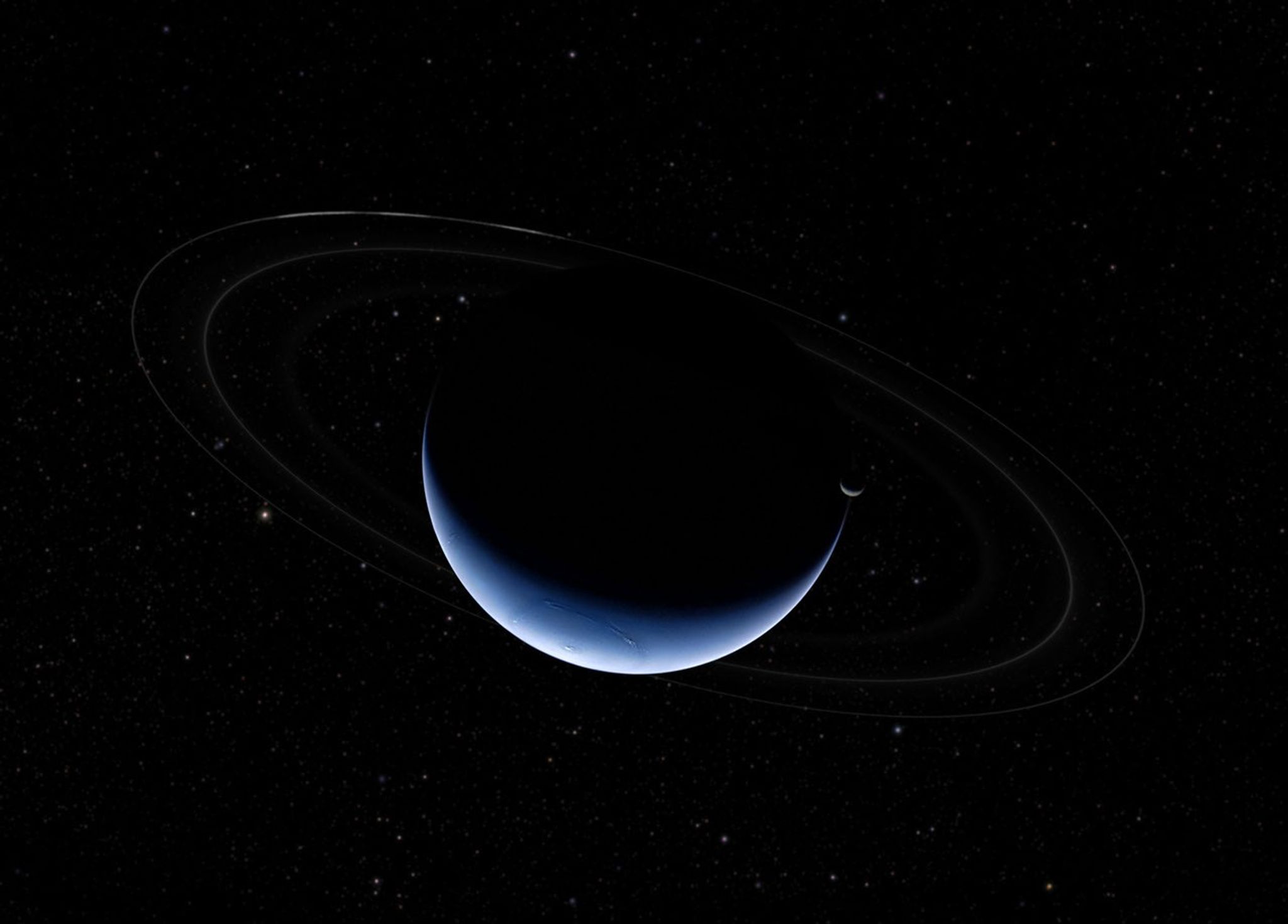
A new composite built from Voyager 2 data and modern modeling shows Neptune, Triton and faint ring arcs as thin crescents against a survey-based star field.
Voyager 2’s brief visit to Neptune in 1989 remains one of the most consequential flybys in planetary exploration—and still the only close-up encounter humanity has ever made with the solar system’s most distant ice giant.
The spacecraft reached its nearest point to Neptune on August 25, 1989, skimming past the planet and returning a trove of images over the close approach and the days that followed. Those observations underpin a newly assembled composite view that brings together Neptune, its largest moon Triton, and the planet’s delicate ring system into a single outward-looking scene.
The perspective is striking: positioned just outside Neptune’s orbit, the view turns back toward the Sun. From that vantage, Neptune and Triton appear as narrow crescents, lit from behind. That thin arc of sunlight outlines Neptune’s atmosphere, where high, wispy cirrus clouds can be seen, along with a dark belt that wraps around the south polar region. Above the pole itself, the composite highlights a cloudy vortex—an atmospheric swirl suggesting vigorous weather activity even at the cold edge of the Sun’s domain.
The image also emphasizes a feature that was barely detectable at the time: Neptune’s faint rings. Voyager 2 was the mission that first captured clear images of parts of this tenuous ring system and, notably, three brighter “ring arcs”—localized concentrations within the rings that stood out against the otherwise dim material. In the composite, the brightest structures are based on Voyager’s direct observations, while the most elusive ring segments are reconstructed through modeling to match what scientists understand about the system’s subtle geometry and visibility.
To place the Neptunian system in context, the backdrop is not drawn from Voyager’s cameras. Instead, the star field behind Neptune spans about 7.5 degrees and is built from sky-survey observations centered on the constellation Camelopardalis. That star map corresponds to the general skyward direction Voyager 2 would have been heading as it departed Neptune, giving the scene a sense of the craft’s outbound trajectory through deep space.
More than three decades later, Voyager 2 is still traveling. By 2026 it has passed beyond the heliosphere and is operating in interstellar space—continuing to send back data from a region no other spacecraft from Earth had reached when the Neptune flyby took place.
Why it matters
Neptune remains largely unexplored up close, and Voyager 2’s 1989 encounter still defines what scientists know from direct measurements of the planet, Triton, and their rings. The composite underscores how much information can be extracted—and reinterpreted—from historic datasets when combined with modern modeling and survey astronomy. With no new Neptune mission yet at the planet, these observations remain a critical reference point for future exploration and planning.