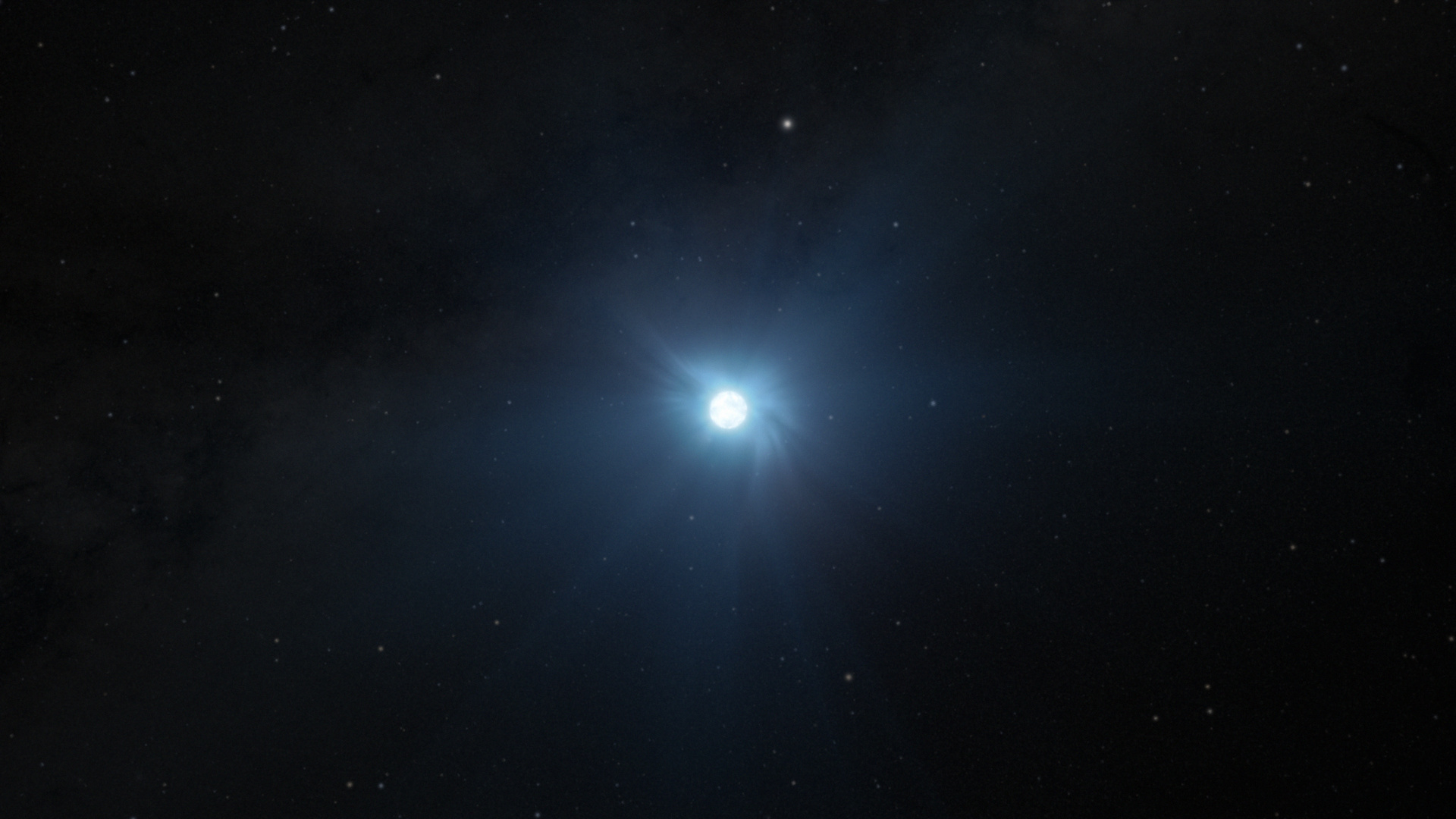
Neutron stars—the ultra-compact remnants left when massive stars explode—should be plentiful in the Milky Way. Yet most are practically undetectable.
Neutron stars—the ultra-compact remnants left when massive stars explode—should be plentiful in the Milky Way. Yet most are practically undetectable. Unless a neutron star happens to behave like a pulsar that sweeps radio beams across Earth, or shines in X-rays, it can sit in deep darkness, invisible even to today’s best observatories. Now, a study in Astronomy & Astrophysics argues that NASA’s forthcoming Nancy Grace Roman Space Telescope could begin revealing this hidden population using an effect that does not rely on the neutron stars emitting any light at all.
The research team, led by Zofia Kaczmarek of Heidelberg University, used detailed simulations of the Milky Way combined with projections of Roman’s capabilities to estimate what the mission might achieve. Their conclusion: Roman should be able to identify and study dozens of isolated neutron stars by catching them in the act of gravitational microlensing.
Microlensing occurs when a massive object passes in front of a faraway background star. The intervening object’s gravity bends spacetime enough to deflect the starlight, briefly altering what astronomers see. The background star can appear to brighten, and—more subtly—its apparent position on the sky shifts slightly from where it would otherwise be. “Most neutron stars are relatively dim and on their own,” Kaczmarek noted, making them “incredibly hard to spot without some sort of help.” Microlensing provides that help, because the neutron star’s gravity does the signaling.
Many telescopes can detect the temporary brightening, but Roman is designed to do more. It will measure both the photometric change (the star’s brightening) and the astrometric change (the minute positional wobble) with unusually high precision. That second measurement is crucial: neutron stars, packing more mass than the Sun into a sphere roughly the size of a city, produce a larger astrometric microlensing signature than lighter objects. In some events, Roman’s data could be strong enough to infer the lens’s mass—effectively allowing astronomers to “weigh” an object that emits little or no light.
Peter McGill of Lawrence Livermore National Laboratory, a co-author on the paper, emphasized why that matters. Photometry alone can indicate that something crossed in front of a star, he explained, but the size of the positional shift is what reveals how massive the intervening object is. Direct mass measurements are especially valuable because neutron-star masses are currently well measured only in binary systems, not for solitary neutron stars drifting through the galaxy.
The payoff extends beyond completing the census. Roman’s microlensing detections could test whether there is a true gap between the heaviest neutron stars and the lightest black holes, and they could help pin down neutron-star speeds. Astronomers want to understand the “kicks” neutron stars receive at birth in supernova explosions—violent impulses that can send them careening through the Milky Way at hundreds of miles per second.
The study points to Roman’s planned Galactic Bulge Time Domain Survey as the key engine for these discoveries. The program will repeatedly image extremely crowded star fields toward the galactic center, monitoring millions of stars at high cadence to catch transient lensing events. McGill said the team expects to begin flagging promising candidates quickly once the telescope is commissioned, potentially within the first months of operations.
Only a few thousand neutron stars have been identified so far—mostly pulsars—despite estimates that the Milky Way could contain tens to hundreds of millions. Even a modest number of isolated neutron-star mass measurements, the researchers argue, would sharpen models of stellar explosions and the behavior of matter at extreme densities, where physics is pushed to its limits.