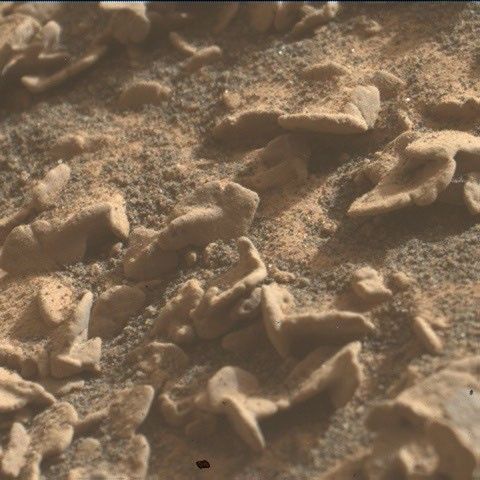
NASA’s Curiosity rover is wrapping up drilling at the Nazca site and analyzing powdered rock in its onboard lab, while imaging and chemistry tests probe disk-like crystals and their origins.
Curiosity spent the week of sols 5063 through 5069 wrapping up a drilling campaign at a site known as “Nazca,” where the rover team has been investigating unusual bedrock packed with disk-like crystals—features that, in a more informal description, resemble stacked potato chips. The overarching goal at Nazca has been to determine what these distinctive crystal forms are and what they reveal about the rock’s formation.
After drilling at the Nazca hole, Curiosity delivered powdered sample material to its Sample Analysis for Mars (SAM) instrument for laboratory work inside the rover. While SAM processed the material, the mission continued a busy slate of remote sensing and imaging intended to put the drill results into geologic context and further probe the chip-shaped textures.
Early in the week, Monday’s plan combined chemistry, imaging, and weather monitoring. Curiosity used its ChemCam instrument—specifically its laser-induced breakdown spectroscopy (LIBS) capability—to analyze the composition of a separate crystal feature dubbed “Ahi Veremos.” Mastcam continued taking frames to expand a mosaic covering the near- to mid-distance terrain around Nazca, building a broader view of the outcrop and its relationships. At the same time, the rover carried out environmental observations, including an extended search for dust devils and sky imaging that captured both the horizon and the overhead (zenith) atmosphere.
By midweek, Wednesday’s activities emphasized targeted compositional work. ChemCam performed a LIBS depth profile on a crystal-form target named “Colca,” allowing scientists to compare chemistry below the surface to the outer rind that may be altered by dust coatings or weathering. Another LIBS observation focused on a target called “Bermejo.” Curiosity also used ChemCam’s Remote Micro-Imager (RMI) to assemble a long-distance mosaic of rock clusters below “Cordillera” ridge, a reconnaissance step that helps the team assess potentially interesting layers and plan future approaches. Mastcam continued filling in the Nazca mosaic, and the rover added another round of atmospheric monitoring.
Planning on Friday set up a three-sol sequence that would include multiple focused science blocks followed by a drive away from the Nazca drill site. The team scheduled a MAHLI mosaic documenting the side of the rock block that contains the drill hole, preserving detailed context for how the material fractured and how the distinctive crystals are distributed. Nighttime MAHLI imaging was also planned using the camera’s white-light and ultraviolet LEDs, a strategy that can highlight textural differences and, in some cases, help distinguish materials based on how they respond under UV illumination.
A celestial event took priority as well: Mars’ small moon Phobos was expected to pass in front of the Sun, and Curiosity planned to image the eclipse. Across the three-sol plan, ChemCam LIBS observations were slated for a cluster of crystal forms, a tougher layer exposed along the Nazca block’s flank, and a dark “float” rock—material that has been transported from its original bedrock source. RMI was also tasked with a long-distance mosaic of dark lenses beneath a planar surface on “Mishe Mokwa” ridge. Environmental monitoring continued alongside these investigations.
The drive at the end of the plan was intended to steer Curiosity back toward its southward route, positioning the rover to resume its longer traverse and continue exploring new terrain.
Why it matters
Nazca’s disk-shaped crystals could record how water, chemistry, and time interacted to build or alter Martian rocks—clues central to reconstructing past environments. By combining drilling, onboard laboratory analysis, and high-resolution imaging, the mission strengthens the link between what Curiosity sees at the surface and what it measures chemically. The coming sols will be worth watching as the rover leaves the drill site and tests whether these unusual textures persist—or give way to a new chapter in the geology ahead.