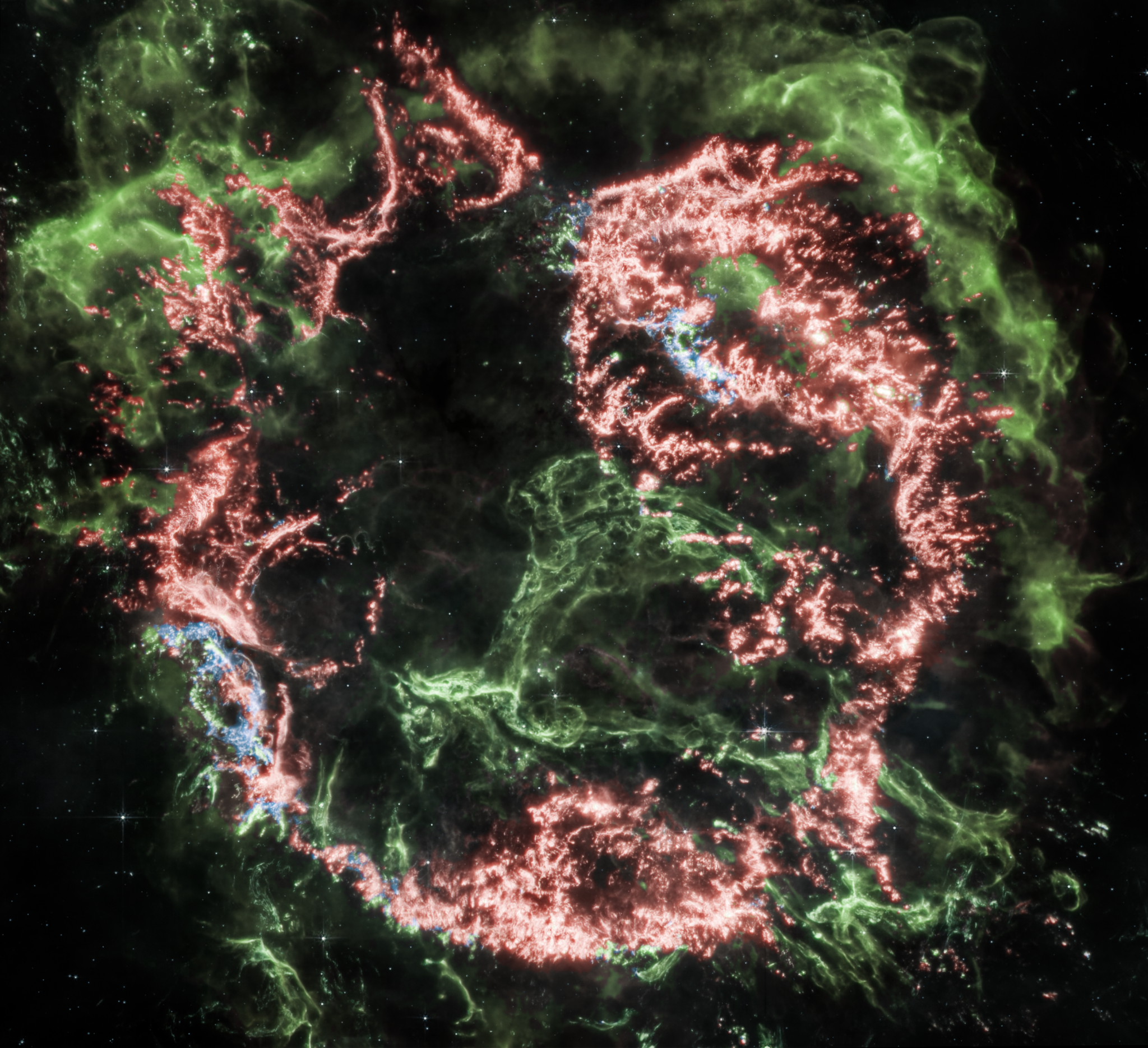
James Webb has captured a high-resolution mid-infrared view of Cassiopeia A, mapping heated dust forged in the supernova. The data hints at a sudden late-stage shift inside the doomed star.
NASA’s James Webb Space Telescope has delivered a sharply detailed new look at Cassiopeia A (Cas A), one of the best-studied supernova remnants in the Milky Way, by mapping the glow of heated dust in the wreckage of a long-dead massive star. The mid-infrared view—released Nov. 23, 2026—captures fine structure in the remnant at high resolution, highlighting the dusty material forged and dispersed when the star exploded.
Cas A is the expanding cloud of gas and dust left behind after a supernova. Such remnants are more than cosmic debris fields: over time, their ejected material mixes into surrounding space, enriching it with heavy elements and dust grains. Those ingredients can later become part of newly forming stars and planetary systems, linking stellar death to future worlds.
Webb’s mid-infrared sensitivity makes it particularly well suited to tracking warm and hot dust, which emits strongly at these wavelengths. In the new image, that emission outlines where dust is concentrated and heated within the remnant, offering researchers a clearer inventory of what the explosion produced and where that material now resides.
Beyond the striking imagery, the Webb observations bolster an emerging interpretation of what happened inside the star shortly before it collapsed. According to the analysis supported by the new dataset, the star’s interior may have experienced an abrupt, major change in its final phase—potentially only hours before the supernova. That kind of late-stage upheaval would reshape conditions in the core and surrounding layers, leaving signatures that can later be read in the distribution and properties of the debris.
Because Cas A is both relatively nearby and extensively observed across the electromagnetic spectrum, it serves as a crucial laboratory for testing ideas about how massive stars end their lives. Webb’s data adds a fresh, dust-focused perspective to that long-running investigation, giving scientists another way to trace the history of the explosion and the last moments of the progenitor star.
The image was produced through an international effort involving NASA, the European Space Agency (ESA), and the Canadian Space Agency (CSA), with science contributions from the Space Telescope Science Institute (STScI) and researchers including Tea Temim (Columbia University), Rick Arendt (University of Maryland, Baltimore County), and Dan Milisavljevic (Purdue University). Image processing was led by Joseph DePasquale (STScI).
Why it matters
Supernova remnants like Cassiopeia A are key sources of the dust and elements that ultimately feed the formation of new stars and planets, meaning their composition affects how galaxies evolve over time. By indicating a possible last-minute internal shift inside the star, Webb’s observations could refine models of how massive stars die—and what warning signs, if any, precede core collapse. Scientists will be watching for whether similar dust patterns and pre-explosion changes show up in other remnants and future Webb studies.