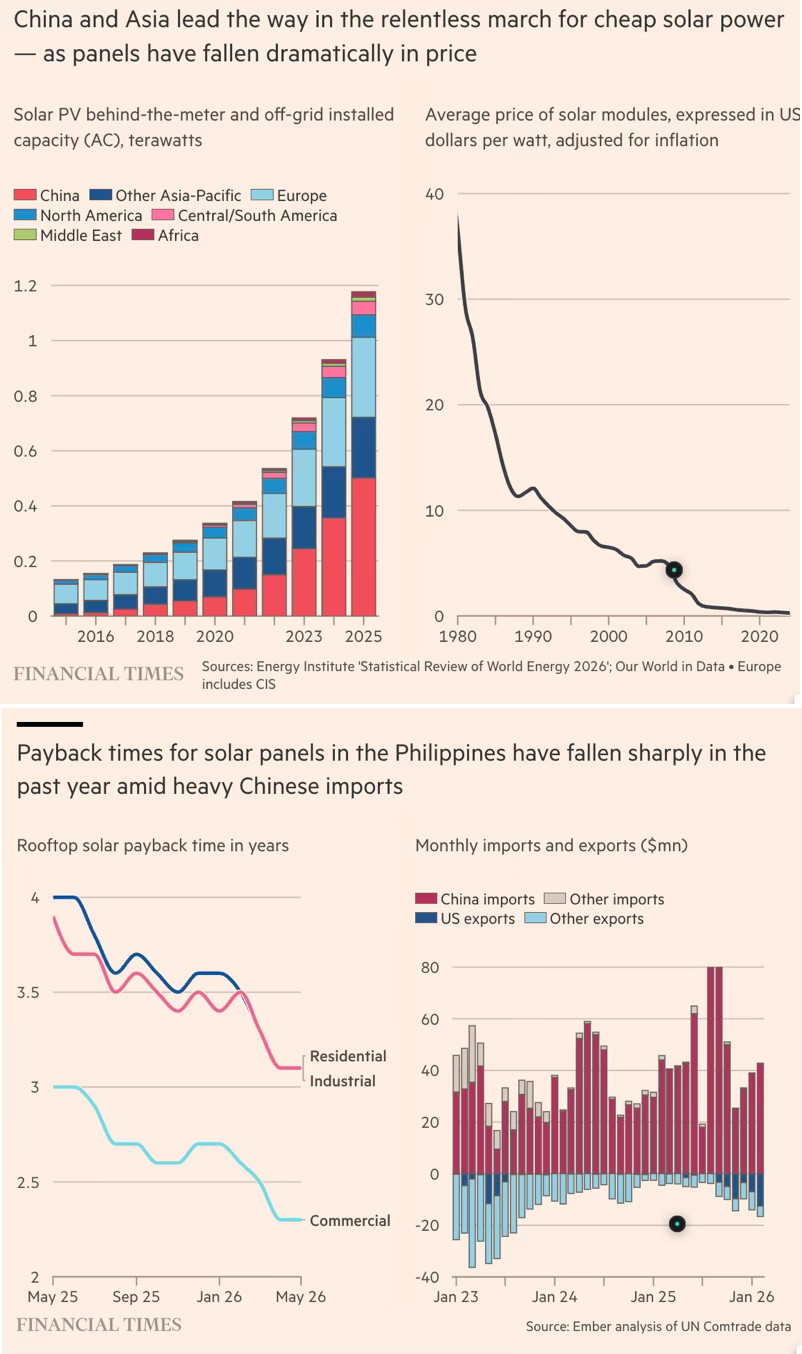
Around the world, the rooftop solar boom is being propelled less by clever new technology than by a blunt economic fact: photovoltaic panels have become astonishingly cheap.
Around the world, the rooftop solar boom is being propelled less by clever new technology than by a blunt economic fact: photovoltaic panels have become astonishingly cheap. A wave of Chinese manufacturing overcapacity has pushed export prices down to about $0.12 per watt, enabling households and companies to generate their own electricity and, in some cases, reduce their dependence on traditional power grids.
That supply-driven shift is visible in places where electricity is costly, unreliable, or hard to access. In Pakistan’s Chakwal district, for example, Bestway Cement is converting stretches of dry land and orchards into a large solar installation. The company expects to add 6.34 megawatts of capacity by the end of the year. Solar power already provides more than a quarter of the electricity used at its cement plant—an illustration of how cheap panels can quickly turn self-generation into an industrial-scale strategy, not just a household upgrade.
The same falling costs have changed solar’s global profile. What began largely as a subsidised tool for decarbonisation in wealthier markets has become a key source of power in countries such as Pakistan, Brazil and South Africa—before spreading more widely. China’s own domestic buildout, accelerated by low module prices, is part of the story; so is the growing appeal of small-scale systems that can be deployed rapidly without waiting for grid expansion.
Geopolitics is also feeding demand. After the fallout from the US-Iran war, interest in rooftop solar has increased in Britain. Since late August, households there have been able to purchase 800-watt “plug-in” solar panels from supermarkets and DIY retailers—products designed to be connected at home with minimal fuss.
In the United States, small plug-and-play panels have also gained traction even as national politics remain hostile to renewables. The report notes that President Donald Trump eliminated a tax credit for rooftop solar systems, yet consumer interest in easy-to-install units persists.
But the rapid spread of rooftop generation creates challenges for grid operators. Pierluigi Mancarella, chair professor of electrical power systems at the University of Melbourne, points to Perth as an example of a city blanketed in rooftop solar. When a large cloud band passes overhead, he says, photovoltaic output can drop so sharply that it resembles the sudden loss of “almost a nuclear power station.” Complicating matters, system operators often have limited visibility into the combined gigawatts of dispersed rooftop capacity—making real-time balancing harder.
Against this global backdrop of acceleration, one major exception stands out: California. There, rooftop solar growth has slowed not because panels are expensive, but because policy has changed the economics. The article points to two key shifts. One is the removal of a tax credit that had helped make installations pencil out for homeowners. The other is a revision to compensation for electricity exported back to the grid—rules that reduced the value of “backflow” power. The result, as described, is a market where batteries, rather than panels, increasingly become the most financially attractive purchase.
Two big questions remain. Is today’s $0.12-per-watt export price a durable new normal—or a temporary trough created by overcapacity, alleged dumping, and state support? And why has the US, at least in places like California, stalled while adoption elsewhere keeps climbing? The first is uncertain. The second, the evidence suggests, may come down to policy: when incentives and export payments change, even “offensively cheap” solar can lose momentum.