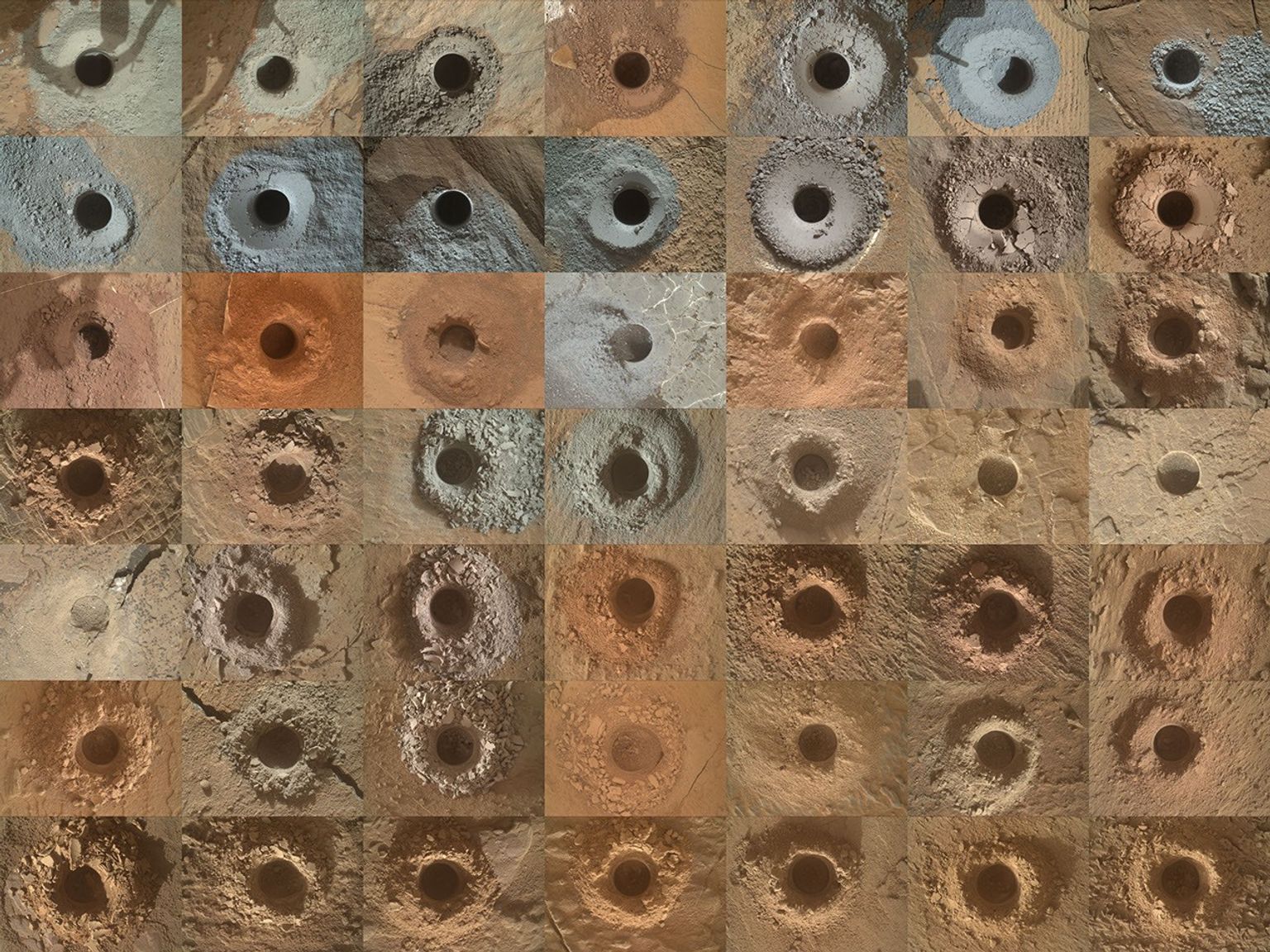
A new collage documents 49 drill holes made by NASA’s Curiosity rover on Mars, compiling close-up MAHLI images that trace its rock-sampling campaign.
A newly assembled collage documents 49 drill holes made by NASA’s Curiosity rover on Mars, representing the mission’s sampling work up to November 2026. The mosaic brings together close-up views of each borehole—physical traces of the rover’s ongoing effort to read Mars’ geological record directly from its rocks.
Curiosity creates these holes to obtain fresh material from the Martian surface. Mounted at the end of the rover’s robotic arm, the drill grinds into selected rock targets and produces fine, powdered debris. That pulverized sample is then delivered into analytical instruments housed inside the rover’s body, where it can be examined to determine chemical and mineral composition.
All 49 drill-hole images in the collage were captured by Curiosity’s Mars Hand Lens Imager, known as MAHLI. Like the drill itself, MAHLI is positioned on the rover’s robotic arm, allowing the camera to take detailed, near-field photographs of the holes and surrounding textures immediately after drilling. Each borehole is the same size—about 0.63 inches (16 millimeters) across—providing consistent sampling geometry as the rover moves from one site to the next.
Curiosity was designed and built at NASA’s Jet Propulsion Laboratory (JPL). JPL is managed by the California Institute of Technology (Caltech) in Pasadena, and it oversees the Curiosity mission for NASA’s Science Mission Directorate in Washington. The mission operates as part of NASA’s broader Mars Exploration Program portfolio. MAHLI, the camera responsible for the close-up drill-hole imagery, was built by Malin Space Science Systems in San Diego.
Why it matters
Each drill hole marks a moment when Curiosity accessed unweathered material that helps scientists reconstruct Mars’ environmental history from the ground up. The growing tally of samples underscores how long-term, mobile laboratory missions can systematically build a picture of a planet’s composition and past conditions. With dozens of boreholes now documented, researchers can compare results across many locations and rock types, sharpening the search for how Mars evolved over time.