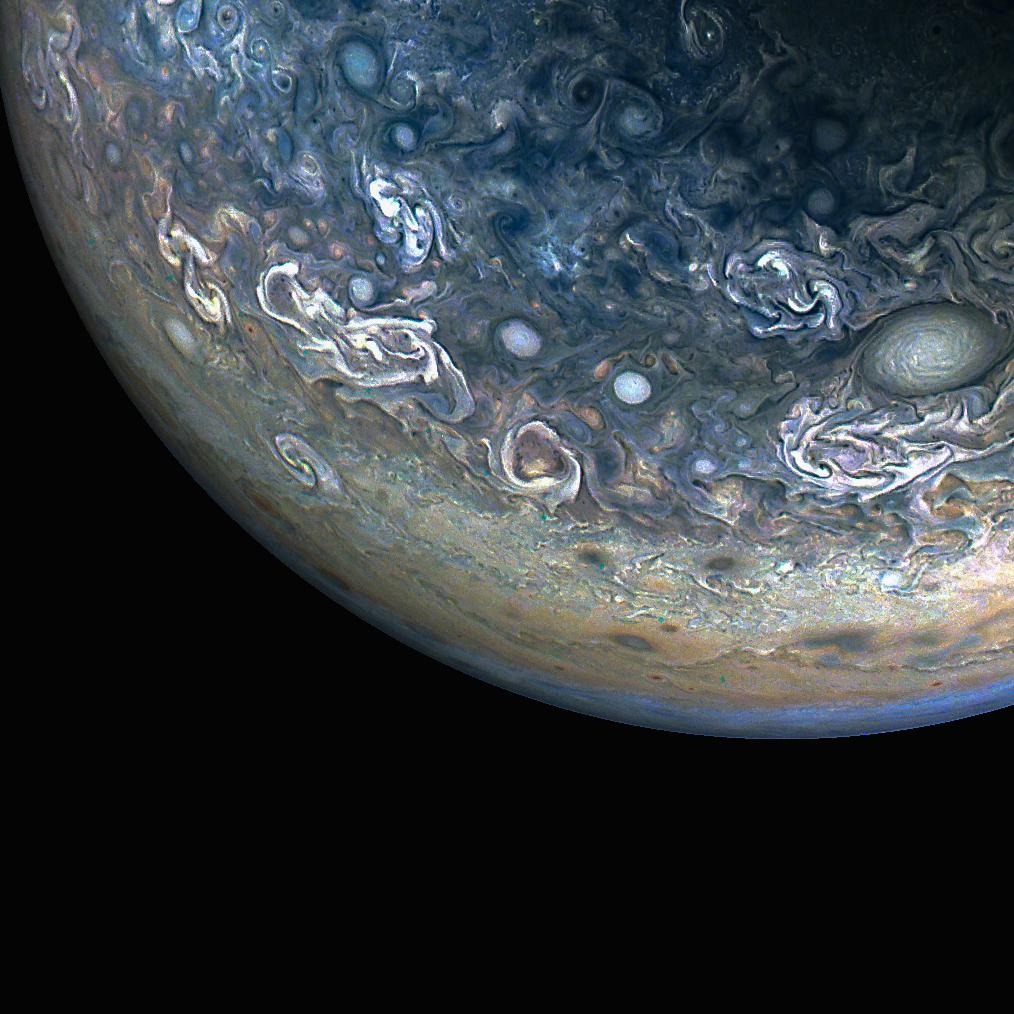
NASA’s Juno spacecraft has returned a striking, color-intensified portrait of Jupiter’s northern hemisphere, captured during the mission’s 61st close pass of the gas giant on May 12, 2024.
NASA’s Juno spacecraft has returned a striking, color-intensified portrait of Jupiter’s northern hemisphere, captured during the mission’s 61st close pass of the gas giant on May 12, 2024. The view comes from JunoCam, the spacecraft’s visible-light camera, and was built from the instrument’s raw data by citizen scientist Gary Eason, who used digital processing to bring out finer detail, sharpen structures, and heighten subtle color differences in the planet’s cloud tops.
The resulting image offers a close look at a particularly unruly stretch of Jupiter’s atmosphere filled with tangled cloud textures and swirling storm systems. Scientists refer to the area as a “folded filamentary region,” a name that reflects the way cloud bands there appear twisted into overlapping strands rather than arranged in Jupiter’s more familiar, neatly striped pattern.
In most latitudes, Jupiter’s appearance is dominated by strong east–west winds known as zonal jets. These high-speed atmospheric currents help carve the planet into alternating bright zones and darker belts that encircle the globe. But folded filamentary regions stand out because those organized jets weaken or break down. Without the stabilizing influence of the jets, the atmosphere becomes more turbulent, producing chaotic cloud shapes and cyclonic storms that can shift and transform quickly.
Researchers note that these turbulent patterns are not static features: the cloud structures in such regions can change markedly in just a few days, highlighting how dynamic Jupiter’s weather can be even at the level of individual cloud formations. The enhanced view from JunoCam helps scientists and the public alike appreciate the fine-scale complexity of these rapidly evolving atmospheric systems.
NASA also emphasizes that images like this illustrate the value of public participation in space science. JunoCam data are publicly available, enabling citizen scientists to process, analyze, and share new perspectives on Jupiter alongside the mission’s professional science team. Information about additional opportunities to contribute through NASA’s citizen science projects is available through the agency’s programs.
Image credit: NASA/JPL-Caltech/SwRI/MSSS; image processing by Gary Eason (CC BY).