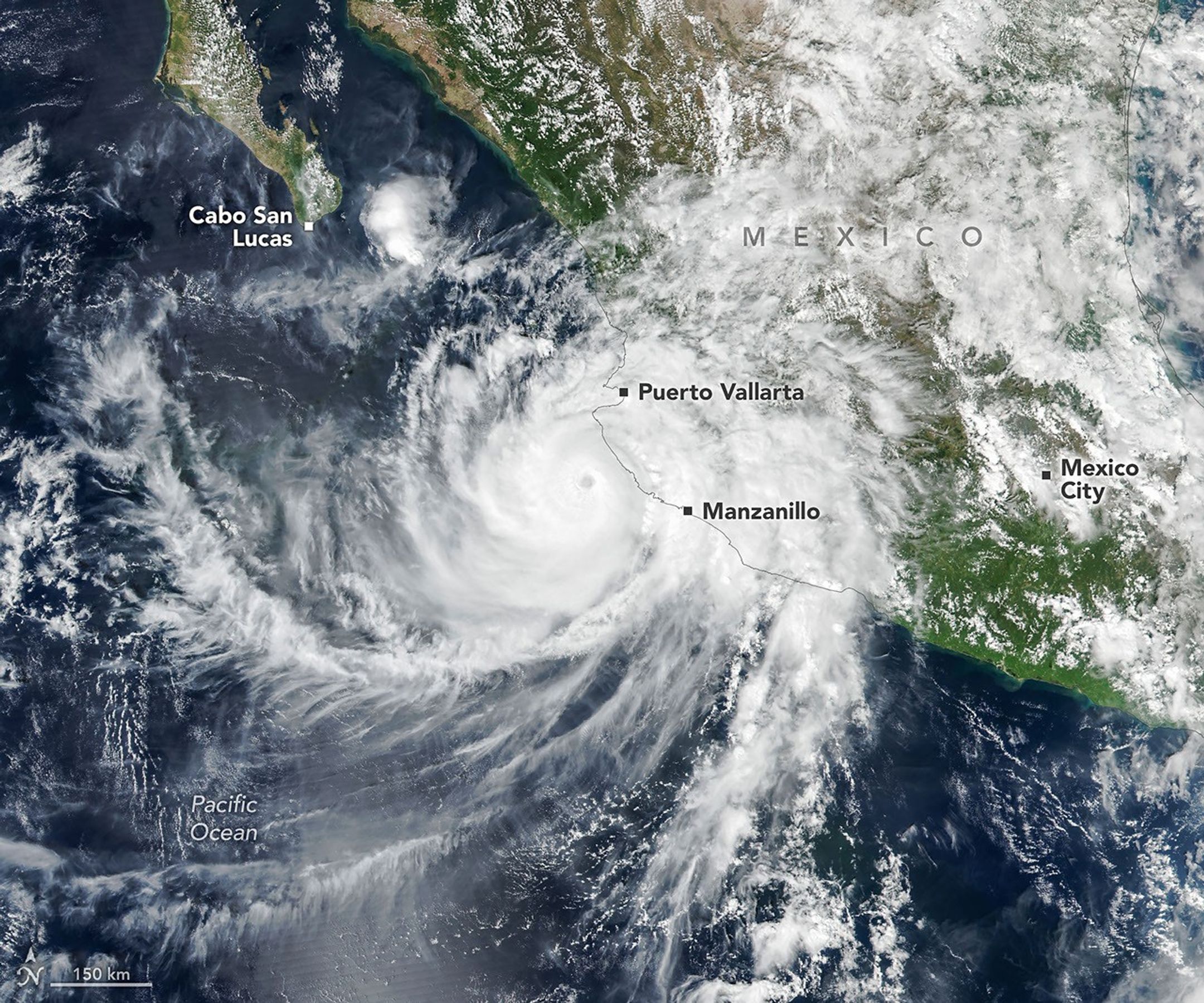
Hurricane Simon strengthened into a Category 4 storm near Mexico’s Pacific coast, bringing damaging winds and heavy rain. Satellites also captured rare high-altitude wave patterns above it.
Hurricane Simon, one of a steady parade of Eastern Pacific tropical cyclones this season, intensified into a powerful Category 4 storm as it tracked close to Mexico’s Pacific shoreline on October 11, 2026. Although the hurricane’s center stayed just offshore, its winds and rain affected coastal communities, while satellites also documented rare wave-like patterns high above the storm in the upper atmosphere.
At its peak on October 11, Simon’s sustained winds reached about 250 kilometers per hour (155 miles per hour) as the system moved north-northwest. Later that afternoon, when the Visible Infrared Imaging Radiometer Suite (VIIRS) aboard the Suomi National Polar-orbiting Partnership (Suomi NPP) satellite captured imagery around 2:30 p.m. local time (20:30 UTC), the National Hurricane Center (NHC) estimated sustained winds near 210 kilometers per hour (130 miles per hour). The hurricane’s eye at that time was roughly 50 kilometers (30 miles) offshore, positioned between Manzanillo and Puerto Vallarta, with the storm’s compact inner core brushing the coastline.
Forecasters noted that the Sierra Madre’s rugged terrain appeared to influence the hurricane’s structure. According to the NHC, the mountain topography likely helped curb Simon’s intensity and reduce the breadth of its wind field. Even with that moderating effect, Simon remained a major hurricane capable of significant impacts. News reports indicated heavy rainfall and flooding in coastal areas, including the port city of Manzanillo, and warned of an elevated mudslide risk in higher-elevation terrain where steep slopes can fail after intense downpours.
Satellite observations also revealed a less familiar signature of the storm: atmospheric gravity waves spreading outward above the hurricane. In the early morning hours of October 11, the VIIRS instrument on the NOAA-21 satellite collected nighttime imagery showing concentric ripples radiating from Simon. These waves can form when the hurricane’s eyewall releases large amounts of latent heat—energy liberated as water vapor condenses into cloud droplets. That energy fuels vigorous convection and towering cumulonimbus clouds. Strong updrafts in these thunderstorms can disturb the atmosphere and launch waves upward into the stratosphere and even the mesosphere.
Such waves are not always visible from space. Upper-level winds can weaken or disperse the disturbances before they reach the mesosphere, where they can modulate airglow—a faint natural light emitted by gases at high altitudes—into ripple-like bands. Detection also depends on viewing conditions: VIIRS’ day-night band can sense airglow, but moonlight reflected from clouds can overwhelm the subtle signal. In Simon’s case, minimal lunar illumination on the night of the observation allowed the airglow pattern to stand out more clearly.
By the morning of October 13, uncertainty still dominated projections of Simon’s track and strength. The NHC described confidence in the forecasts as “very low,” as the hurricane’s behavior continued to challenge expectations. One scenario suggested the system could turn northward, move into the Gulf of California, and later come ashore. Meanwhile, forecasters expected large swells to create hazardous nearshore conditions along portions of Mexico’s southwestern and west-central coastline over the following days.
Why it matters
Close-tracking hurricanes like Simon can deliver damaging rain, surf, and landslide risk even when the eye remains offshore, affecting ports, tourism hubs, and mountain communities. The satellite-detected gravity waves offer a window into how powerful storms couple energy into the upper atmosphere—an active research area that can improve understanding of storm dynamics. With forecast confidence low, residents and emergency managers along Mexico’s Pacific coast must watch for rapid changes in track, rainfall, and coastal hazards.