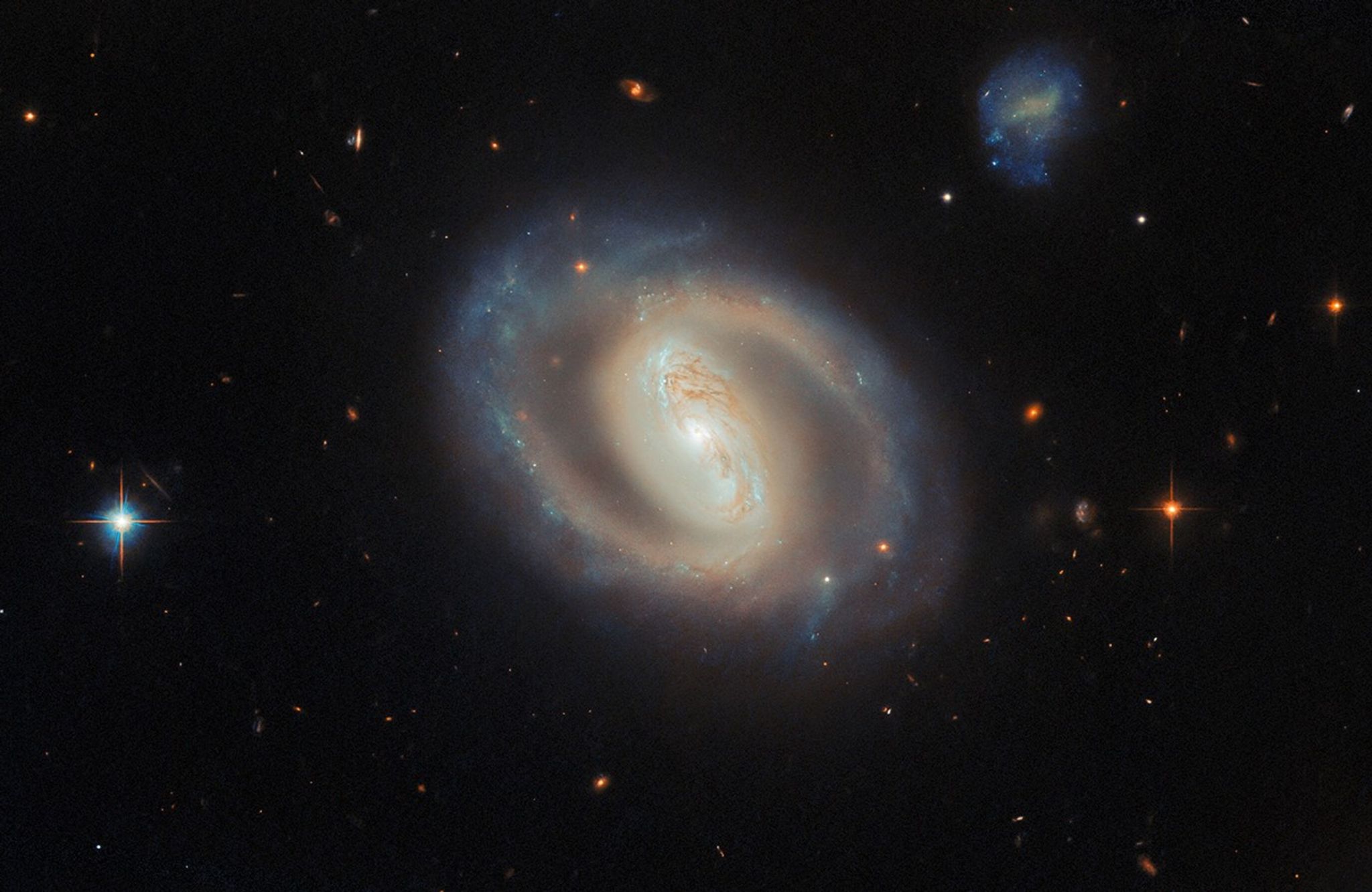
A softly shining galaxy appears to drift in a sea of darkness in a new image captured by NASA’s Hubble Space Telescope and released on April 13, 2026.
A softly shining galaxy appears to drift in a sea of darkness in a new image captured by NASA’s Hubble Space Telescope and released on April 13, 2026. The target is IC 486, a barred spiral galaxy whose luminous structure stands out with an almost misty glow against the black background of space.
IC 486 sits near the boundary of the constellation Gemini, the Twins, and lies about 380 million light-years from Earth. From that vast distance, Hubble’s view still resolves the galaxy’s defining architecture: a bright, elongated bar running through its center. Astronomers classify IC 486 as a barred spiral because this central bar is a dominant feature, acting as the galaxy’s structural backbone as the surrounding disk takes shape.
From the ends of the bar, IC 486’s spiral arms sweep outward and curve around the nucleus in a notably smooth configuration. In Hubble’s portrait, the arms appear to wrap the core in a pattern that can look nearly ring-like, giving the galaxy a cohesive, gently coiled form rather than a more ragged or fragmented spiral.
Images like this are more than visual showcases. Detailed observations of nearby and moderately distant galaxies provide researchers with crucial snapshots for investigating how galaxies grow and change over time. By comparing the shapes, brightness distributions, and internal structures of systems like IC 486—especially the prominence of features such as bars and spirals—scientists can test ideas about how stars and material move within galaxies and how those internal dynamics relate to broader galactic evolution.
The image was produced from Hubble observations and is credited to ESA/Hubble and NASA, with acknowledgment of M. J. Koss and A. J. Barth.