From Lorenzo “the Magnificent” to Duke Cosimo, Florence’s elite embraced firearms once seen as dishonourable. Militias helped normalise guns in civic life and power.
Lorenzo de’ Medici is remembered as the cultured powerbroker of Renaissance Florence, not as a man with a gun. Yet the inventory compiled after his death in 1492 records that Lorenzo “the Magnificent” owned five portable firearms. That detail captures a moment of transition: gunpowder weapons were already present in elite households, even as many contemporaries denounced them as morally suspect. Writers and artists often portrayed guns as instruments of the Devil and as the opposite of chivalric combat—effective, perhaps, but dishonourable.
What changed over the next few decades was not simply technology, but acceptance. By the early months of 1539, Lorenzo’s descendant Cosimo de’ Medici, now Duke of Florence, had amassed 91 firearms stored in the city. In the courts of late-Renaissance Italy, the gun had moved from troubling novelty to respectable tool of power.
This shift was not confined to princely armouries. Across the Italian peninsula, firearms began filtering into more ordinary lives through an institution that expanded rapidly in the early 16th century: the militia. Most Italian states did not maintain standing armies. Instead they relied on temporary mobilisations and, often, professional mercenaries. Florence’s leaders, however, increasingly doubted the reliability of hired soldiers. A 1506 provision establishing a Florentine militia stated bluntly that there was “little hope” in “foreign and hired arms.” The answer, the decree argued, was a new magistracy empowered to enlist at least 10,000 men from Florentine territory.
Firearms were written into this civic project. One in ten of the recruits was to be equipped with guns, and the city was instructed to keep 500 handguns—schioppetti—in the Palazzo della Signoria (today’s Palazzo Vecchio), alongside whatever funds were needed for the weapons, presumably including gunpowder and shot. Plans even envisioned several companies—three or four bandiere—made up entirely of handgun-armed troops, the schioppettieri.
Florence’s militia, often associated with Niccolò Machiavelli’s role in its creation, was modelled in part on German practices of urban self-defence, where male citizens were expected to maintain suitable arms. The city also drew expertise from abroad. One early constable was a German known as Giovanni Tedesco, and another, Giliberto Spagnolo, came from Spain—a rising leader in battlefield use of small arms. Tedesco organised target practice for his company, and from 1508 shooting exercises were expanded across the militia, held monthly.
Militias themselves were not new. But in the 1490s, large-scale foreign intervention in Italy gave them fresh urgency, as did a broader military trend: infantry were becoming more decisive in war. On Venice’s eastern frontier in Friuli, where Venetian territory bordered the Ottoman world, militia units were using handguns by the 1490s. Elsewhere, city guards soon received firearms as well. Taken together, militia growth became the most important driver of gun proliferation in 16th-century Italy.
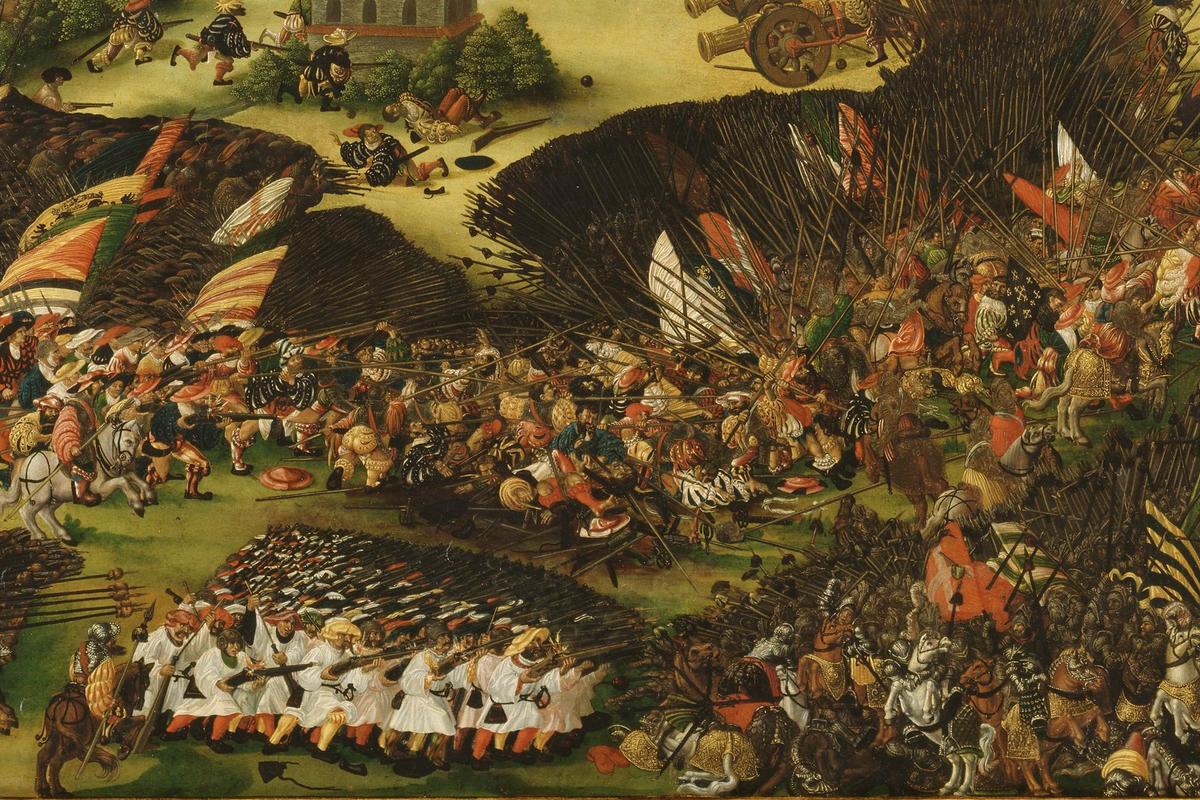
The wider backdrop was near-constant conflict as France and Spain fought for dominance on the peninsula from 1494 to 1559. By the turn of the century, Spanish arquebusiers—infantry armed with the long, wooden-stocked arquebus—were demonstrating what such weapons could do in Italian campaigns. Italian rulers encouraged shooting both for civic defence and for military readiness, and their own tastes shifted accordingly. The Medici were not alone: in 1538 the Duke of Urbino could describe a new firearm as “very dear to me,” a striking sentiment given how recently guns had been condemned as shamefully unknightly.
Why it matters
The spread of firearms in Renaissance Italy was not just a story of battlefield innovation; it reshaped civic institutions, public training, and the relationship between states and their citizens. As militias expanded, governments normalized gun ownership and shooting practice as part of collective security. The pattern also highlights how long cultural resistance can persist—and how quickly it can fade when strategic pressures make a once-despised technology indispensable.