Future lunar missions are increasingly expected to rely on distributed, “disaggregated” infrastructure—networks of smaller systems rather than a few large, centralized installations.
Future lunar missions are increasingly expected to rely on distributed, “disaggregated” infrastructure—networks of smaller systems rather than a few large, centralized installations. That shift creates a difficult engineering problem: how to keep compact, mobile devices operating through the Moon’s severe temperature swings without depending on bulky heaters, large power budgets, or support from nearby infrastructure.
Conventional thermal-control approaches can be effective for large, fixed facilities, but they are harder to scale down to small autonomous units that must survive on their own. These independent surveyors and mobile platforms need temperature regulation that not only prevents components from freezing or overheating, but also reduces rapid temperature changes that can cause mechanical stress and shorten hardware life. The challenge is to accomplish this with minimal penalties in size, weight, power, and cost—often summarized as SWaP-C.
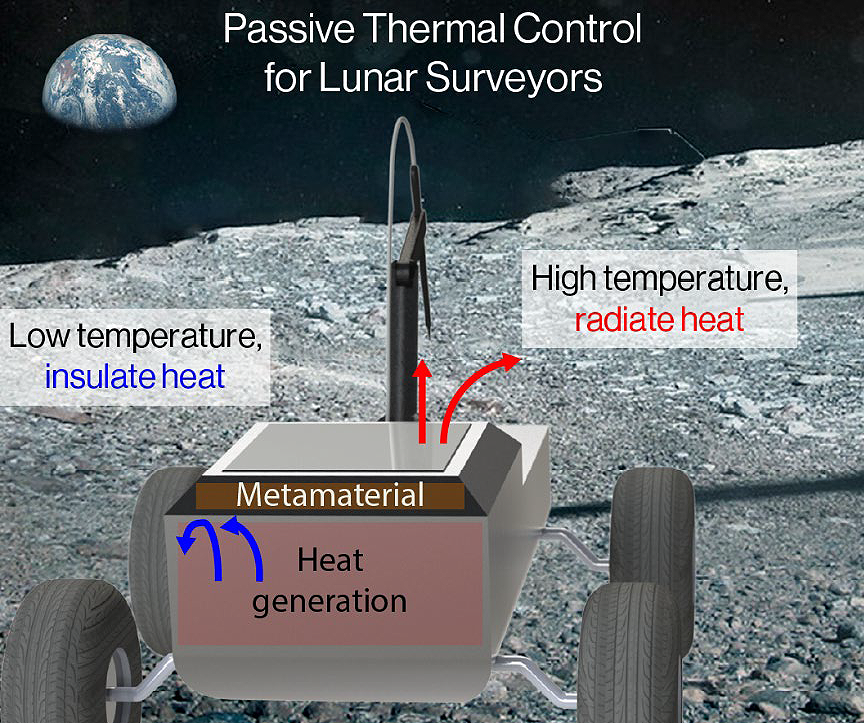
A proposed solution, called ECLIPSE (Efficient variable Conductivity Lunar Insulator for Passive Surveyor Environmental control), centers on a new class of material: a Variable Thermal Conductivity Metamaterial (VTCM). The concept is designed to manage heat passively by changing how readily it conducts thermal energy as its own temperature changes. Compared with other variable-conductivity metamaterials, this VTCM is positioned as higher-performing and can be configured to operate like an advanced mechanical thermal switch.
At the heart of the approach is a straightforward physical mechanism: regulate heat flow by controlling internal contact. In the metamaterial’s cold state, internal elements are arranged so that there is essentially no contact along key thermal pathways. With minimal contact, heat conduction remains low—useful for insulating sensitive components during low-temperature conditions.
As temperatures rise, the system responds automatically through shape memory alloy (SMA) actuation. SMAs can change shape as they warm, and in this design that motion is used to bring internal surfaces into partial contact. Even a small increase in contact area can create new conduction paths, raising the effective thermal conductivity and allowing heat to flow more efficiently toward a radiator. With continued warming, the SMA-driven motion increases the contact area further until full contact is achieved, producing a high-conductivity state that promotes heat rejection.
Crucially, the metamaterial is not limited to a simple “on/off” behavior. By tailoring internal geometry, choosing appropriate materials, and tuning the SMA actuation response, engineers can design the conductivity curve—how thermal conductivity varies with temperature—to match specific mission needs. Adjusting the cross-sectional area and length of the internal heat pathways provides a way to program the material’s overall thermal behavior, enabling what the developers describe as an arbitrary conductivity profile as a function of temperature.
If demonstrated as planned, the VTCM-based ECLIPSE approach could give small, mobile lunar systems a way to endure the Moon’s extremes while avoiding continuous electrical heating or other power-hungry thermal controls. The goal is to extend the operating life and capability of autonomous surveyors during prolonged lunar operations, while keeping SWaP-C demands low enough for practical deployment at scale.