Democrats may soon control Congress, but lawmakers have limited tools to quickly lower living costs, and Trump’s veto power narrows options. Tariffs may be one of the few areas for near-term action.
Democrats may soon hold narrow majorities in both chambers of Congress, but that doesn’t mean they can quickly deliver the kind of cost-of-living relief voters are demanding. In a Wall Street Journal analysis, reporters Josh Grossman, Andrew Whalen and Jordan Bade argue that even unified congressional control offers only limited leverage over the forces currently pushing prices higher—and that President Trump’s veto power further constrains what lawmakers can realistically achieve.
The core problem, they contend, is that Congress’s primary economic tools—tax policy and federal spending—tend to work slowly and indirectly. Even when majorities agree on a course of action, translating it into lower everyday prices can take time. And on many of the most politically salient household expenses—such as gasoline—lawmakers have little direct control at all.
Energy is a case in point. The new Democratic majority may find it difficult to halt the war in Iran, which the Journal piece notes has contributed to higher energy costs in the months following President Trump’s decision to launch an attack. Even in a scenario where the conflict eases, pump prices may not return quickly to earlier levels, because gasoline is priced through global oil markets and reflects broader supply-and-demand conditions, not just U.S. domestic politics.
Trade policy is another flashpoint. Senate Democrats are preparing votes to roll back some of Trump’s tariffs, including duties imposed on Canada as part of a wider trade war. Those tariffs have been linked to higher prices for consumers and businesses by raising the cost of imported goods and inputs. But Democratic lawmakers also acknowledge the limits of their reach: broader attempts to tighten statutory controls over presidential tariff powers—authorities Trump has pushed aggressively across many trading relationships—could face a veto and may have to wait for a different administration.
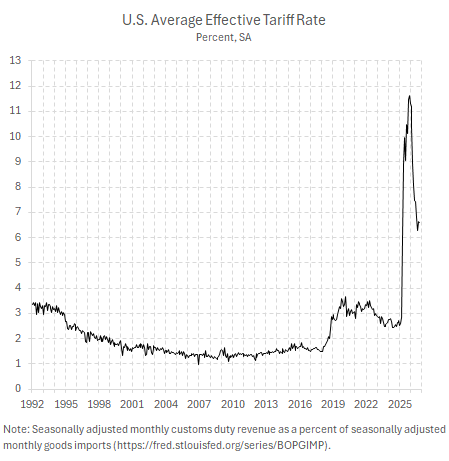
Still, there are signs that tariff pressure could be one of the few near-term areas where Congress can make headway. The effective U.S. tariff rate, while elevated relative to some earlier periods, has declined from its recent peak, in part because subsequent measures have not fully replaced the “reciprocal tariffs” implemented in 2025. Additional changes could be coming as more Section 301 trade cases move through the pipeline. If lawmakers can successfully push the administration to retreat from a tariff agenda that has become broadly unpopular—and that some observers view as legally vulnerable—they could ease at least one meaningful source of price pressure.
Any relief, however, would not be immediate or complete. Some tariff-related costs can persist after policies change, because supply chains and contracts adjust slowly. And the aftershocks of earlier trade actions are already embedded in key markets: fertilizer costs, for instance, have been squeezed, affecting agricultural producers worldwide.
On other major drivers of living costs, prospects for congressional influence look dimmer. The administration’s anti-immigration program is one area where pressure campaigns may have limited effect, particularly amid mixed signals from Trump and the reality that rhetoric does not always translate into policy reversals. Meanwhile, resolving security and shipping risks tied to passage through the Strait of Hormuz—one of the world’s most critical chokepoints for oil—could prove even more difficult, with potentially large implications for global energy prices.
Why it matters
Americans’ day-to-day expenses are being shaped largely by global energy markets and executive-branch trade and security decisions—areas where Congress has only partial leverage. Tariff rollbacks may be among the few plausible near-term steps to relieve price pressure, but lingering effects and veto politics could limit impact. The next signal to watch is whether congressional votes translate into sustained pressure on tariff policy, and whether geopolitical tensions around Iran and the Strait of Hormuz continue to feed into fuel prices.