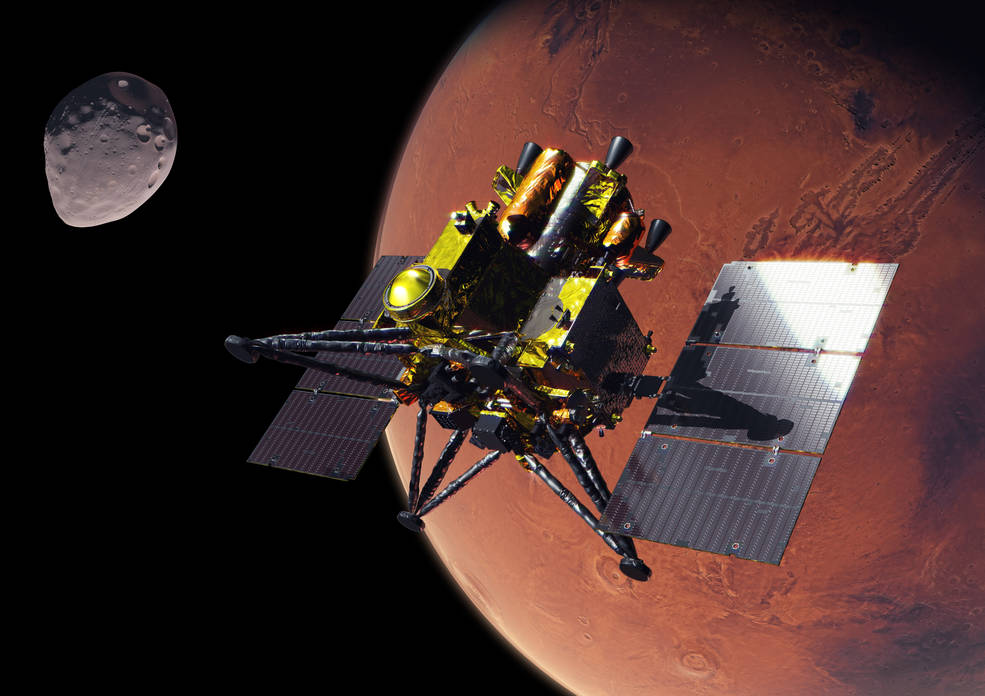
NASA will preview its role in Japan’s Martian Moons eXploration mission, detailing U.S. instruments, sampling hardware and Deep Space Network support.
NASA will host a media teleconference at 4 p.m. EDT on Thursday, Oct. 15, offering a preview of the agency’s role in Japan’s upcoming Martian Moons eXploration (MMX) mission. The briefing will outline the mission’s goals and detail what NASA is providing to the Japan Aerospace Exploration Agency (JAXA) spacecraft. Audio from the event will be streamed on NASA’s website.
MMX is scheduled to lift off from JAXA’s Tanegashima Space Center in Japan on Monday, Oct. 19 (EDT), which corresponds to Tuesday, Oct. 20 in Japan Standard Time. NASA said journalists who want to ask questions by phone must RSVP no later than two hours before the call by contacting Molly Wasser at molly.l.wasser@nasa.gov. NASA also noted that its media accreditation policy is available online.
Once launched, MMX will take several years to reach Mars, arriving in August 2027. The spacecraft’s central objective is to investigate Mars’ two small moons—Phobos and Deimos—beginning with a broad survey of both bodies. After completing detailed observations of Phobos, the mission plans to collect material from the moon’s surface no earlier than December 2028. The spacecraft is then expected to return that sample to Earth in 2031, a step designed to enable laboratory analyses that cannot be performed by remote sensing alone.
NASA’s support for MMX spans both hardware and services. The agency is providing MEGANE, a gamma-ray and neutron spectrometer intended to help characterize the composition of the Martian moons. NASA is also supplying the surface sampling mechanism that will assist the spacecraft in acquiring material from Phobos. In addition, the agency will contribute communications and navigation services through NASA’s Deep Space Network, the global array of antennas used to track and relay data to and from spacecraft operating far from Earth. NASA funding will also support U.S. scientists serving on the mission’s science team.
The MEGANE instrument was developed by the Johns Hopkins Applied Physics Laboratory. The sampling system—a pneumatic mechanism designed for collecting surface material—was built by Honeybee Robotics, a Blue Origin company.
NASA said its participation is being funded through the agency’s Discovery Program, which is designed to enable regular flight opportunities for targeted, high-value planetary science missions. The Discovery Program is managed by NASA’s Marshall Space Flight Center in Huntsville, Alabama, for the Science Mission Directorate at NASA Headquarters in Washington.
Why it matters
MMX is a rare chance to bring back material from a moon of another planet, potentially clarifying how Phobos and Deimos formed and what they are made of. NASA’s instruments, sampling hardware, and Deep Space Network support underscore how modern planetary exploration often depends on international partnerships. The teleconference will offer an early look at the mission’s science priorities and how the U.S. contributions are expected to shape what MMX can discover.