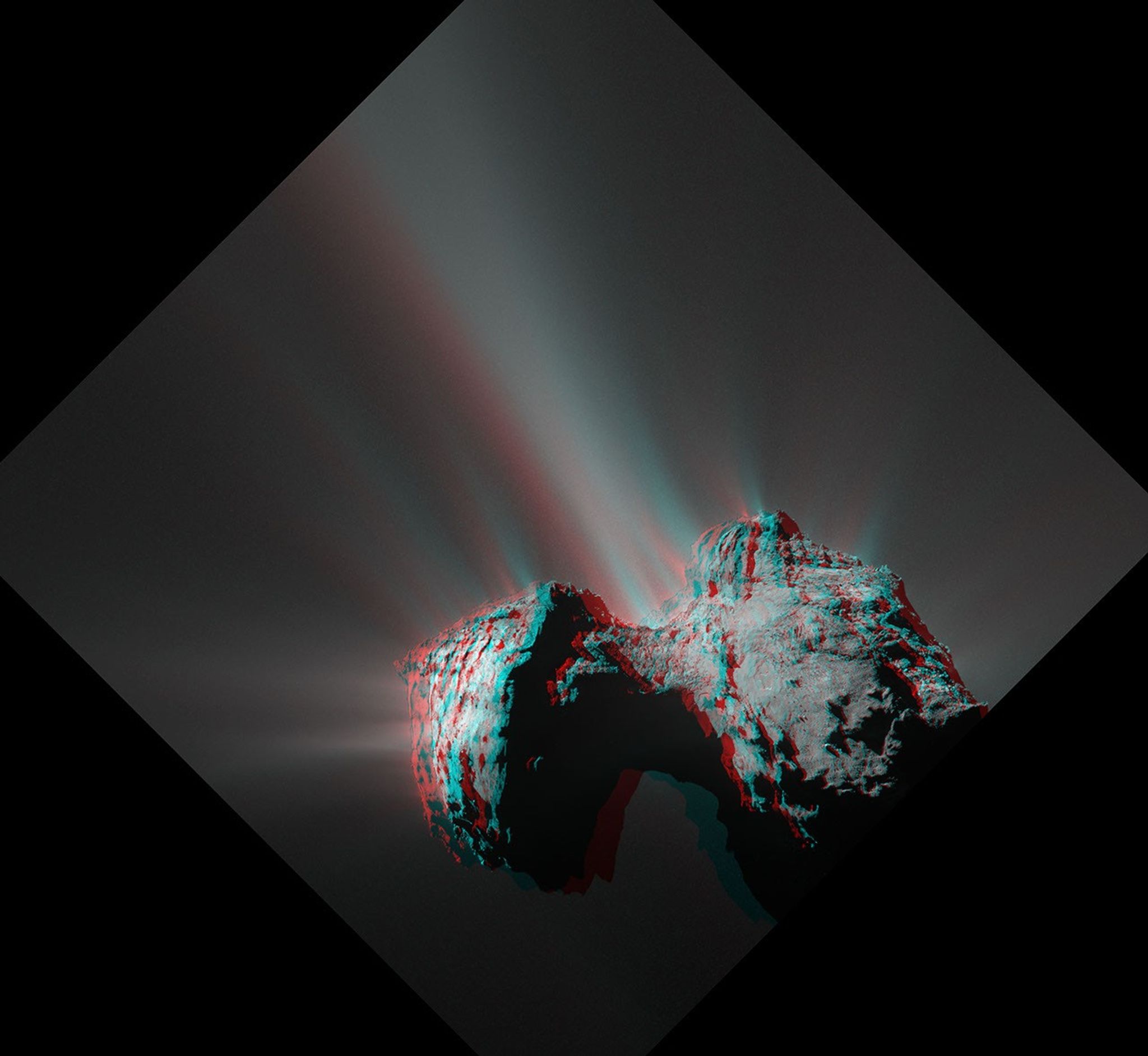
A newly highlighted 3D anaglyph lets viewers “fly” alongside Comet 67P’s rubber-duck nucleus and active jets, using paired Rosetta OSIRIS images and simple 3D glasses.
Slip on a pair of red-and-blue 3D glasses and you can virtually drift beside one of the Solar System’s most distinctive comets. A newly highlighted stereo anaglyph offers a three-dimensional view of Comet 67P/Churyumov–Gerasimenko, the rugged, two-part nucleus famously explored up close by the European Space Agency’s Rosetta mission.
The 3D effect comes from pairing two separate images captured by Rosetta’s OSIRIS narrow-angle camera. Both frames were taken on July 25, 2015, when the spacecraft was about 184 kilometers from the comet—close enough to resolve sharp topography across the nucleus and to catch activity erupting from its surface. In the anaglyph, multiple jets of gas and dust can be seen streaming into space, driven by solar heating as the comet approached its closest point to the Sun.
Comet 67P’s “rubber duck” shape—one of its defining features—is on full display. The nucleus consists of two lobes connected by a narrower bridge of material often described as a neck. The larger lobe measures roughly 4 kilometers across, while the smaller is about 2.5 kilometers in diameter. The uneven landscape appears fractured and jagged, emphasizing how irregular and complex these small bodies can be compared with more familiar, spherical worlds.
Rosetta’s long-running escort of the comet provided an unprecedented look at how such objects evolve as they warm. Jets like those visible in the 2015 imagery are a hallmark of cometary behavior: sunlight heats near-surface ices, releasing gas that can lift dust off the nucleus and carve the surface over repeated orbits.
The mission’s story ended dramatically. In September 2016, after completing its scientific program, Rosetta was deliberately sent to the comet’s surface in a controlled impact, bringing the spacecraft’s operations to a close.
For viewers eager to continue exploring the comet in depth, there is more than a single 3D portrait available. A public online archive hosts nearly 1,400 stereo anaglyphs assembled from Rosetta’s image data, allowing anyone with simple 3D glasses to browse a wide range of angles and moments from the mission’s close encounter with 67P.
Why it matters
Comets are time capsules from the early Solar System, and close-up imagery helps scientists connect surface features and jets to the physics of ices, dust, and sunlight-driven activity. Public 3D archives also broaden access to mission data, giving educators, researchers, and enthusiasts new ways to study and communicate how these small bodies change over time. With Rosetta now gone, such datasets remain a key resource for interpreting future comet missions and planning what to observe next.