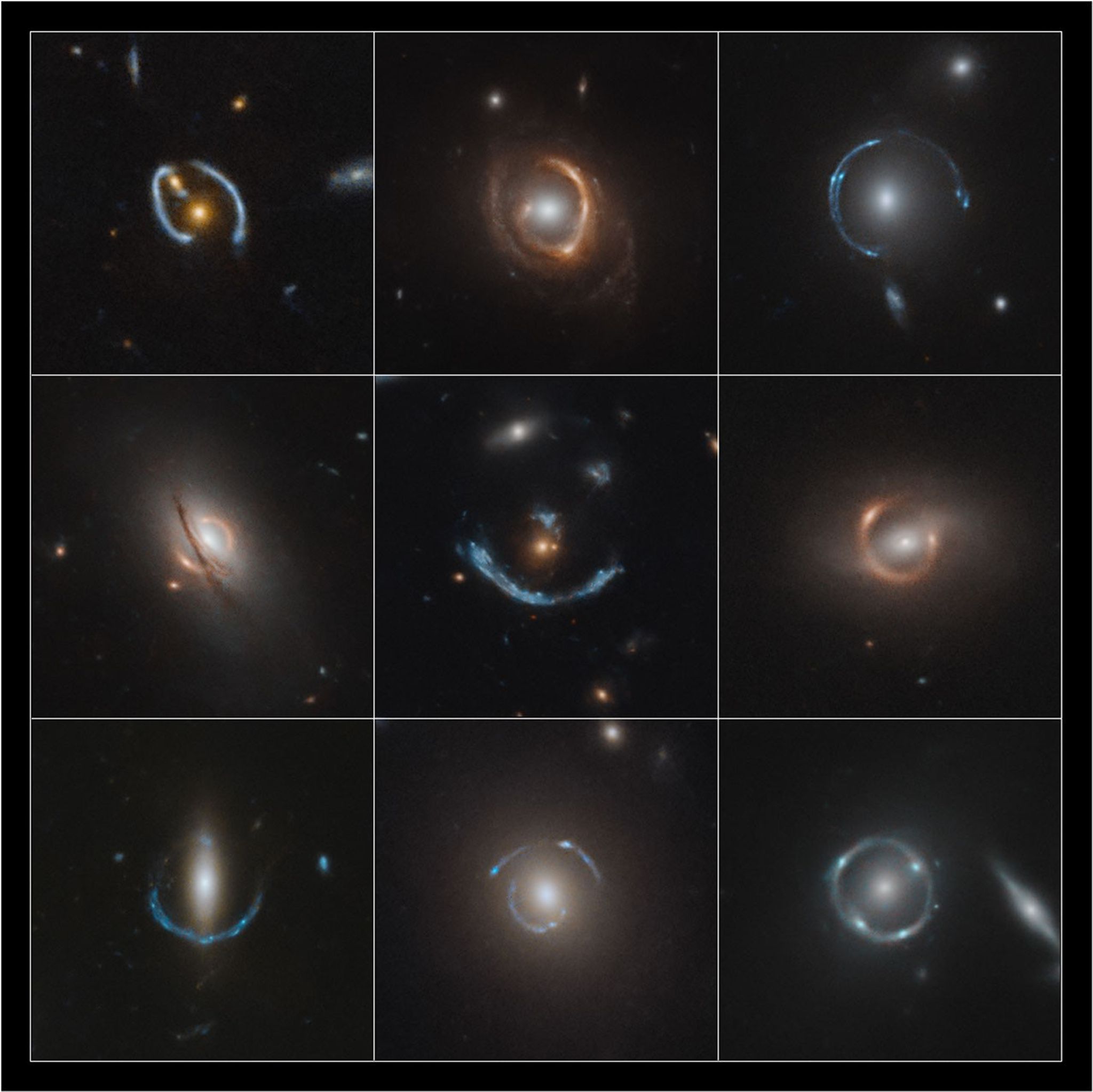
Hubble has assembled a new set of dramatic gravitational lens images that will guide the Nancy Grace Roman Space Telescope in finding and modelling more lenses to map dark matter.
NASA’s Hubble Space Telescope has assembled a new collection of striking gravitational lenses—natural optical tricks created by gravity—that scientists plan to use as a roadmap for future discoveries with the agency’s upcoming Nancy Grace Roman Space Telescope.
Gravitational lensing was anticipated more than a century ago from Albert Einstein’s theory of general relativity. The idea is simple in principle but powerful in practice: a massive object in the foreground, such as a galaxy or a cluster of galaxies, can bend and amplify light from a much more distant galaxy lying behind it. When the alignment is just right, the background galaxy’s light is stretched into bright arcs and other distorted shapes around the nearer galaxy, acting like an enormous “lens” in space and revealing objects that would otherwise be too faint or too far away to study.
The Hubble images highlight how varied lensing can look, even when the basic ingredients are the same. In these systems, the warped arcs are produced when a distant background galaxy lines up precisely with the mass of a foreground galaxy. Depending on the geometry and how the mass is distributed, the background galaxy can appear duplicated, smeared into multiple images, or wrapped into near-circular structures.
That diversity is more than aesthetic. Astronomers plan to use a large sample of lenses like these to build detailed “lens models,” mathematical reconstructions that link the amount of distortion in the background galaxy to the total mass—and its distribution—in the foreground lensing galaxy. Crucially, those models can probe dark matter, the unseen material thought to make up most of a galaxy’s mass. Because dark matter does not emit light, it must be mapped indirectly through its gravitational influence, and strong lensing provides one of the most sensitive methods available.
Hubble and Roman will contribute in complementary ways. Hubble primarily observes in visible and ultraviolet wavelengths, with some infrared capability, delivering exceptionally sharp views of individual targets. Roman, by contrast, will observe mainly in infrared with some visible-light coverage, but over a far larger field of view—ideal for sweeping panoramas that can capture many lenses at once. In other words, Hubble excels at close inspection, while Roman will build the big statistical sample. If Roman turns up an especially intriguing lens, Hubble can be tasked with follow-up imaging to exploit its high-resolution visible and UV strengths.
Researchers are also looking for subtle “imperfections” in lensed arcs—small deviations that could betray the gravitational pull of otherwise invisible substructures: compact clumps of dark matter within the lensing galaxy’s halo. Detecting these would provide a key test of the cold dark matter model, which predicts many such clumps with masses ranging from about a million to a billion Suns. For comparison, the Milky Way’s overall dark matter halo is estimated at roughly 1.3 trillion solar masses.
To prepare for Roman’s flood of imagery, the team aims to use the Hubble lens set to help train an advanced, “super-intelligence” search tool that can efficiently identify similar arc patterns in Roman data.
The gallery also includes recognizable lensing configurations. One example is an “arc–counterarc” system where the background galaxy appears as paired arcs, magnified by two foreground galaxies acting together. Another is an Einstein ring, formed when alignment is so precise—and the lensing mass sufficiently symmetric—that the background galaxy nearly encircles the foreground object. The set also features quadruply lensed systems, where the background galaxy is reproduced four times as smeared points around the lens; in one case, doubled bright knots likely mark intense star-forming regions.
Color offers clues too: bluish arcs suggest younger stars, while redder arcs point to older stellar populations. Comparing these differences with Hubble and Roman will help scientists trace how galaxies changed earlier in cosmic history.
Why it matters
This Hubble dataset is both a scientific resource and a rehearsal for Roman’s wide-field lens surveys, linking today’s sharp close-ups to tomorrow’s cosmic census. By combining Hubble’s precision with Roman’s scale, astronomers hope to sharpen measurements of dark matter’s structure and test whether predicted small clumps really exist. What to watch next is how effectively these lens models and automated search tools translate to Roman’s much larger, infrared-rich view of the universe.