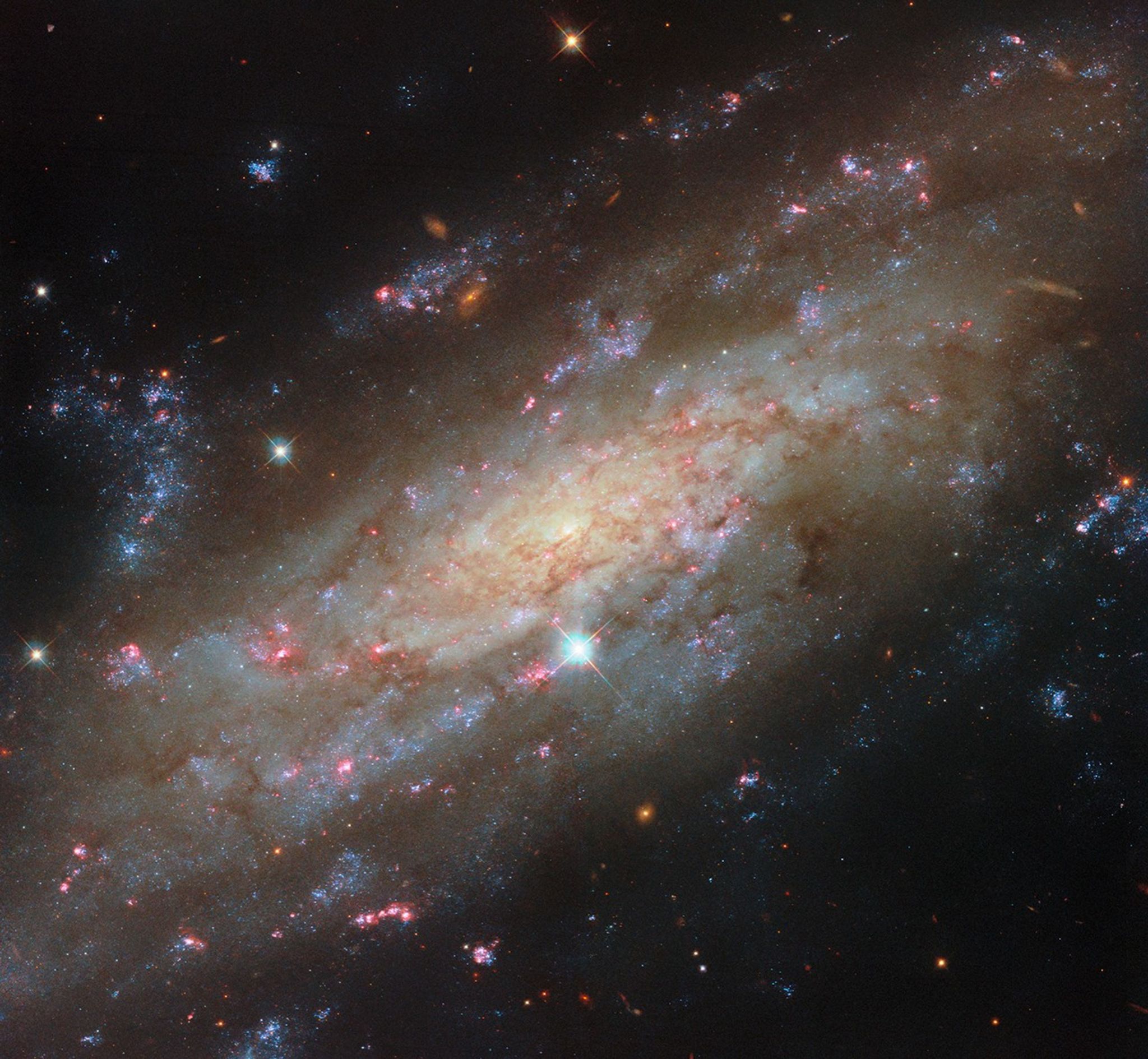
A newly released image from NASA’s Hubble Space Telescope puts the spiral galaxy NGC 3137 in the spotlight, its disk shimmering with dense groupings of stars.
A newly released image from NASA’s Hubble Space Telescope puts the spiral galaxy NGC 3137 in the spotlight, its disk shimmering with dense groupings of stars. The galaxy lies about 53 million light-years from Earth in the constellation Antlia, also known as the Air Pump, close enough on cosmic scales to make it a valuable laboratory for astronomers.
Because NGC 3137 is a relatively nearby spiral, researchers can more readily pick out details such as star clusters and regions where new stars are forming, along with the remnants left behind as stars age and die. That makes the galaxy a useful stand-in for studying processes that also shape the Milky Way, offering a view of how a spiral system evolves over time.
NGC 3137 is drawing additional interest not only for what’s happening inside it, but for the company it keeps. The galaxy moves through space as part of the NGC 3175 group, a collection of galaxies that astronomers consider broadly comparable to our own Local Group—the neighborhood that includes the Milky Way.
Both groups share a similar overall architecture: two prominent spiral galaxies dominate. In the NGC 3175 group, those major members are NGC 3137 and NGC 3175, the latter of which has also been observed by Hubble. In the Local Group, the leading spirals are the Milky Way and the Andromeda Galaxy.
Like the Local Group, the NGC 3175 group is also expected to host a population of smaller dwarf galaxies. Exactly how many remain uncertain. Researchers have identified more than 500 candidate dwarf galaxies associated with the group, but their status as true members has not yet been firmly established.
By examining a galaxy group that may mirror the structure of the Local Group, astronomers hope to sharpen their understanding of how such collections behave—how galaxies interact, how smaller companions are distributed, and how the overall system evolves. Observations of NGC 3137 and its neighbors therefore serve a dual purpose: revealing the life cycle of stars within a spiral galaxy and offering clues to the broader dynamics of the kind of galactic environment the Milky Way calls home. Image credit: ESA/Hubble & NASA, D. Thilker and the PHANGS-HST Team.