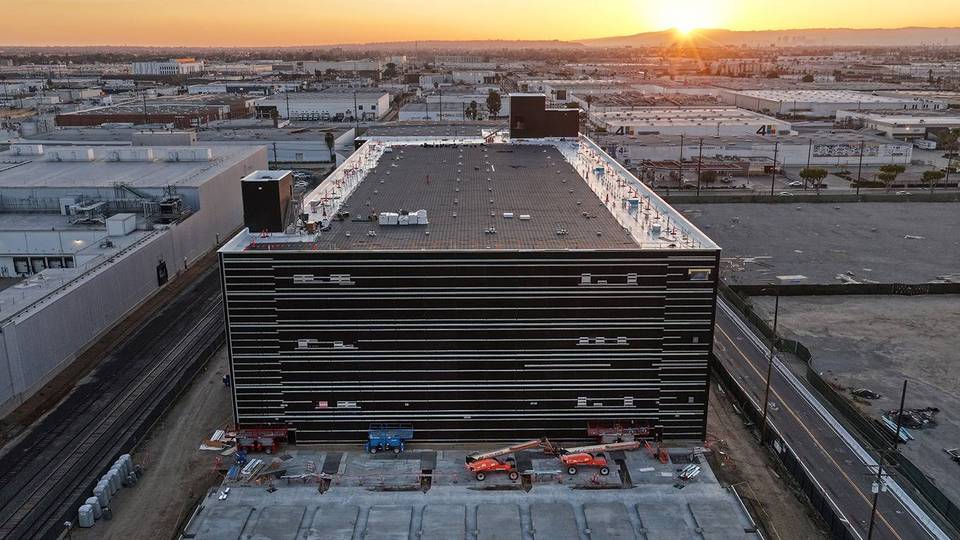
As AI labs race to scale computing power, delays in data-center expansion may offer a crucial pause for testing, safety and governance amid rapid disruption to expert work.
Pressure inside top AI research organizations to keep pushing the limits of what their systems can do has created a race that is increasingly defined by computing power. Newer models typically require larger clusters of specialized chips, bigger data centers, and more electricity and cooling. In that context, any friction that slows the rapid expansion of these facilities—whether it comes from permitting battles, grid constraints, financing costs, or community opposition—can look like an obstacle to innovation.
But there is a plausible upside to that slowdown. When progress is driven by a sprint for scale, the institutions building frontier systems have less time to test, evaluate, and govern them before a more capable version is deployed. Buying time can matter. Extra months can be used to improve methods for assessing model behavior, strengthen safety protocols, and build rules for how powerful systems should be trained and released. In other words, resistance to an all-out buildout of compute may not simply be “anti-technology.” It may also function as an unplanned pause—one that increases the chance of capturing the benefits of AI while limiting foreseeable harms.
I was reminded of that dynamic in Chicago by a friend whose career sits at the heart of human intellectual achievement. He is a tenured mathematics professor—someone who, by any traditional measure, occupies one of the most secure and prestigious jobs in academia. And yet he has chosen to step away for a year to focus on AI safety.
His decision is rooted in a sense that the ground is shifting under his field. He points to an episode that, to him, signals how quickly AI could change the meaning of expertise. OpenAI has published 722 papers that it says resolve 377 mathematical problems that had previously resisted solutions. Combined with the steady improvements in model performance, he sees a trajectory in which machines do more of the work that once defined the value of professional mathematicians.
The anxiety is not only about prestige, or even employment, but about the pace at which the change is occurring. A decade ago, it would have sounded far-fetched that a leading lab could credibly claim progress on hundreds of open mathematical questions at once, packaged in the form of manuscripts. Today, it is being presented as a signpost of what is coming next: more capable systems, trained with more computation, producing results in domains once considered uniquely human.
If that kind of disruption can reach a “brilliant mathematician,” the implications stretch well beyond academia. Many knowledge-based professions—law, software engineering, finance, medicine, and scientific research—depend on the assumption that specialized training translates into long-term economic security. AI challenges that bargain by making high-level pattern recognition, drafting, and problem-solving cheaper and more widely available.
That is why the politics and economics of data-center construction matter. Slower growth in compute capacity could slightly reduce the speed at which frontier models leap forward, and with it the speed at which societies are forced to adapt to new capabilities. A delay is not a solution, but it can be an opportunity: time to set standards, to build oversight, and to decide what kinds of systems should be deployed in the first place.
Why it matters
The pace of AI progress is increasingly tied to how quickly companies can build and power enormous data centers, and the consequences will be felt by workers in high-skill fields as well as by regulators and communities hosting new infrastructure. A slowdown in expansion could provide breathing room to develop safety testing, governance, and accountability before the next jump in capability. Watch for whether permitting, energy supply, and public resistance continue to constrain compute growth—and whether policymakers use that window to put durable rules in place.