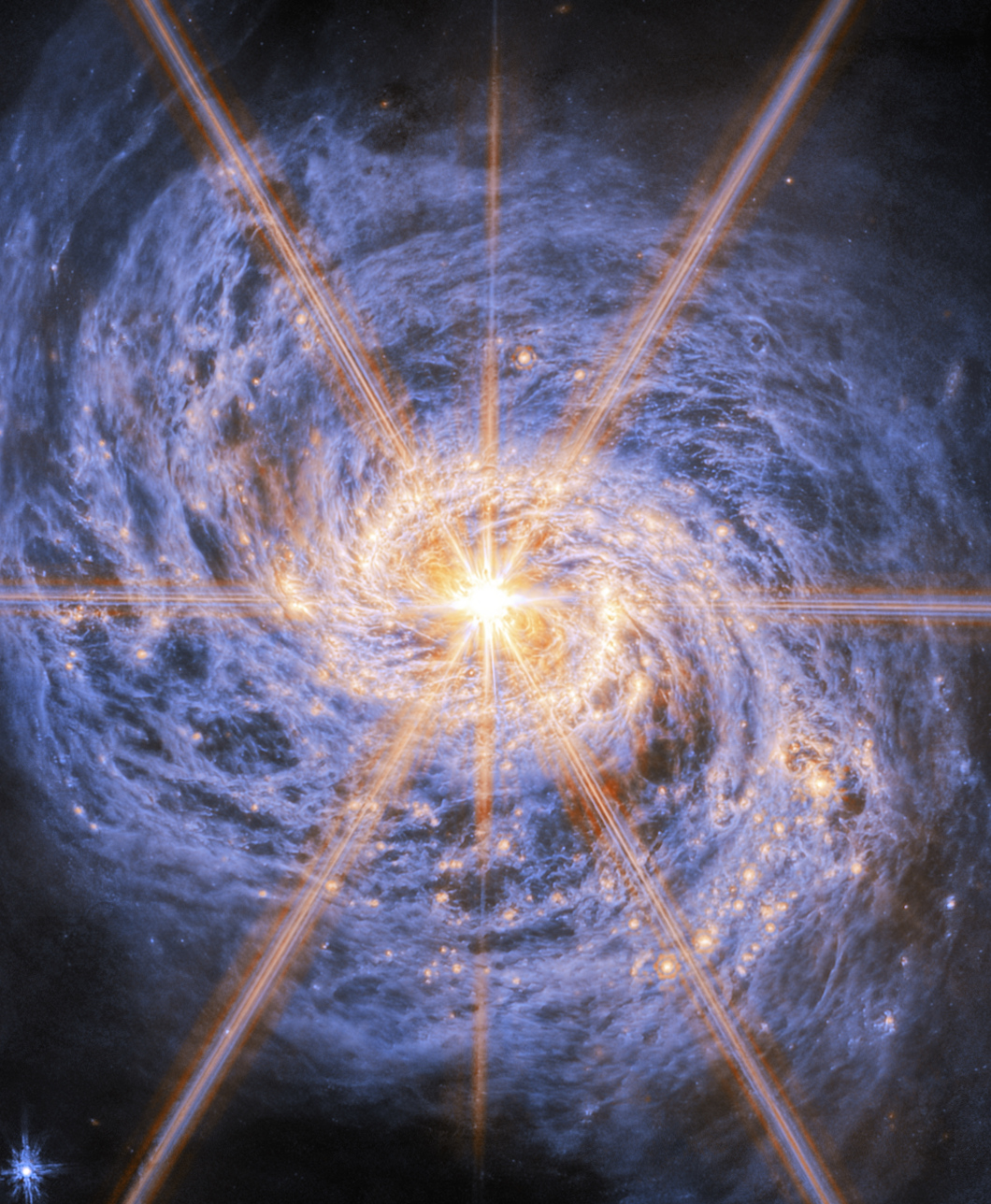
In a new image captured on May 7, 2026, NASA’s James Webb Space Telescope has turned its gaze toward the luminous core of the galaxy M77, revealing a brilliant central region powered by extreme gravity.
In a new image captured on May 7, 2026, NASA’s James Webb Space Telescope has turned its gaze toward the luminous core of the galaxy M77, revealing a brilliant central region powered by extreme gravity.
The striking brightness originates near M77’s central black hole, where surrounding gas is being drawn inward and forced into a compact, fast-moving orbit. As this material accelerates and crowds into a tight swirl, it heats dramatically. That rise in temperature drives the gas to emit enormous amounts of radiation, making the galaxy’s nucleus stand out as an intense beacon in Webb’s view.
The scene also features prominent, straight rays that appear to shoot outward from the center. Despite their dramatic appearance, these lines are not structures within M77. They are diffraction spikes—an imaging artifact produced by the telescope’s optics when observing a very bright, concentrated source of light. In other words, the spikes are a signature of the instrument, not a feature of the galaxy itself.
Together, the image showcases both the violent environment around a supermassive black hole and the distinctive optical effects that can accompany such high-contrast observations.