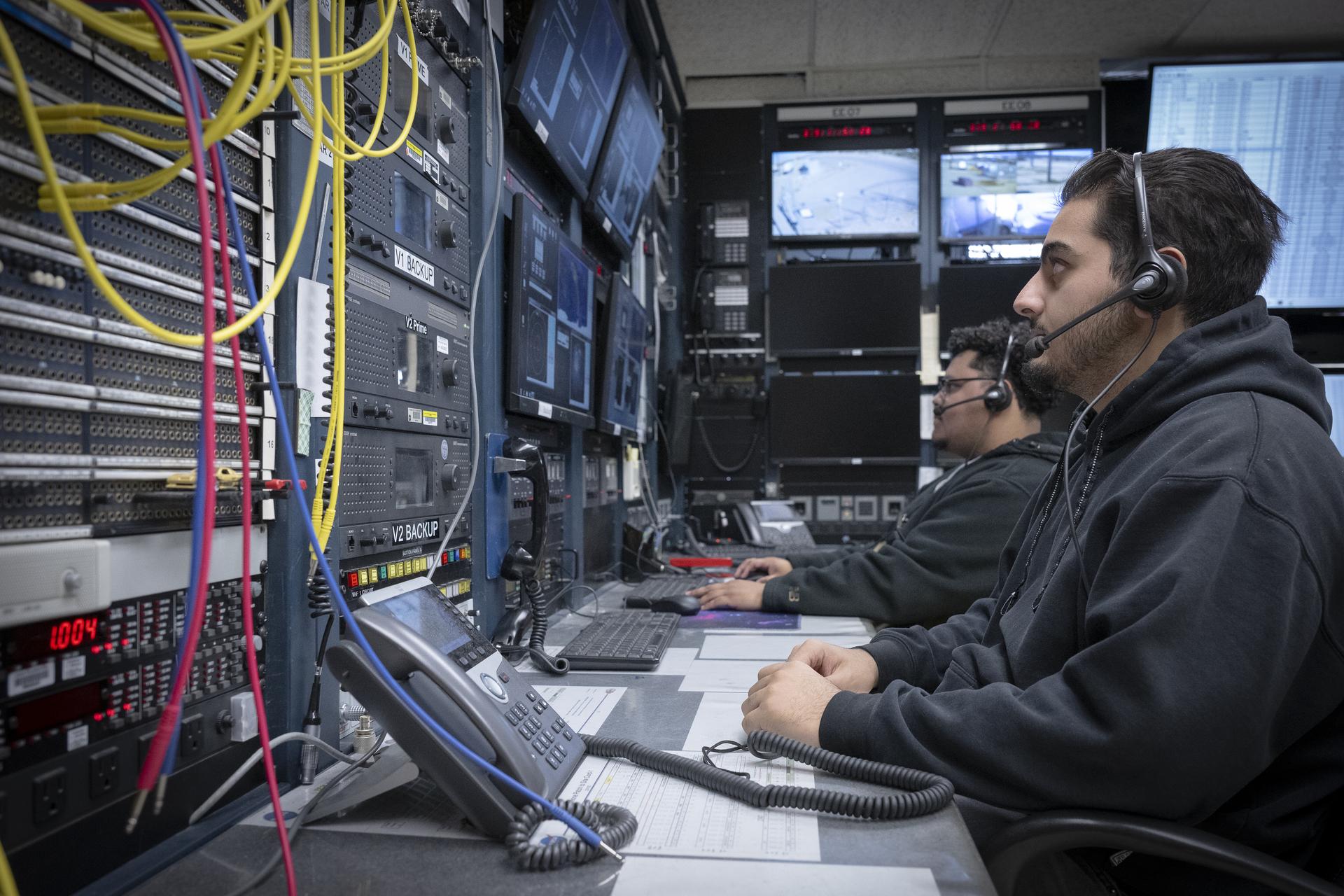
In the skies over Edwards, California, NASA’s Armstrong Flight Research Center routinely puts experimental aircraft through their paces, collecting the measurements…
In the skies over Edwards, California, NASA’s Armstrong Flight Research Center routinely puts experimental aircraft through their paces, collecting the measurements needed to push aeronautics and space technology forward. Less visible than the aircraft themselves, but essential to nearly every mission, is the Dryden Aeronautical Test Range (DATR)—the communications and tracking backbone that helps keep flight research safe, coordinated, and productive.
For most research sorties flown from NASA Armstrong, the test range delivers core services including communications links, radar tracking, and telemetry—the streams of data sent from an aircraft to the ground in real time. DATR also provides video coverage that can capture imagery from the ground and follow aircraft at long distances, giving engineers and mission teams additional ways to monitor operations as they unfold.
Those capabilities have been expanding. Modernization work that began in the early 2020s has strengthened the range’s ability to support both cutting-edge flight tests and spaceflight-related communications. The upgrades are designed to keep pace with major efforts such as upcoming testing of NASA’s X‑59, the agency’s quiet supersonic research aircraft, while also reinforcing the range’s role in spacecraft support.
“The DATR provides real-time data, tracking, and situational awareness that help keep flight research safe and efficient,” said Tara McCoy, acting deputy director for DATR Mission Operations at NASA Armstrong. She added that the range’s reach extends beyond aeronautics: it supports science missions, works alongside industry partners, and contributes capabilities used in International Space Station operations.
Current improvement projects include installing new very high frequency (VHF) ground antennas, refreshing electronic hardware, and enhancing software used to track the International Space Station and visiting vehicles. NASA has also added antennas specifically to provide backup coverage—an important layer of resilience when missions depend on continuous links.
DATR’s real-time processing and display of radar, telemetry, and video are particularly critical during complex aeronautics research. One example is NASA’s Crossflow Attenuated Natural Laminar Flow (CATNLF) experiment, which mounts a scale-model wing beneath a NASA F‑15B research aircraft. The goal is to better maintain laminar flow—smooth airflow over a surface—which can reduce drag and potentially lower fuel costs for future commercial airplanes.
Beyond flight research, the range supports aircraft used for scientific work, including NASA’s ER‑2 high-altitude platform and the agency’s C‑20A aircraft.
Another focus is speeding up how quickly researchers receive usable post-flight data. DATR engineers are pursuing multiple methods to reduce the time required to process and validate raw flight information—an effort aimed at saving both time and resources. Faster turnaround can directly influence what happens next in a test campaign, said DATR chief engineer David Tow: “The faster we can get data to the project engineers to review, the faster they can determine whether certain test points need to be repeated, or future test points can be skipped.”
One strategy seeks to automate and consolidate data-processing workflows, cutting the number of steps from five to one. Another builds on an existing partnership with the U.S. Air Force, enabling multiple computers to handle post-processing for different missions in parallel. Together, the team is working to shrink post-flight processing from about two hours to under 30 minutes.
DATR also forms part of NASA’s safety and communications architecture for International Space Station missions, providing backup communications and telemetry during launches, dockings, and reentries. NASA Armstrong is one of only two ground stations in the U.S. that can transmit and receive across all station frequencies—the other is NASA’s Wallops Flight Facility in Virginia. Armstrong has been providing communications and radar tracking support for the station since the first ISS element launched in 1998, and it continues to assist commercial cargo and crew flights today.
Operating under NASA’s Flight Demonstrations and Capabilities project within the Aeronautics Research Mission Directorate, the Dryden Aeronautical Test Range remains positioned as an enabling hub—linking aeronautics, science, and human spaceflight with the communications, tracking, and data services those missions depend on.