NASA’s Curiosity rover is preparing to return to drilling after engineers freed its arm from an unexpected snag involving a rock target named “Atacama.” With that issue…
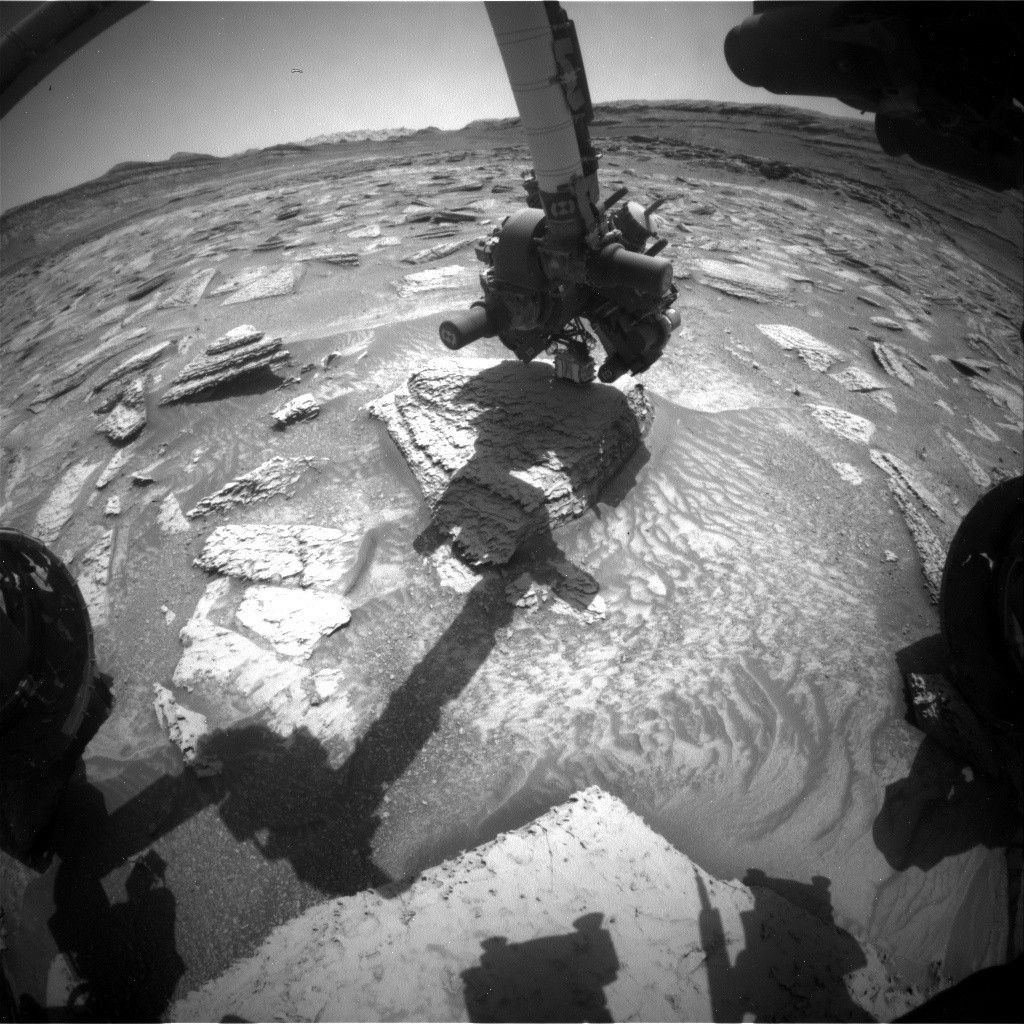
NASA’s Curiosity rover is preparing to return to drilling after engineers freed its arm from an unexpected snag involving a rock target named “Atacama.” With that issue resolved, the science team has selected a new drilling candidate intended to sample the same layer of Martian geology: a stratified sulfate-bearing unit that sits above distinctive “boxwork” structures in the surrounding terrain.
The new target has been christened “Campo Marte,” a name borrowed from a naturally red sandstone feature in Bolivia. The choice continues Curiosity’s established naming convention in this region of Mars, where targets are often labeled after places near South America’s Uyuni area. In Spanish, “Campo Marte” translates to “Field of Mars”—an especially fitting designation for a rock block being studied on the Red Planet.
Before committing to drilling, Curiosity conducted a careful pre-drill survey of Campo Marte. The rover’s ChemCam instrument used laser-induced breakdown spectroscopy (LIBS) to probe the rock’s chemistry, while the Alpha Particle X-ray Spectrometer (APXS) provided complementary composition measurements from contact science. The Mars Hand Lens Imager (MAHLI) added close-up photographs to characterize surface textures and help scientists assess whether the target is suitable for the drill.
ChemCam also performed additional LIBS “raster” observations on nearby blocks to broaden the geochemical context. Among the features examined were vein-like and nodule-like structures—small-scale components that can carry important clues about past fluid activity and chemical alteration.
As Curiosity has documented at several stops within this sulfate-rich unit, many rocks display a striking polygonal surface pattern. The team notes the same prominent texture on a block called “Paso Malo” and on other nearby slabs, a recurring feature that continues to draw attention as scientists piece together the environment that produced these deposits.
A key lesson from the Atacama incident is shaping the new drilling strategy. Imaging of Campo Marte from multiple angles indicates that it is substantially thicker than Atacama. That extra mass matters: the team is optimistic that Campo Marte will remain stable on the ground during drilling, allowing Curiosity to withdraw its drill bit in the normal way. While the earlier mishap yielded useful information about Atacama’s volume and density, the rover team has little appetite for repeating that particular “experiment.”
Curiosity’s work also intersected with another NASA mission as the Psyche spacecraft passed near Mars to gain a gravitational assist on its journey to the main asteroid belt. Psyche is headed for 16 Psyche, a large asteroid belonging to an unusual spectral class that has never been visited by a spacecraft. Although 16 Psyche is expected to be radically different from Mars—among other contrasts, it is too small to hold onto an atmosphere—the Mars flyby offered an important chance to test Psyche’s instruments, validate calibration, and rehearse data processing.
To support that effort, Curiosity scheduled extra atmospheric monitoring timed to the flyby, including a Navcam “zenith movie” to track clouds overhead and a Mastcam solar observation designed to quantify atmospheric opacity. The Mastcam campaign was paired with fresh calibration measurements. Together with coordinated observations from Mars orbiters and NASA’s Perseverance rover, Curiosity’s contributions are intended to help confirm Psyche’s instrument performance as the spacecraft heads toward its asteroid destination.