NASA’s Psyche spacecraft has returned a striking new look at the Martian surface from a recent close pass, using its onboard multispectral imager to build an…
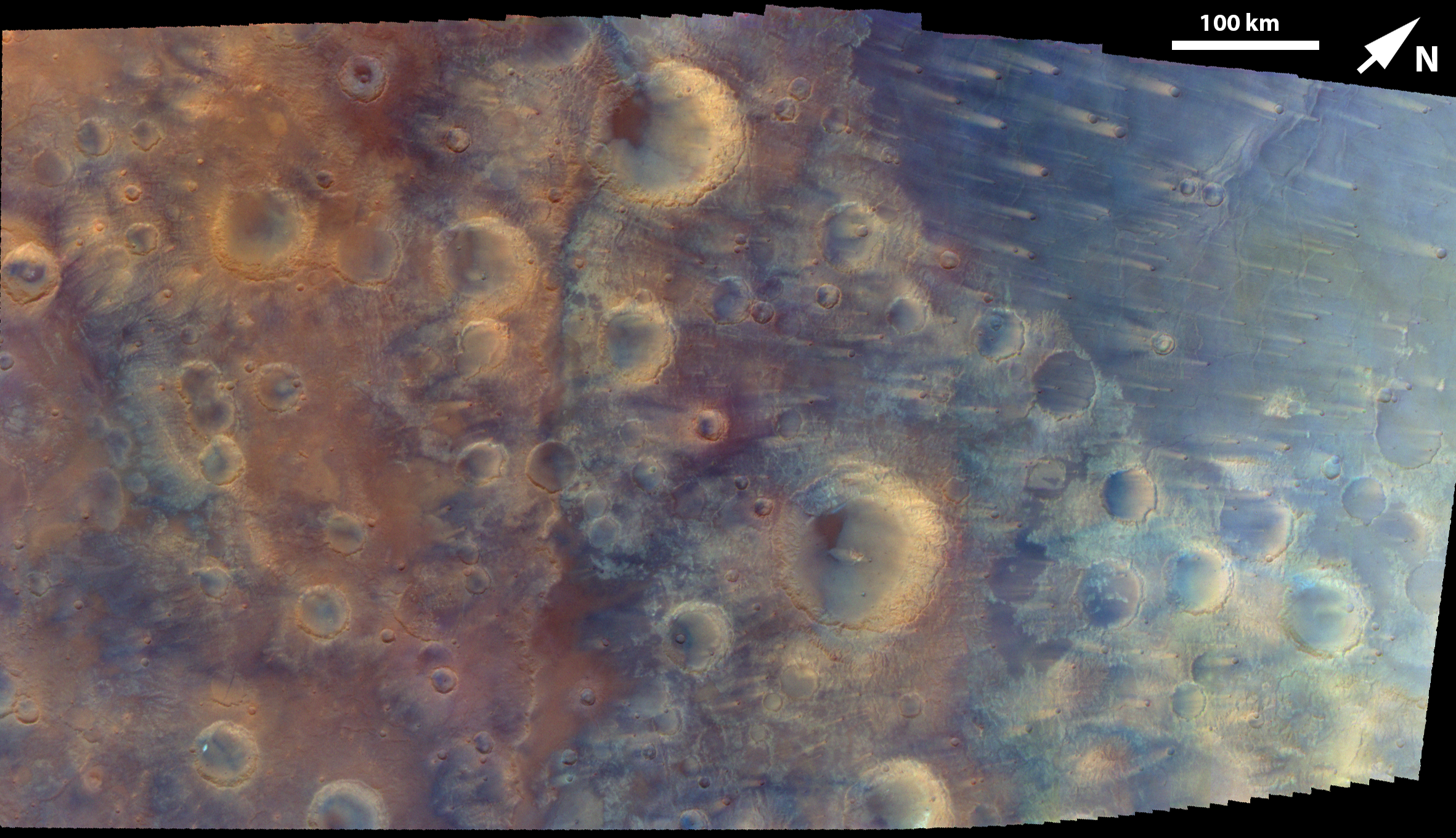
NASA’s Psyche spacecraft has returned a striking new look at the Martian surface from a recent close pass, using its onboard multispectral imager to build an enhanced-color mosaic that teases out subtle differences in terrain.
The composite view was assembled from four separate frames collected on May 15, 2026, during Psyche’s flyby of Mars. Because the spacecraft was moving steadily across the planet during the observation—traveling from right to left in the finished image, corresponding to a northeast-to-southwest track on Mars—the mosaic captures a changing perspective over the roughly six minutes it took to acquire the full set of pictures. That motion also means the sharpness is not uniform across the scene: the pixel scale shifts from about 381 meters (1,250 feet) per pixel on the right side to about 440 meters (1,440 feet) per pixel on the left.
Rather than producing a true-color snapshot, the instrument combined data from near-infrared, green, and blue filters to generate an enhanced-color rendering. This approach is designed to emphasize contrasts in surface materials and textures, helping geological features stand out more clearly than they would in a standard visible-light view. In the mosaic, the technique brings crisp definition to impact craters and ridged terrain, highlights wind-shaped streaks, and differentiates volcanic plains materials across the landscape.
The area shown lies within Iapygia, part of Mars’ rugged southern highlands. The mosaic spans roughly 62 degrees east to 78 degrees east longitude, and from about 4 degrees north down to 14 degrees south latitude—an equatorial-to-southern swath that captures a mix of heavily cratered ground and broader structural features.
One of the most prominent landmarks appears just below the center: the impact crater Fournier, measuring about 71 miles (114 kilometers) across. Its size and well-defined outline make it the dominant circular feature in the scene, surrounded by smaller craters and textured terrain that record a long history of impacts.
Cutting through the mosaic is a stark, nearly vertical linear feature positioned slightly left of center. This is part of Oenotria Scopuli, a lengthy, irregular system of cliffs—known to planetary scientists as scarps. The structure is not an isolated formation: it belongs to the wider circular architecture associated with the enormous Isidis impact basin, located to the northeast of the imaged region. The scarp system traces the basin’s broader geologic imprint, providing a reminder that even far from the basin’s center, its ancient collision has left recognizable signatures on the planet’s crust.
While Psyche’s primary destination is not Mars, flybys like this offer valuable opportunities for instrument checkouts and scientific observations. By capturing Mars in multiple wavelengths during the encounter, the mission has produced a detailed, information-rich snapshot of a complex stretch of the southern highlands—showing how impacts, volcanic resurfacing, and wind-driven processes have together sculpted the Red Planet’s surface.