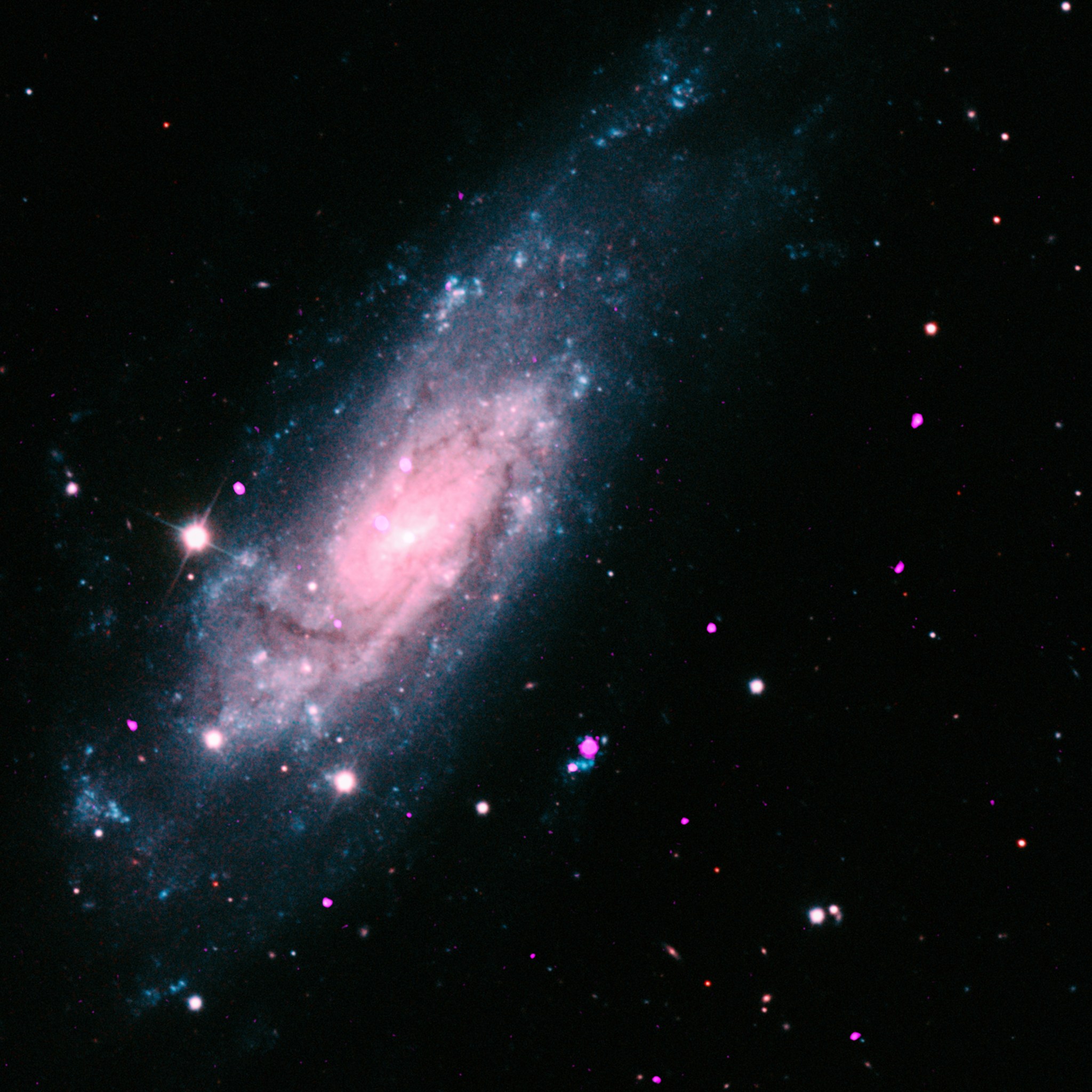
NASA’s Chandra X-ray Observatory has helped astronomers identify the trigger behind recurring outbursts from AT 2016blu, a massive unstable star in galaxy NGC 4559.
Observations from NASA’s Chandra X-ray Observatory have helped astronomers pin down the cause of recurring eruptions from a huge, unstable star in a nearby galaxy, according to an image release dated Nov. 9, 2026.
The object at the center of the study is AT 2016blu, a highly variable star in the spiral galaxy NGC 4559. Located roughly 30 million light-years from Earth, NGC 4559 appears in a composite view that combines Chandra’s X-ray data with optical imaging from the Sloan Digital Sky Survey, with additional processing by NASA’s Chandra X-ray Center.
AT 2016blu has drawn attention because it undergoes repeated outbursts—sudden episodes in which it brightens dramatically—signaling that it is not a quiet, steady star. Chandra’s ability to detect high-energy X-rays allowed researchers to identify what is driving these recurrent flare-ups, linking the eruptions to physical processes occurring in and around the star.
Astronomers estimate AT 2016blu is extremely massive, with a minimum mass of about 33 times that of the Sun. Stars in this weight class live fast and turbulent lives, shedding material through powerful winds and episodic blasts that can reshape their immediate surroundings and influence how they evolve.
The new Chandra results offer a clearer explanation for why AT 2016blu keeps erupting, strengthening the idea that high-energy observations are essential for untangling the behavior of unstable, massive stars beyond the Milky Way. By catching the system in X-rays—radiation produced in some of the hottest, most energetic environments in the universe—scientists can probe conditions that are otherwise difficult to measure using visible light alone.
The image release credits the X-ray data to NASA’s Chandra X-ray Observatory, with analysis led by a team at the University of Virginia (M. Aghakhanloo and collaborators). The optical component comes from SDSS, and the final presentation of the combined data was produced by NASA’s Chandra X-ray Center at the Smithsonian Astrophysical Observatory.
Why it matters
Massive, unstable stars like AT 2016blu are key actors in galactic ecosystems, returning energy and matter to their surroundings and setting the stage for eventual supernova explosions. Understanding what triggers their outbursts helps astronomers interpret transient events in other galaxies and refine models of how the most massive stars live and die. Researchers will be watching for future eruptions to test whether the newly identified trigger can reliably predict when these dramatic episodes occur.