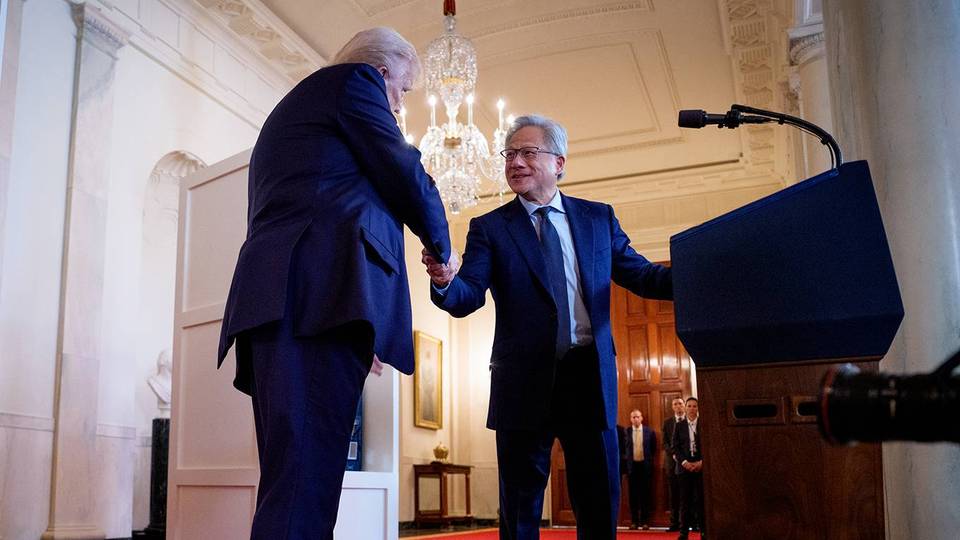
Nvidia’s CEO reinstatement after alleged security concerns and reported presidential pressure highlights how U.S. AI dominance depends on one firm—and its sway in Washington.
Nvidia’s brief leadership crisis has thrown a spotlight on a growing tension inside America’s technology advantage: the same company whose chips underpin U.S. leverage in the global AI race may also wield unusual influence over U.S. policymakers.
On November 23, Nvidia’s board reinstated Jensen Huang as chief executive, reversing course less than two weeks after he stepped down following a controversy framed in national-security terms. Huang acknowledged he had engaged in multiple extramarital relationships, including one involving a person U.S. officials reportedly suspected of ties to Chinese intelligence. Despite the gravity of those allegations—and the optics at a time of heightened U.S.-China rivalry—President Donald Trump personally pressed Nvidia’s directors to bring Huang back, according to the account.
The episode has sharpened questions about who truly controls the “chokepoints” in advanced computing. Nvidia sits at the center of modern artificial intelligence: its high-performance chips and software ecosystem have become essential for training and running the large models used by companies, governments, and militaries. That dominance has given Washington a powerful tool in its campaign to slow Beijing’s access to cutting-edge AI capabilities. Export controls and licensing regimes aimed at advanced processors are most effective when a single supplier’s products are difficult to replace—and Nvidia’s position has helped make that true.
Yet the reinstatement drama suggests a second, less discussed dynamic. If U.S. national-security strategy increasingly depends on one firm’s technology, the firm can become a strategic actor in its own right. In that environment, leadership stability at Nvidia is no longer just a corporate governance matter; it can be treated as a policy concern with repercussions for industrial planning, defense, and diplomacy.
Huang’s rapid return, secured after direct presidential intervention, underscores how entangled corporate decisions can become with geopolitical priorities. The underlying implication is stark: Washington may be willing to accept significant reputational and security risks at a critical supplier if it believes continuity at the top is necessary to maintain America’s edge in AI hardware and the broader technology contest with China.
The controversy, triggered by personal conduct but amplified by intelligence-related suspicions, also highlights the vulnerability created when national power is concentrated in a narrow part of the supply chain. Even if U.S. authorities restrict sales abroad, the United States may still find itself constrained at home by the need to protect the stability and output of the company that makes those restrictions meaningful.
Why it matters
Nvidia’s chips are central to AI development, making its leadership decisions consequential far beyond shareholders. If U.S. policy relies on a single corporate chokepoint to enforce export controls and maintain technological advantage, the government may face pressure to prioritize continuity over risk mitigation. The key question now is whether Washington will reduce that dependency—by diversifying suppliers and strengthening governance expectations—or continue to treat Nvidia’s internal turmoil as a national-security variable.