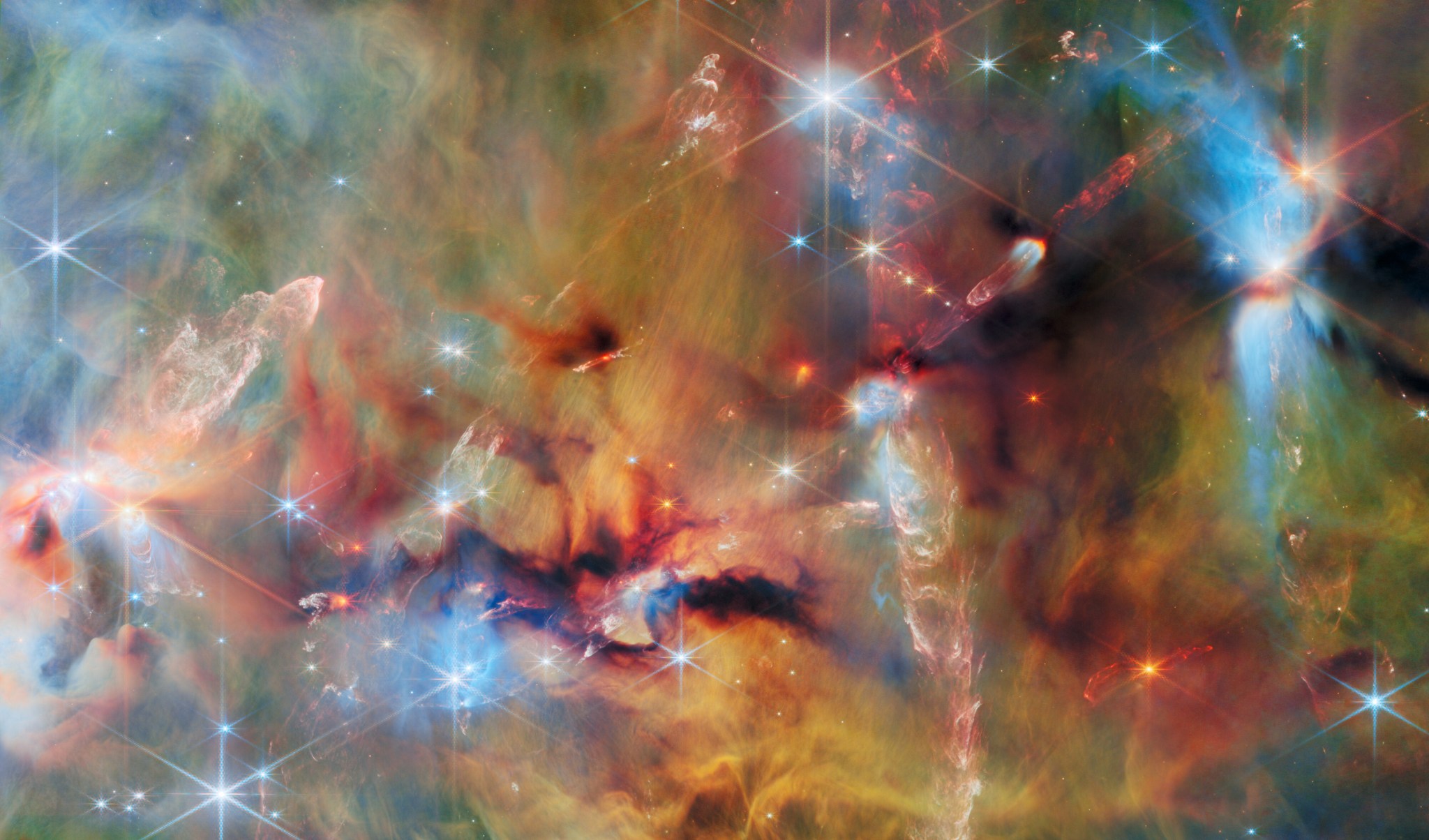
NASA’s James Webb Space Telescope has delivered a sweeping new look at stellar birth in action, capturing a rich slice of the Orion Molecular Clouds in an image released on June 5, 2026.
NASA’s James Webb Space Telescope has delivered a sweeping new look at stellar birth in action, capturing a rich slice of the Orion Molecular Clouds in an image released on June 5, 2026. The view highlights only a small section of this immense star-forming complex, yet it reveals an extraordinary range of activity occurring within a vast, elongated structure of frigid gas and dust located beyond the better-known Orion Nebula.
The Orion Molecular Clouds form a long, dense filament—an extended thread of material where gravity can gradually draw matter together. In the newly released Webb image, that cold, obscuring mix of dust and gas becomes a dramatic backdrop for star formation at multiple phases, offering a kind of visual timeline of how stars emerge from their natal environments.
Within the scene are the earliest stellar “embryos,” objects so young that they remain deeply embedded in their surrounding material as they begin accumulating mass. Alongside them are protoplanetary disks—flattened, rotating structures of gas and dust that encircle young stars and serve as the raw material for planet formation. The image also includes newly formed pre–main sequence stars, which have advanced beyond their initial infancy but have not yet matured into stable, hydrogen-fusing main-sequence stars like the Sun.
What makes this Webb view especially notable is the way it gathers these stages into a single frame. Rather than isolating one step of the process, the image contains a cross-section of stellar development, from the most nascent beginnings through the formation of disks and into the early evolution of young stars. The captured region spans 150 light-years across, emphasizing the sheer scale of the star-forming filament and the breadth of phenomena unfolding within it.
The image is credited to ESA/Webb, NASA, and CSA, with contributions by T. Megeath and M. Zamani (ESA/Webb). The release also acknowledges M. H. Özsaraç.