Inside NASA’s Glenn Research Center in Cleveland, a small blue crane lifts an unusually dense piece of hardware: a cylindrical regenerative fuel cell that resembles a…
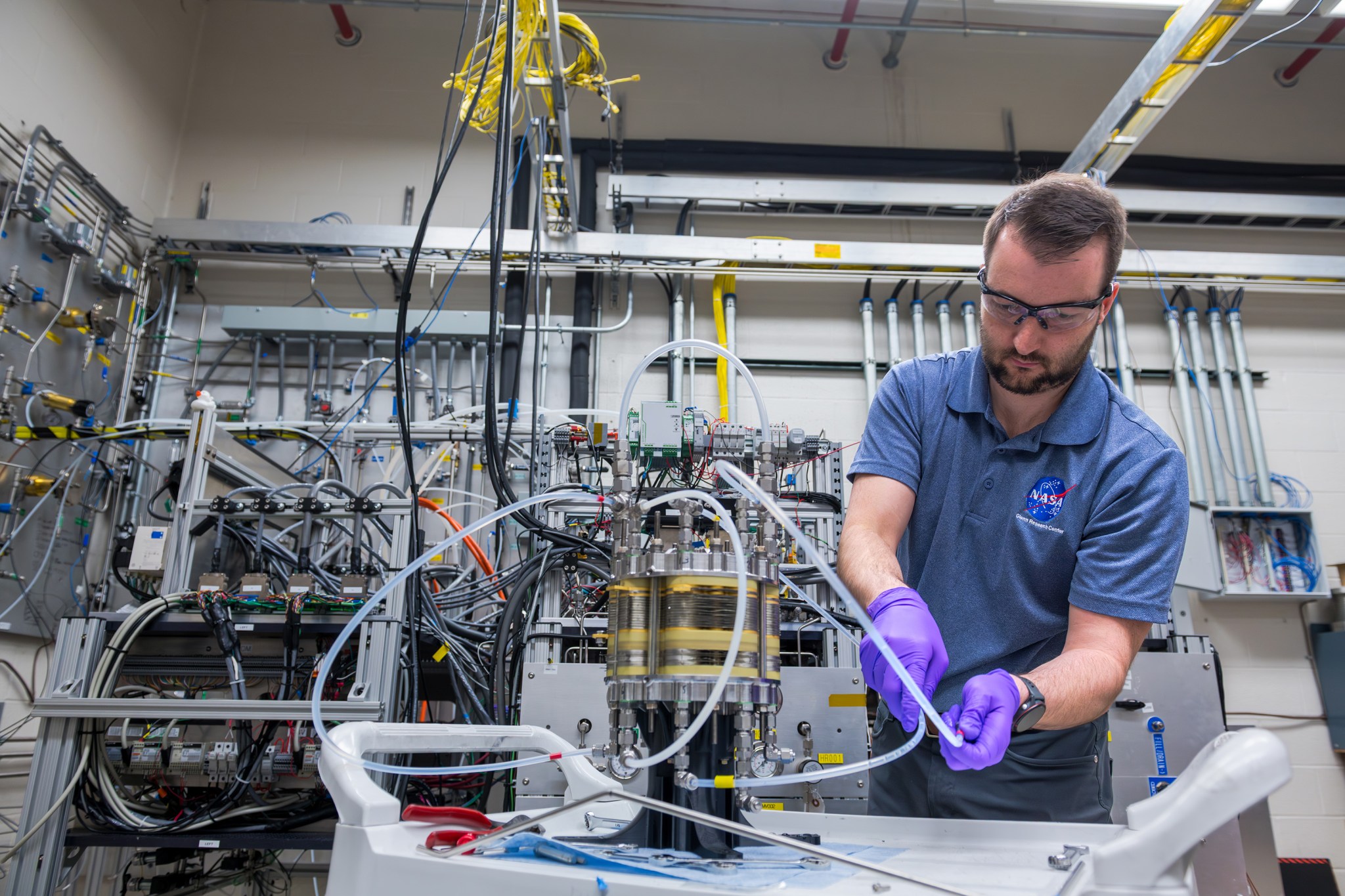
Inside NASA’s Glenn Research Center in Cleveland, a small blue crane lifts an unusually dense piece of hardware: a cylindrical regenerative fuel cell that resembles a tightly packed column of flattened metallic discs. Four researchers guide it into a wheeled, rectangular test cart while bundles of tubing and wiring fan outward. Beneath the casing sits a highly instrumented machine—nearly 270 sensors monitoring a system built from roughly 1,000 parts—intended to tackle one of the toughest challenges of living and working on the Moon: reliable energy storage.
The prototype, about the length of a sedan and roughly as tall as an adult, is scheduled for a major round of testing over the coming months in NASA Glenn’s Fuel Cell Testing Laboratory. Dr. Kerrigan Cain, the project’s lead engineer, describes the setup as a dream for researchers precisely because it is so complex and so thoroughly measured. The aim is to prove that regenerative fuel cells can function as a rechargeable, long-duration power system for NASA’s Artemis missions, which are designed to return humans to the lunar surface and establish a sustained presence there.
Regenerative fuel cells store energy by cycling between two modes. When electricity is needed, the system combines hydrogen and oxygen to produce electric power, heat, and water. When excess electricity is available, it runs the reaction in reverse—splitting water back into hydrogen and oxygen so the gases can be stored and used again later. In effect, it behaves like a rechargeable battery, but with the potential to deliver comparable energy storage at a lower mass than traditional battery systems.
That weight advantage matters for lunar operations, where every kilogram launched from Earth carries steep costs. Equally important is endurance. Cain and colleagues emphasize that a regenerative fuel cell could keep critical equipment running during the Moon’s harsh environmental cycles, including the frigid, sunless lunar night that can last nearly two weeks. By regenerating its own reactants on site, the technology could also reduce dependence on resupply shipments from Earth—helping astronauts stretch limited resources while operating habitats, rovers, and other surface systems.
The upcoming campaign represents a key milestone after more than five years of development work at NASA Glenn. Early testing completed in 2025 focused on understanding fundamental behavior and guiding design changes. Now the team plans to run the fully integrated system and, for the first time, store the hydrogen and oxygen produced during the recharge phase. Those operations are expected to yield data needed to uncover remaining technical hurdles and move the technology closer to flight readiness.
On typical test days, the researchers will seal the facility’s thick, double doors, relocate to a nearby control room, and run the system remotely. Once powered up and a test sequence begins, the unit can operate autonomously without constant hands-on adjustments—an important feature for eventual use in remote or crew-limited environments.
Even if laboratory trials go well, the work will not end there. Before any lunar deployment, the system must demonstrate performance beyond controlled conditions. The team’s next steps include testing that more closely mimics the realities of the lunar surface, where temperature extremes and operational constraints are far less forgiving than a lab setting.
The project is funded through the Space Technology Mission Directorate’s Game Changing Development Program and managed at NASA’s Langley Research Center in Hampton, Virginia—part of a broader push, Cain notes, that will require close collaboration between NASA and industry to make long-term lunar habitation feasible.