NASA’s Curiosity rover has delivered a newly detailed look at a Martian rock that recently caused an unexpected hiccup for the long-running mission—by hitching a ride on the rover’s drill.
NASA’s Curiosity rover has delivered a newly detailed look at a Martian rock that recently caused an unexpected hiccup for the long-running mission—by hitching a ride on the rover’s drill.
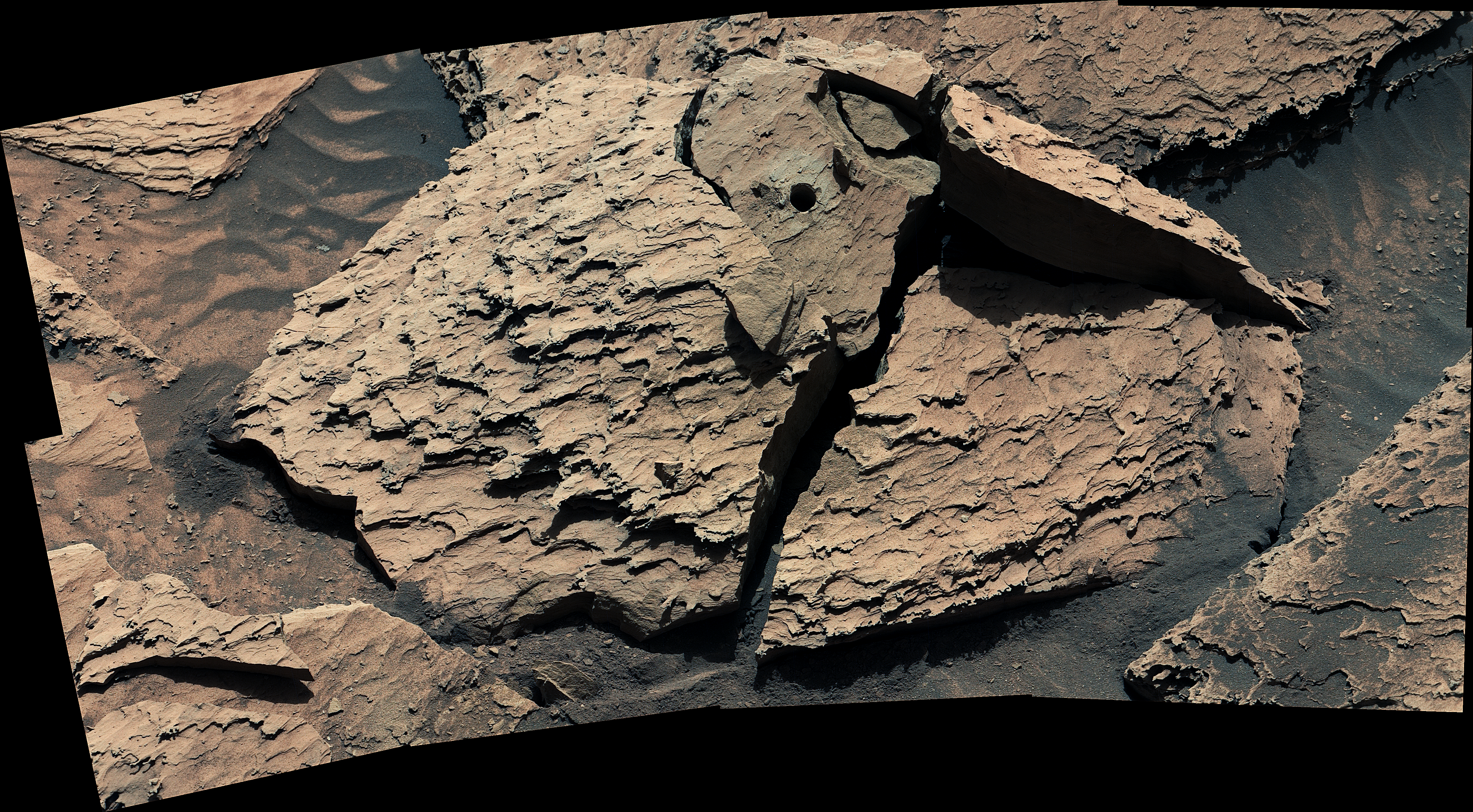
On May 6, 2026, Curiosity used its Mast Camera, known as Mastcam, to photograph a rock the team has nicknamed “Atacama.” The images were taken on sol 4,877 of the mission and show the target up close after it briefly became lodged on the drill mounted at the end of the rover’s robotic arm.
The trouble began April 25, when Atacama became stuck to the drill. Over the next several days, engineers worked through a careful set of maneuvers aimed at freeing the sample. The team repeatedly adjusted the position of the robotic arm and used vibration of the drill in an effort to shake the rock loose. Those efforts ultimately succeeded: the rock detached on May 1.
The Mastcam view offers a clear reminder of what prompted the episode. Atacama bears the round hole created by Curiosity’s drill, visible on its surface. The rock itself is substantial for something that can momentarily cling to the rover’s hardware. Mission estimates put it at about 1.5 feet (roughly 45 centimeters) across at its base and around 6 inches (about 15 centimeters) thick. If the same rock were weighed on Earth, it would come in at about 28.6 pounds (13 kilograms). Under Mars’ weaker gravity, it would weigh roughly a third of that.
The newly released scene is not a single snapshot, but a composite. The image is a mosaic assembled from eight individual frames captured by Mastcam and later combined after the data were transmitted back to Earth. The colors have also been adjusted with an approximate white balance so the terrain appears closer to how it would look under daylight conditions on Earth, making details easier to interpret.
Curiosity, built at NASA’s Jet Propulsion Laboratory (JPL), continues to operate as part of NASA’s Mars Exploration Program. JPL is managed by the California Institute of Technology in Pasadena and leads the mission for NASA’s Science Mission Directorate in Washington. The Mastcam instrument was built by Malin Space Science Systems of San Diego, which also operates the camera system.