An international research group analyzing observations from NASA’s Fermi Gamma-ray Space Telescope says it has found the clearest evidence yet that a superluminous…
An international research group analyzing observations from NASA’s Fermi Gamma-ray Space Telescope says it has found the clearest evidence yet that a superluminous supernova can shine in gamma rays—an elusive signal astronomers have hunted for nearly two decades. The team argues the extraordinary outburst was likely energized by a magnetar, an ultramagnetized neutron star created in the same collapse that destroyed the original star. The results were published Wednesday in Astronomy & Astrophysics in a paper led by Fabio Acero of France’s National Centre for Scientific Research (CNRS) and the University of Paris-Saclay.
Core-collapse supernovae mark the violent deaths of stars far more massive than the Sun. When their central engines exhaust nuclear fuel, gravity wins, the core implodes, and an explosion blasts the outer layers into space. The collapse can leave behind a neutron star—an object roughly the size of a city—or, in some cases, a black hole. The ejected material expands rapidly as an extremely hot, dense plasma.
In the past two decades, astronomers have identified nearly 400 especially extreme core-collapse events known as superluminous supernovae. These outbursts radiate at least ten times more visible light than typical supernovae, but what supplies the extra energy has remained a central question. One long-standing possibility is that a rapidly spinning magnetar forms in the collapse and injects energy into the debris, effectively “recharging” the explosion.
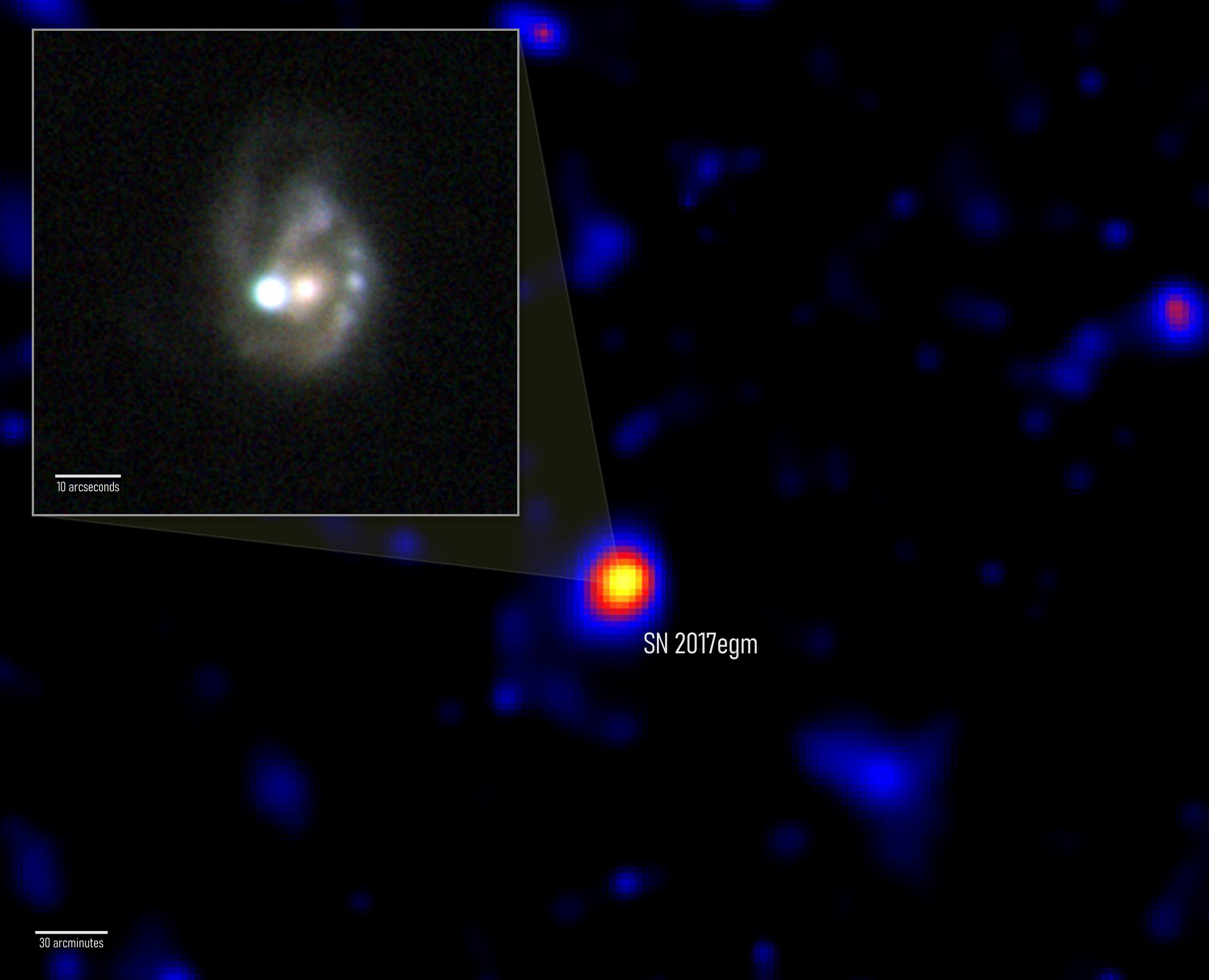
The new analysis focuses on a standout event called SN 2017egm. The supernova erupted in the galaxy NGC 3191, about 440 million light-years away in the constellation Ursa Major, making it one of the nearest known examples of its class—close enough, astronomers hoped, to offer the best chance of spotting high-energy emission. Earlier work in 2024 led by Li Shang of Anhui University suggested that Fermi’s Large Area Telescope (LAT) might have captured gamma rays from SN 2017egm years after the explosion, but the evidence was not yet conclusive.
To test the claim, the team conducted a systematic search for gamma-ray signals from the six closest superluminous supernovae observed during Fermi’s first 16 years. According to Guillem Martí-Devesa—formerly at the University of Trieste and now a fellow at the Institute of Space Sciences in Barcelona—only SN 2017egm showed signs consistent with gamma-ray emission, strengthening the case that at least some of these events can be bright in gamma rays as well as in optical light.
To explain both the visible and gamma-ray behavior, the researchers compared theoretical scenarios and found strong agreement with a magnetar-based model developed by co-authors Indrek Vurm of the University of Tartu and Brian Metzger of Columbia University. In this picture, the newborn neutron star carries magnetic fields up to 1,000 times stronger than those of ordinary neutron stars—roughly 10 trillion times the strength of a typical refrigerator magnet—and spins hundreds of times per second. That rapid rotation drives a powerful wind of electrons and positrons, building a magnetar wind nebula: an enormous reservoir of highly energetic particles inside the expanding supernova debris.
Within that nebula, particles and photons continually interact. Electrons and positrons can annihilate into pairs of gamma-ray photons, while gamma rays can collide and convert back into particle pairs. But the surrounding ejecta initially traps much of this high-energy radiation. Instead of escaping directly, gamma rays are absorbed and “reprocessed” as the blast expands, shifting their energy down into visible wavelengths—helping to account for the supernova’s exceptional brightness.
The detection, if confirmed by further studies, would provide a new way to probe how the most overpowered stellar explosions are fueled, using Fermi’s high-energy view alongside traditional optical observations.