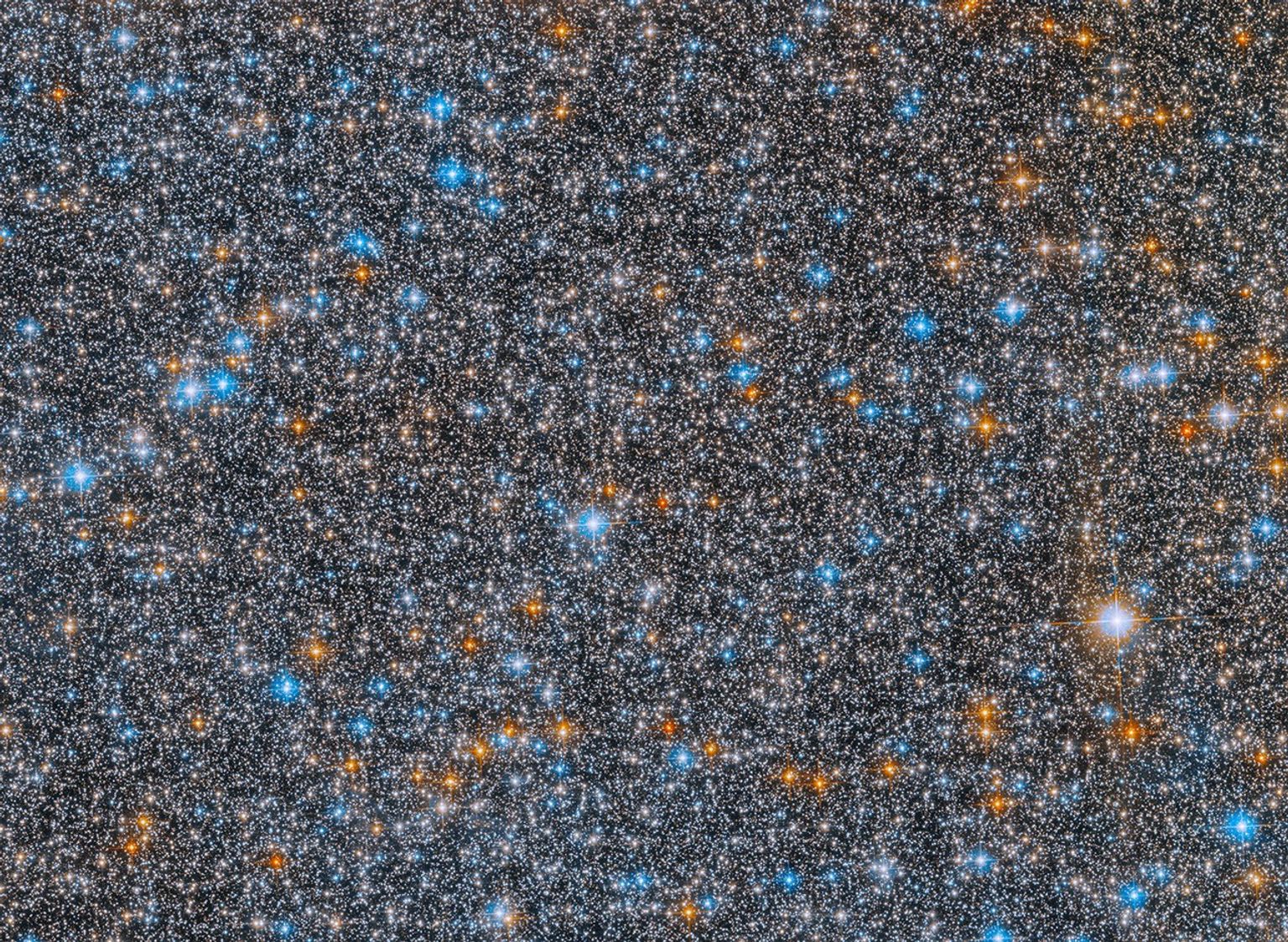
New Hubble images reveal thousands of colorful stars toward the Milky Way’s crowded bulge, providing baseline data to aid Roman’s future microlensing search for exoplanets.
A dense star field toward the heart of the Milky Way sparkles in newly released images from NASA’s Hubble Space Telescope, showing thousands of stars rendered in a range of colors. The view targets the direction of the galactic bulge—the tightly packed, roughly spherical concentration of stars that surrounds the center of the galaxy’s disk. Beyond their aesthetic appeal, the observations are designed to serve as foundational context for future studies with NASA’s Nancy Grace Roman Space Telescope, which will probe the same crowded region in a major hunt for exoplanets and other compact objects.
Astronomers are especially interested in the Milky Way’s bulge because it contains nearly one-quarter of the galaxy’s total stellar mass and is close enough for detailed scrutiny. Similar bulges can be seen as a diffuse glow in other galaxies, but they are too distant and too densely populated for telescopes to disentangle individual stars. In our own galaxy, however, researchers can resolve the bulge’s stellar population and use it as a laboratory for testing ideas about how galaxies form, evolve, and interact across billions of years—while also searching for new planets.
Hubble typically observes the cosmos in ultraviolet, visible, and near-infrared light. Roman, by contrast, will collect data mainly in the near-infrared with some visible-light capability. To ensure the datasets can be compared directly, the new Hubble program observed the bulge at wavelengths that overlap Roman’s sensitivity: the red end of the visible spectrum and near-infrared bands. Hubble’s sharp vision allows astronomers to measure fundamental properties of stars in this region, including their brightness, ages, chemical composition, and motions over time. Those measurements can, in turn, help researchers map the galactic environment, constrain the distribution of invisible mass such as dark matter, and identify locations where black holes may reside.
One of Roman’s signature goals in the bulge will be to detect exoplanets via microlensing—events in which the gravity of a foreground star briefly magnifies and warps the light of a more distant background star aligned along the same line of sight. The detailed shape of the brightening can disclose information about the intervening star and can betray the presence of orbiting planets. Microlensing operates on the scale of stars and planets, distinct from the dramatic gravitational lensing seen around entire galaxies and galaxy clusters.
Hubble’s role is to provide “before” snapshots: a characterization of stars in Roman’s target fields prior to any lensing event. When Roman later records a microlensing signal—months or even years after Hubble’s images—researchers will be able to compare the event data against Hubble’s baseline measurements, improving the interpretation of what Roman sees.
The Milky Way’s bulge is not new territory for Hubble. Past legacy efforts include the WFC3 Galactic Bulge Treasury Program, which used Hubble’s Wide Field Camera 3 to track stellar brightness and precisely measure positions and motions, and the Sagittarius Window Eclipsing Extrasolar Planet Search (SWEEPS), which used the Advanced Camera for Surveys to monitor about 180,000 bulge stars. The latest dataset comes from observing program #17776 (principal investigator S. Terry), explicitly aimed at strengthening Roman’s future searches for exoplanets, black holes, neutron stars, and more—while extending Hubble’s long-running record of high-precision bulge observations since its 1990 launch.
Why it matters
Roman is expected to find large numbers of worlds and compact objects in one of the sky’s most crowded neighborhoods, but interpreting those signals requires a detailed census of the background stars. By establishing high-resolution baseline measurements now, Hubble helps ensure Roman’s future microlensing discoveries can be identified and understood more reliably. The next milestone to watch is how Roman’s survey results, combined with Hubble’s preparatory maps, refine estimates of exoplanet populations and mass distributions near the galaxy’s center.