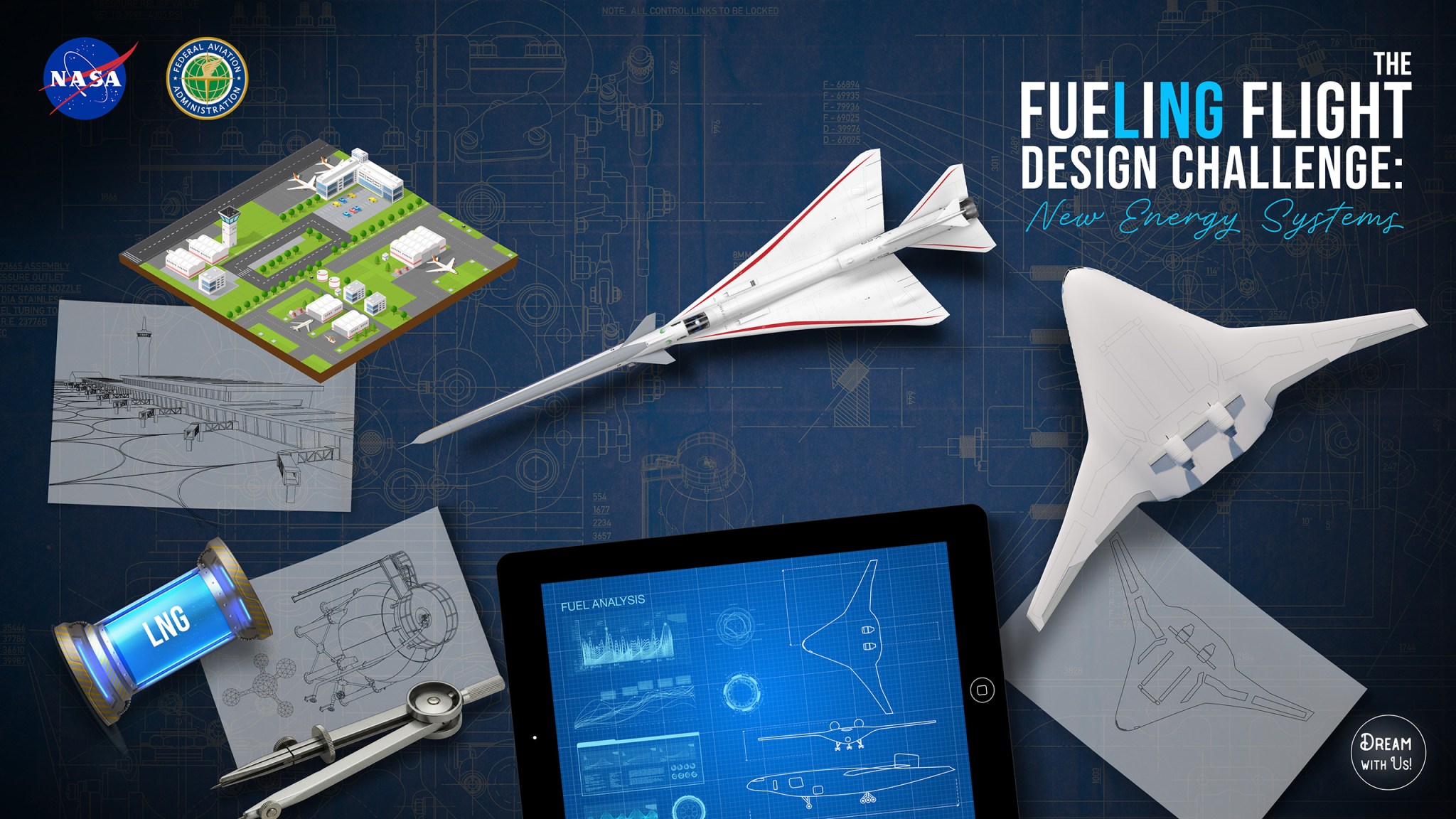
NASA is asking students to imagine what aviation could look like as new energy sources enter the skies.
NASA is asking students to imagine what aviation could look like as new energy sources enter the skies. For the 2026–2027 Dream with Us (DWU) Design Challenge, the agency has set a theme that reflects pressures now building across the U.S. National Airspace System: “Fueling Flight Design Challenge: New Energy Systems.”
With aircraft operations continuing to grow, NASA—working alongside the Federal Aviation Administration, universities, and industry partners—is pursuing ways to improve safety, lower the cost of flying, cut down travel time for passengers and cargo, and broaden the menu of fuels available to aircraft. This year’s DWU challenge puts a spotlight on a central idea in that effort: introducing even one additional fuel can ripple through the entire aviation ecosystem, from how airplanes are designed to how airports are built and operated.
The competition is open to both middle and high school students, with separate tasks for each age group. Across both divisions, teams will be asked to focus on a specific emerging fuel option: liquefied natural gas (LNG). Participants must learn what LNG is, explore how it could be applied in aviation, weigh the benefits of adding another fuel source, and identify what modifications would be necessary for aircraft and airport facilities to support it.
The challenge is framed against the backdrop of aviation’s long reliance on conventional configurations and infrastructure. For decades, commercial airplanes have largely followed a “tube-and-wing” template—an approach shaped by the materials and manufacturing capabilities available when modern aviation took form. NASA notes that advances in technology and materials are loosening those historical constraints, opening the door to aircraft that may not fit today’s standard assumptions. At the same time, research into alternative fuels, rising flight demand, and trends such as greater electrification are pushing airports to prepare for a more complex operating environment.
That complexity could translate into new airport layouts and capabilities: infrastructure able to store and dispense multiple fuel types, revised gate and terminal configurations that can accommodate different aircraft designs, and possibly distinct operating areas tailored to different kinds of vehicles. Exactly what airports and aircraft will look like, the agency suggests, will depend in part on the next generation of researchers and designers—students included.
For the middle school division, teams of two to four students will take on an airport-focused assignment. Their job is to modify an existing airport—or design one from scratch—so it can support operations using both LNG and conventional aviation fuel. The proposed airport must include a full layout featuring core elements such as control tower(s), hangars, fuel storage and fueling locations, a terminal, passenger parking, and runways, along with other required details specified in the official rules.
The 2026–2027 DWU Design Challenge opens on September 25, 2026. Middle school submissions will be accepted beginning that day and must be turned in by January 22, 2027, at 11:59 p.m. Eastern Time. Entries must be submitted through the official portal on the Dream with Us webpage at https://www.nasa.gov/dream-with-us/.
Organizers also emphasize several participation requirements. Each team is limited to one entry, and creating a team registration account must be done by someone older than 13; an adult sponsor may complete registration on a team’s behalf if needed. Signed permission forms from parents or legal guardians are required for all participants, and teams must follow the terms listed in the rules and on the submission form.
Notably, the challenge prohibits the use of artificial intelligence tools. Teams may not upload, process, or generate challenge content using AI systems, including browser-based generative AI services, AI-assisted coding tools, or AI-generated images. All work must be produced solely by the student team members.