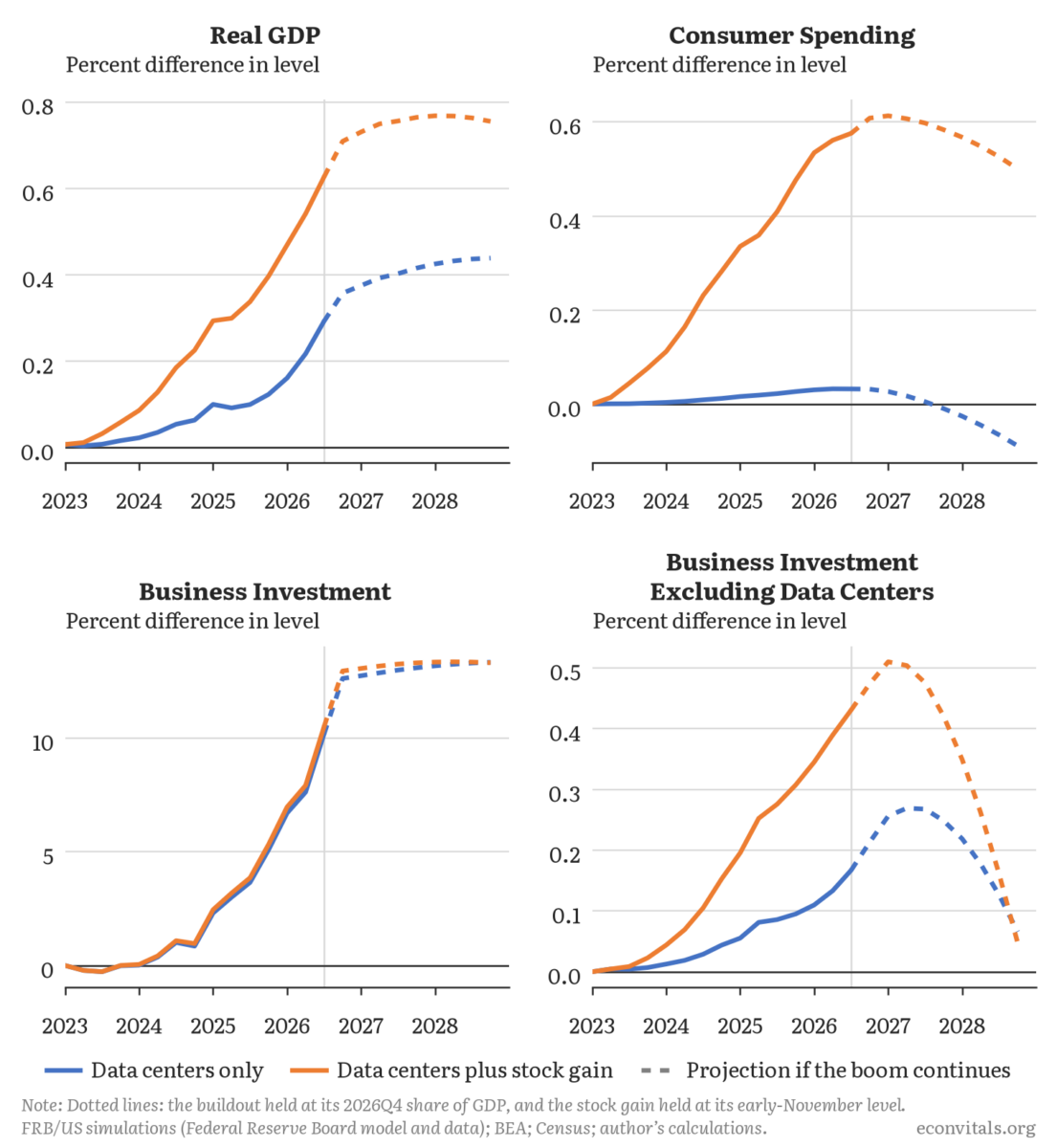
Jason Furman’s new FRB/US-based simulator models an AI investment boom and its ripple effects on output, rates and households, highlighting how debt vs equity financing matters.
Jason Furman has released a macroeconomic simulator built on the Federal Reserve’s FRB/US model and is now using it to sketch what an “AI boom” could mean for the broader economy. The value of the exercise is less about any single forecast and more about forcing a general-equilibrium perspective—one that traces how a technology-driven investment surge can ripple through output, interest rates, financial conditions, and household behavior rather than remaining a story about one company’s spending plan or one headline productivity claim.
Furman’s write-up highlights results for four key variables (presented as charts) to illustrate the model’s implications under an AI-driven scenario. He also notes that the FRB/US framework is accessible to users beyond the Fed’s traditional toolchain: it can be run in Python, and it is also available in R via the “bimets” package, which provides documentation for translating FRB/US-style structures into that environment.
The discussion arrives as markets try to price increasingly ambitious valuations for leading AI firms. One example circulating in finance coverage is a proposed IPO valuation for Anthropic in the neighborhood of 98 per share, which—based on the implied equity value—would put the company closer to roughly $1.7 trillion, higher than the suggested IPO range rather than lower.
Beyond eye-catching valuations, the more consequential macro question is how the coming wave of AI-related capital expenditures will be financed. In a general-equilibrium model, the source of financing can change the channel through which the shock hits the economy. If firms fund investment primarily through equity issuance at rising market valuations, the neutral interest rate may move only modestly and the investment surge might crowd out relatively little elsewhere. If, instead, the expansion is heavily debt-financed—CoreWeave is cited as a clear example—the same investment push can become a “spread” story, where credit conditions and term premia matter as much as (or more than) assumed gains in productivity. In that case, the FRB/US trajectory could be driven less by the productivity impulse and more by the evolution of borrowing costs and credit terms.
Household balance sheets add another constraint. U.S. credit-card balances reached a record $1.29 trillion last quarter, a sign that consumers are already more levered as the economy approaches any potential refinancing cycle tied to AI infrastructure buildouts. That indebtedness could amplify sensitivity to interest rates and tighten the consumer channel just as business investment accelerates.
A general-equilibrium pass like this is often missing from public debate, which can get stuck toggling between firm-level capex anecdotes and sweeping claims about AI-led productivity miracles. One open question raised by the framing is how the simulator operationalizes the “AI boom”: whether it allows users to separate a pure productivity improvement from an investment-demand shock, or whether the scenario bundles those elements together—an important distinction when interpreting the resulting paths of the headline variables.
Why it matters
If AI triggers a major investment cycle, the macro outcome may hinge as much on financing and credit spreads as on productivity gains. Policymakers, investors, and households all face different risks depending on whether the boom is equity-funded or debt-fueled. With consumers already carrying record card balances, any rise in rates or tighter credit could have faster spillovers into spending—making the model’s assumptions about channels crucial to watch.