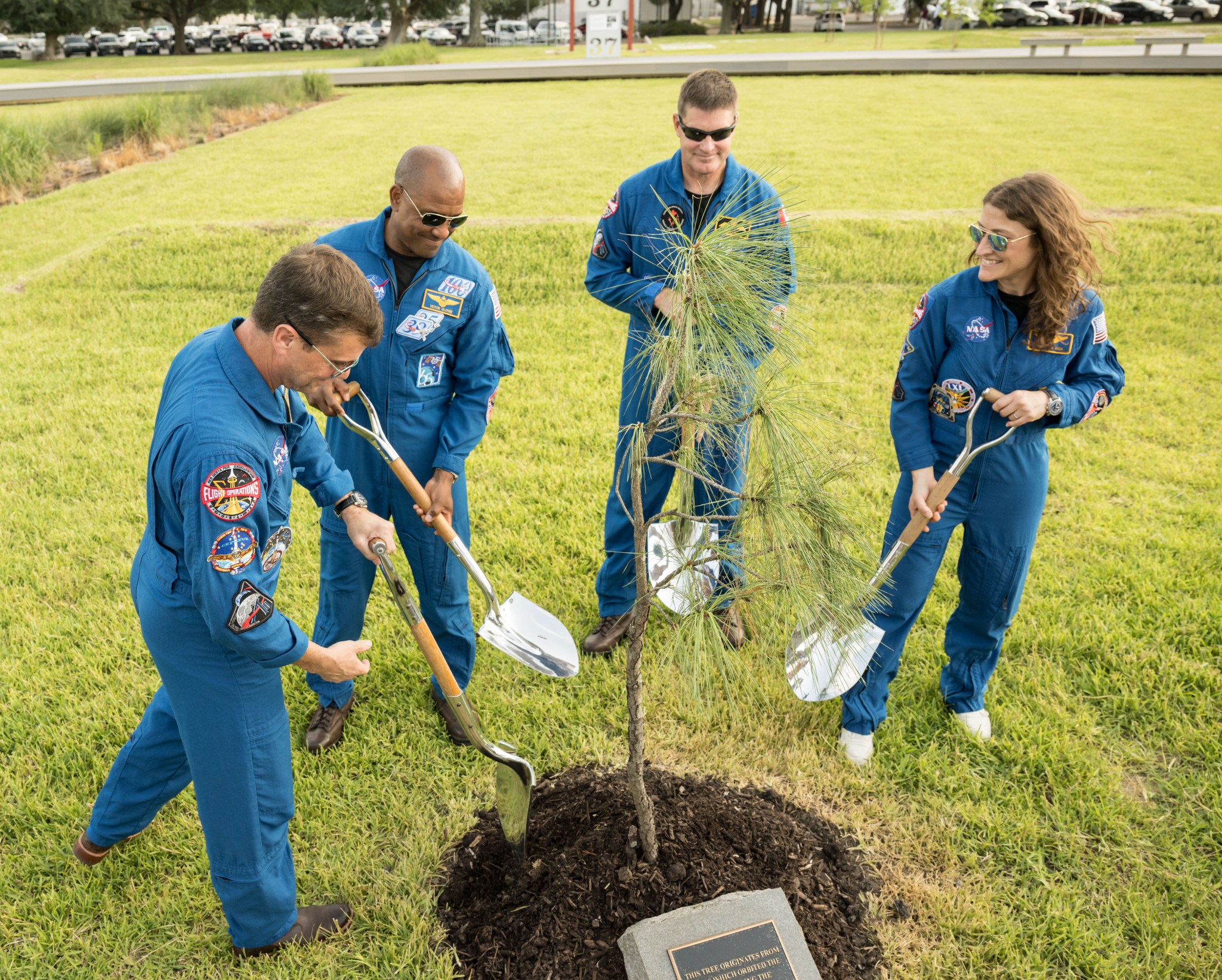
Members of NASA’s Artemis II crew gathered at Johnson Space Center on June 25, 2026, to dedicate a symbolic piece of lunar exploration history: an Apollo 14 Moon tree…
Members of NASA’s Artemis II crew gathered at Johnson Space Center on June 25, 2026, to dedicate a symbolic piece of lunar exploration history: an Apollo 14 Moon tree planted at the agency’s Lunar Receiving Park.
The tree, a loblolly pine, is not one of the original “Moon trees” born directly from Apollo-era seeds. It is a second-generation descendant—grown from the lineage of trees that trace back to seeds that traveled to the Moon and back during the Apollo 14 mission.
The Moon tree story began with NASA astronaut Stuart Roosa, who flew on Apollo 14 carrying a cache of seeds as part of the mission. Before joining NASA, Roosa had worked as a smoke jumper for the U.S. Forest Service, a background that helped inspire the unique payload. After the spacecraft returned to Earth, the Forest Service oversaw the germination of the flown seeds. Those seedlings became the first generation of Apollo Moon trees.
Over time, the resulting trees were distributed and planted widely, taking root in locations across the United States as well as in other countries. Many became living commemorations of the Apollo program—biology paired with spaceflight—marking an era when humans last traveled to the lunar surface.
Now, as NASA prepares to send astronauts around the Moon under the Artemis program, the dedication at Johnson Space Center links past and present through a living descendant of that original Apollo experiment. The ceremony at Lunar Receiving Park, a site long associated with NASA’s handling of lunar materials and mission heritage, underscored how the agency is weaving historic milestones into the narrative of its next steps toward the Moon.