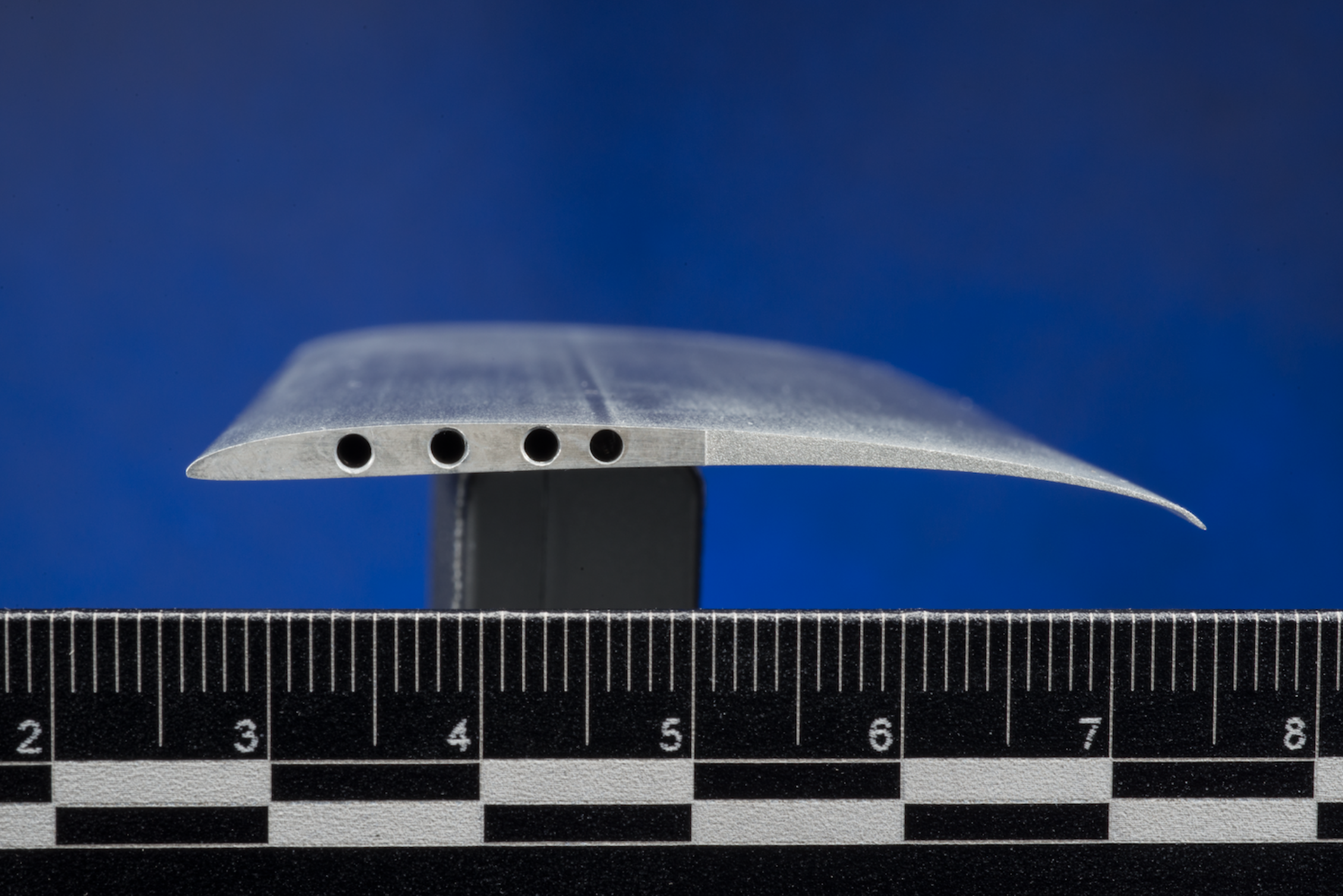
NASA is redesigning Mars helicopter rotor blades with new airfoil shapes, using simulations and wind-tunnel tests to boost range, lift and stability in the thin atmosphere.
NASA engineers are taking the next steps toward routine flight on Mars, reworking rotor blades to help future helicopters travel farther and operate more effectively in the planet’s extremely thin air. Building on the trailblazing success of Ingenuity—the first aircraft to achieve powered, controlled flight on another world—researchers are now using advanced computer modeling alongside wind tunnel experiments to reshape the core technology that makes those flights possible.
That push comes as NASA prepares the SkyFall mission, slated to launch in 2028, which will send three helicopters to Mars. Like Ingenuity, SkyFall’s aircraft rely on blades tailored for Martian conditions, including a distinctive curved edge that resembles—but is not the same as—rotorcraft blades designed for Earth’s denser atmosphere. But NASA’s longer-term goal goes beyond SkyFall: engineers want future rotorcraft to fly higher, carry scientific instruments, and cover much larger distances in a single hop across the Martian surface.
To get there, teams are exploring blade geometries that depart from conventional designs, including shapes that are thinner and sharper than what has flown so far on Mars. At NASA’s Ames Research Center in California’s Silicon Valley, researchers are working with Imperial College London and Nagoya University to evaluate a new blade cross-section, known as an airfoil, intended to substantially improve performance under Mars-like conditions.
The experimental airfoil—named roamx-0201—was developed using high-fidelity simulations and optimization algorithms specifically tuned to the Red Planet’s environment. Those computational tools pointed the team toward a thinner, asymmetric profile. When the design was later tested in a wind tunnel, the results indicated an aerodynamic boost and a greater ability to recover from risky flight conditions.
Using detailed simulation software, the researchers compared roamx-0201’s performance with capabilities demonstrated by Ingenuity. Their analysis suggests that redesigned blades based on the new airfoil could allow future Mars helicopters, even while carrying science payloads, to increase their single-flight range dramatically—from Ingenuity’s roughly 0.7 kilometers to as much as 18.7 kilometers without landing. The work was reported in a paper published Sept. 22 in a journal of the American Institute of Aeronautics and Astronautics.
One reason the new airfoil performs well is that it can sustain higher operating speeds for longer before hitting “drag divergence,” a steep drop in aerodynamic efficiency that can occur as rotor tip speeds approach the speed of sound. That effect is particularly relevant on Mars because the speed of sound is lower there than on Earth, meaning rotorcraft can encounter compressibility-related penalties sooner.
The design also takes a different approach to generating lift by manipulating turbulence. As air moves over a blade, it forms a thin “boundary layer” near the surface. Roamx-0201 intentionally disrupts that boundary layer right at the leading edge, creating a disturbance that paradoxically helps pull the blade upward and enhances lift compared with earlier designs.
Stall—another major hazard for rotorcraft—also appears improved. Stall occurs when changes in airflow angle cause lift to collapse and flight to become unstable. In the conditions studied, the roamx-0201 airfoil showed markedly better behavior near stall than Ingenuity’s blades, indicating a potentially wider safe operating envelope for future missions.
The technology is not yet ready to fly on Mars, but the combined testing and modeling is helping engineers understand where predictions and real-world measurements diverge—an essential step toward more efficient rotorcraft. NASA’s broader effort aims to enable future Mars helicopters that can fly farther, carry more instruments, and open up new categories of scientific exploration.
Why it matters
Longer-range Mars helicopters could transform exploration by reaching terrains too dangerous or slow for rovers, while scouting routes and delivering new science from hard-to-access sites. If the performance gains seen in simulations and wind tunnel tests translate to flight hardware, future missions after SkyFall could cover far more ground per sortie. The next key milestone will be validating these designs at the system level, where materials, manufacturing limits, and full-rotor dynamics can constrain what aerodynamics alone predicts.