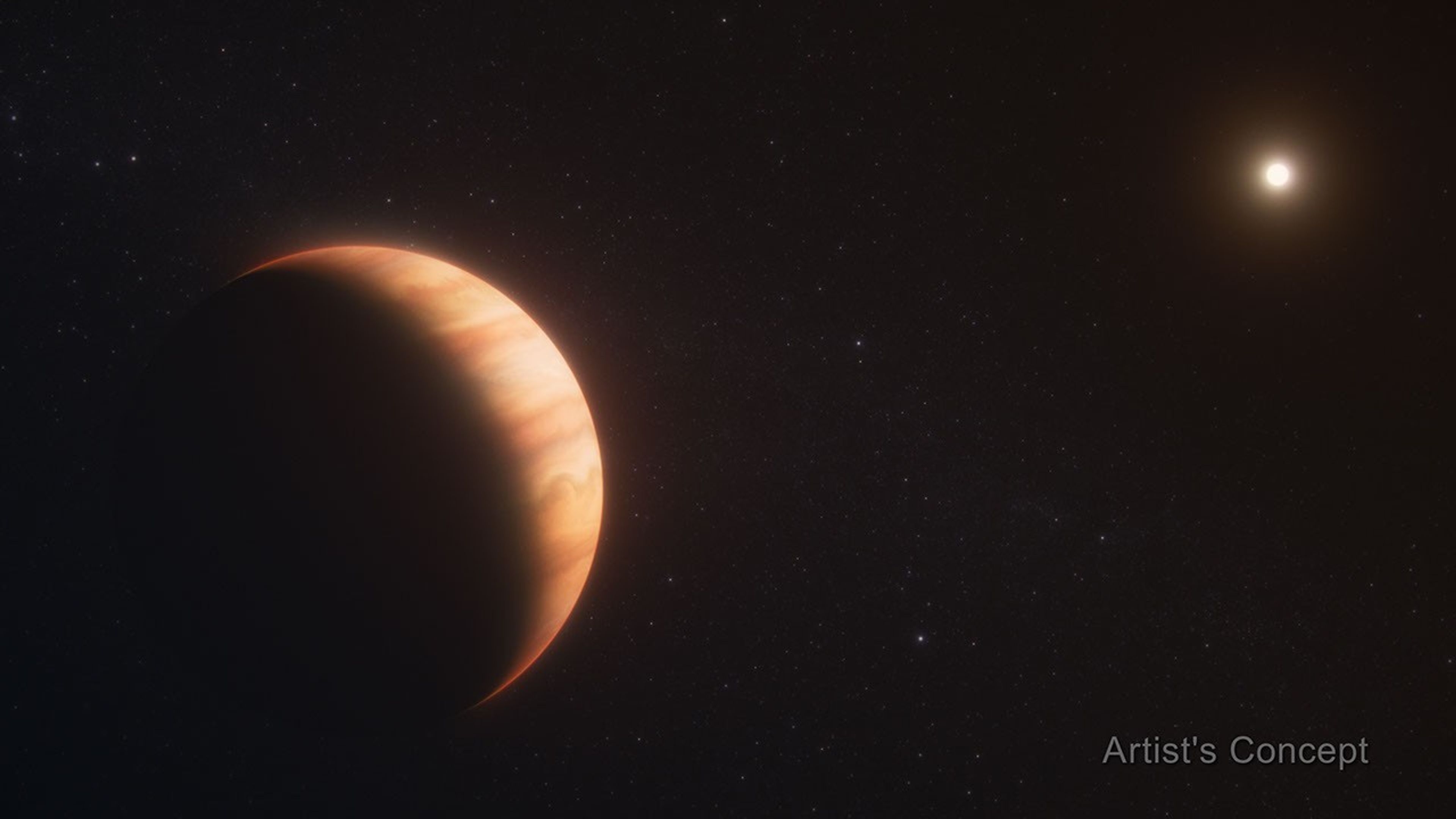
NASA’s James Webb Space Telescope has offered an unusually intimate look at what may await planets in solar systems like our own long after their stars die.
NASA’s James Webb Space Telescope has offered an unusually intimate look at what may await planets in solar systems like our own long after their stars die. The new observations focus on WD 1856 b, a Jupiter-sized world that somehow endured the catastrophic transformation of its Sun-like host into a white dwarf—then ended up circling the stellar remnant at an almost unimaginable distance.
The system’s central star, WD 1856+534, lies about 80 light-years from Earth. Like the Sun will billions of years from now, it once expanded into a red giant, ballooning outward before shedding its outer layers and leaving behind a dense, hot core roughly the size of Earth: a white dwarf. That evolution should have been lethal for any planet orbiting nearby. Yet WD 1856 b completes an orbit every 34 hours at a separation of less than 2 million miles (3 million kilometers), about 50 times closer than Earth is to the Sun. As lead author Ryan MacDonald of the University of St Andrews noted, the geometry is extreme: the planet is about Jupiter’s size, while the star it transits is Earth-sized—making the planet roughly seven times larger than the disk it crosses.
A close-in orbit like this presents an immediate paradox. If WD 1856 b had always been so near its star, it would have been engulfed and destroyed during the red-giant phase. To investigate how the planet survived and reached its current position, an international team used Webb to monitor transits—moments when the planet passes in front of the white dwarf—allowing the researchers to extract both physical and atmospheric information.
Those Webb data sharpened estimates of the planet’s mass, placing it between four and eleven times the mass of Jupiter. The transit measurements also revealed the planet’s temperature in an unusual way. When WD 1856 b eclipsed its star, the overall light dropped, but the dip was smaller in the infrared than at other wavelengths. That mismatch indicates an additional source of infrared emission: heat radiating from the planet itself. The team inferred a temperature near 260 degrees Fahrenheit (126 degrees Celsius), far warmer than expected if the planet were heated only by faint starlight from the white dwarf.
That unexpected warmth became the critical clue to the planet’s history. Co-author Christopher O’Connor of Northwestern University traced the implication backward in time. Two broad explanations have been proposed for WD 1856 b’s present-day orbit: either it was swallowed as the star expanded and somehow survived within the red giant’s envelope, or it migrated inward later due to gravitational interactions with other bodies. The latter idea is especially relevant because WD 1856+534 belongs to a triple-star system, meaning companion stars could have helped reshape planetary orbits.
Today, however, the researchers found no obvious mechanism capable of generating the measured heat. The most plausible explanation is that the planet is still cooling from an earlier heating event. By combining Webb’s measurements with models of how sub-stellar objects cool over time, the team estimated when that heating must have occurred—timing that can distinguish between engulfment during the red-giant phase and a later, dynamical inward migration.
The findings, published Wednesday in Nature, build on the planet’s 2020 discovery using NASA’s TESS mission together with the now-retired Spitzer Space Telescope. More broadly, the work turns WD 1856 b into a rare laboratory for studying the far-future evolution of giant planets—offering a preview of what worlds like Jupiter might experience after the Sun’s eventual demise.