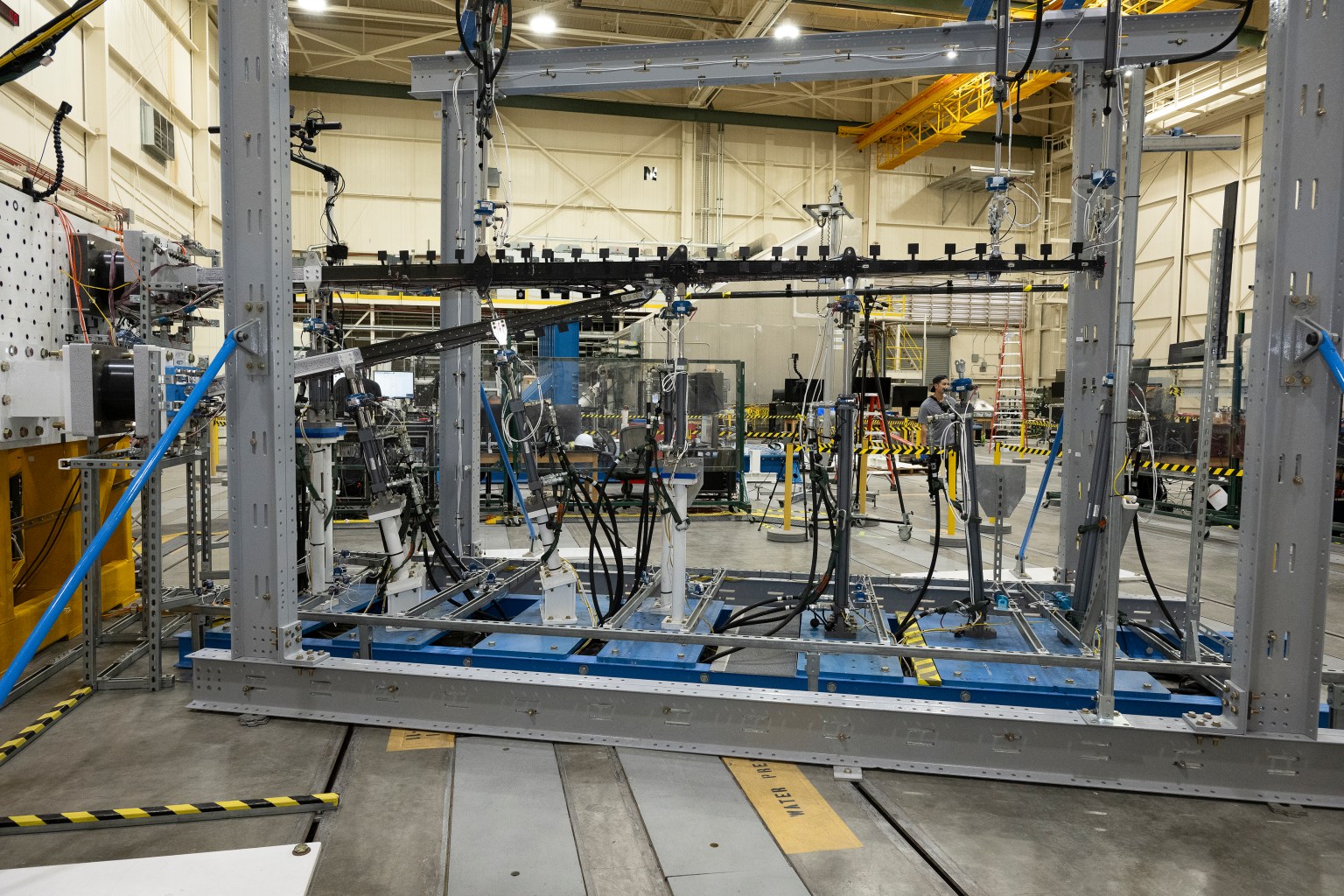
NASA engineers have been stress-testing an unconventional wing built to explore how far ultra-efficient aircraft structures can be pushed before they break.
NASA engineers have been stress-testing an unconventional wing built to explore how far ultra-efficient aircraft structures can be pushed before they break. After months of bending and loading the experimental hardware well beyond what it was designed to endure, researchers say the results are strengthening confidence that a new generation of long, lightweight wings could help future airliners cut fuel use.
The test piece, known as SWEET-15—short for Structural Wing Experiment Evaluating Truss-bracing—is a 15-foot wing section that is deliberately long and slender. Instead of relying solely on a traditional internal structure, the concept adds external support: an aerodynamic strut that braces the wing, a configuration rooted in NASA’s earlier Transonic Truss‑Braced Wing studies. NASA’s goal is to understand whether such a layout, paired with new lightweight composite construction methods, can deliver the strength required for flight while reducing weight and drag enough to improve efficiency.
Before such ideas can be considered for commercial transport, the agency must demonstrate that the structures behave predictably under realistic flight loads. SWEET-15 was created by merging five advanced composite manufacturing and assembly approaches that enabled its novel architecture. The wing was designed and built at NASA’s Langley Research Center in Hampton, Virginia, then shipped to NASA’s Armstrong Flight Research Center in Edwards, California, for full-scale structural evaluation.
Inside Armstrong’s Flight Loads Laboratory, engineers progressively deflected the wing over a series of increasingly demanding load cases. The structure was instrumented with numerous sensors to capture how it responded as forces grew. Among them were fiber-optic strain sensors, used to measure deformation across the wing with high spatial resolution. Those measurements closely matched what NASA’s computer simulations predicted, an important validation step for the analytical tools that would be used to design larger versions of the concept.
Initial findings showed the wing tolerated the expected flight-level forces without problems. That performance also served as a real-world check on the new manufacturing and assembly methods—especially the techniques used to join wing components in a lightweight composite structure.
A key enabling tool in the build was NASA Langley’s Integrated Structural Assembly of Advanced Composites robot, part of an effort to fabricate composite airframe structures that are both lighter and stronger than conventional designs. The SWEET-15 campaign offered a direct way to see whether those fabrication approaches translate into the durability and load paths engineers expect on paper.
The test program culminated in a controlled “test-to-failure,” during which loads were intentionally increased past the wing’s design limit to pinpoint failure modes and margins. Engineers drove the structure to about 127% of its design limit load before it ultimately failed. Visible damage appeared near the wing’s trailing region and in the upper wing cover. Critically, the final phase also revealed how the joints tying the wing to its main strut and to a secondary brace—called a jury strut—behave when forces exceed the anticipated flight envelope.
NASA says this is the first time a representative composite truss‑braced wing configuration has gone through this kind of structural evaluation. The work drew on collaboration across multiple NASA centers and projects, including the agency’s Fiber Optic Sensing System, a data-gathering capability used on both aircraft and spacecraft.
Researchers are now poring over the full dataset to guide future airframe designs as part of NASA’s Subsonic Flight Demonstrator project within the Research Technology Mission Directorate—an incremental but significant step toward more efficient aviation.