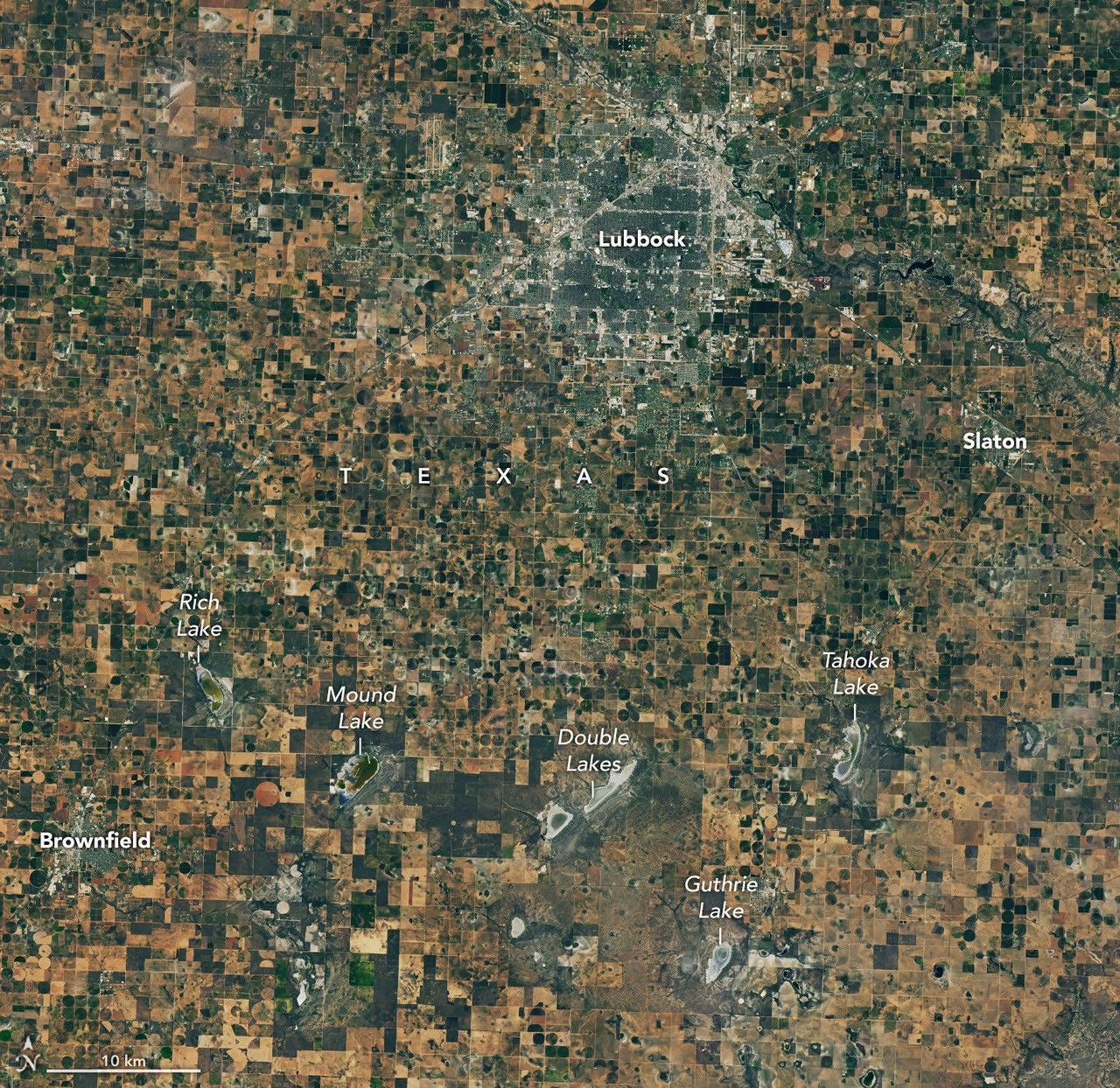
NASA researchers visiting the Texas High Plains found drought and a shrinking High Plains aquifer driving widespread cotton losses, with many dryland fields failing entirely.
Drought—and the shrinking High Plains aquifer—dominated discussions when NASA researchers met with farmers across the Texas High Plains, the heart of U.S. cotton production. For many growers, the harsh conditions of 2026 revived memories of earlier disasters, when extreme dryness forced widespread abandonment of dryland cotton. In 2022, farmers walked away from 72 percent of the region’s dryland crop; in 2011, the figure was 66 percent. But producers say this season has crossed a troubling threshold.
“This is the first year that we’ve had cotton completely die,” said Lacy Cotter-Vardeman, a multigenerational farmer in Lubbock County. After speaking with crop insurance representatives, she came away with an alarming message: they told her they had not encountered losses like this before. Cotter-Vardeman estimated that about 90 percent of her dryland cotton had died.
Satellite imagery underscores how widespread the damage has become in Lubbock County and surrounding areas. On September 9, 2026, Landsat 8’s Operational Land Imager (OLI) captured a landscape dominated by brown, stressed fields and bare ground. The same sensor viewed the area on September 22, 2025—a more typical year—showing noticeably greener, healthier vegetation and a comparatively normal harvest outlook.
The images also reveal subtler adaptations to dwindling water. With groundwater increasingly hard to access, many farmers have begun irrigating only part of their center-pivot fields—sometimes just half or even a third, said Tillery Timmons-Sims, an agricultural conservationist and landowner in Brownfield, Texas, who previously grew cotton. In satellite views, these decisions show up as partial green circles—semicircles and quarter-circles—surrounded by drier ground.
Scattered across the scene are shallow depressions known as playa lakes, also called mud holes, buffalo wallows, or lagoons. The Texas High Plains contains more than 19,300 of these features. While some—such as Double Lakes and Mound Lake—are relatively large, most are small, measuring under 30 acres. In September 2026, many playas were dry, unlike the previous year.
These ephemeral lakes matter because, when functioning, their clay-lined basins capture rainfall and can help channel water downward to replenish the aquifer that underpins regional irrigation. Yet roughly 80 percent of playa lakes have been altered by farming practices—tilled, reshaped, or filled with sediment—reducing or eliminating their ability to serve as recharge points.
The cotton belt here lies along the eastern edge of the High Plains aquifer, where declines have accelerated over the decades. U.S. Geological Survey data show that since about 1950—when large-scale pumping for irrigation expanded—the water table across much of Lubbock County has fallen by 25 to 100 feet. In several northern counties, including Parmer, Castro, Swisher, and Briscoe, the drop has exceeded 150 feet.
That long-term depletion, compounded by the 2026 drought, has pushed some wells past their limits. Timmons-Sims said some farmers she knows found their systems “pumping air” this summer. “We simply don’t have groundwater to fall back on anymore,” she said, noting that many expected the crunch to arrive in a future generation, not in the present.
Cotter-Vardeman has felt that reality directly: several of her irrigation wells stopped working in August. Rainfall in September and October—boosted by a strong El Niño in the Pacific—has brought some relief, but not enough to erase the drought, according to U.S. Drought Monitor assessments. Jonathan Case, a meteorologist at NASA’s Marshall Space Flight Center and a Drought Monitor author, said it would take about seven inches of rain over three months to bring the current drought to an end.
Timmons-Sims said the aquifer’s decline was a key reason she left farming in 2007, and she now focuses on identifying strategies that could keep agricultural operations viable as water grows scarcer.
Why it matters
The Texas High Plains is America’s top cotton-producing region, so crop failure and shrinking irrigation supplies reverberate through rural economies, commodity markets, and supply chains. With wells failing and natural recharge systems degraded, farmers are being forced to change how—and whether—they can farm. What happens next will depend on rainfall, but also on whether water conservation and land-management changes can slow aquifer decline.