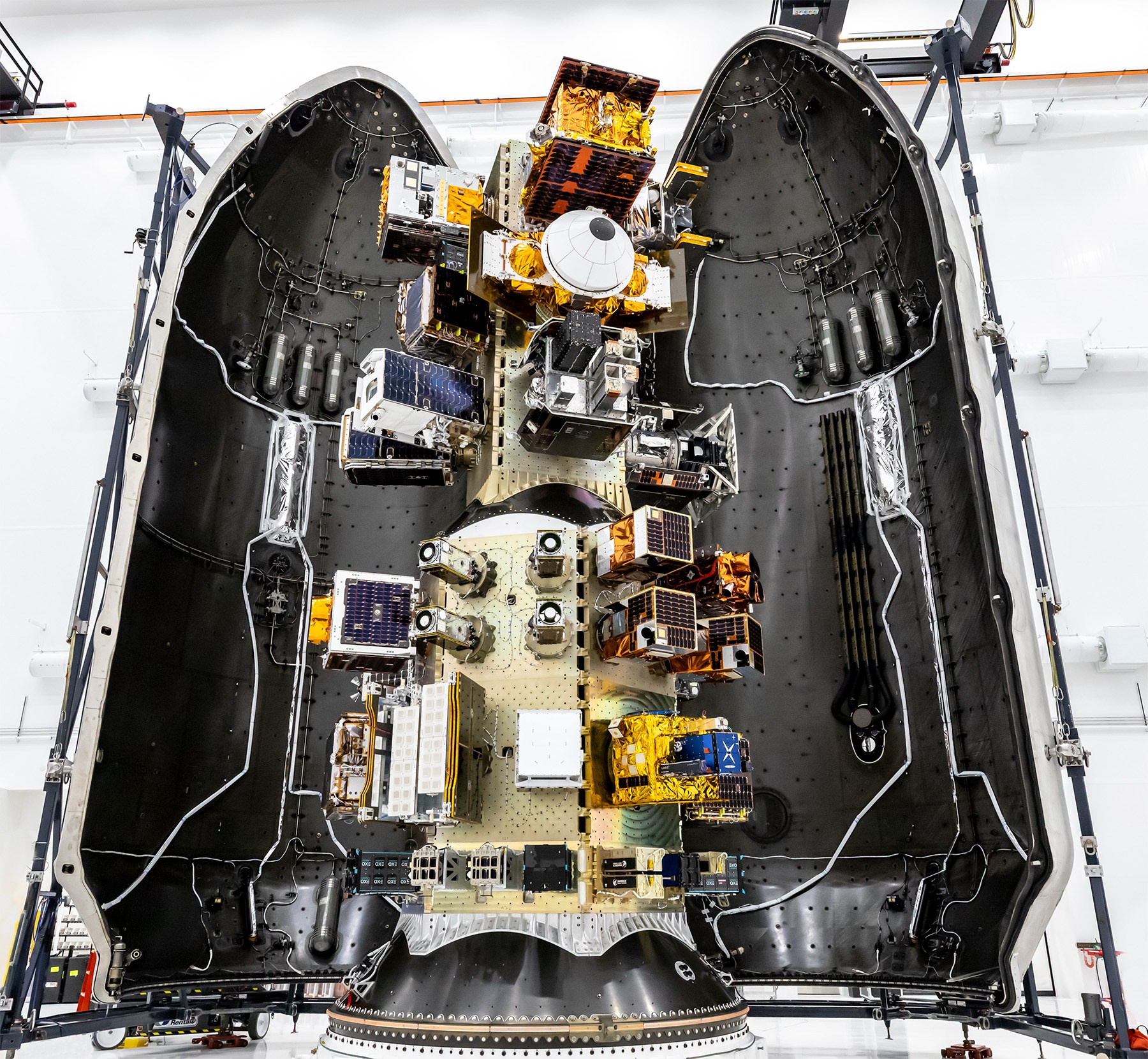
Three NASA-backed small spacecraft have been sealed inside a SpaceX Falcon 9 for a rideshare launch, aiming to test propulsion, astrophysics and satellite inspection technologies.
Three small NASA-backed spacecraft are preparing to ride to orbit alongside a large set of commercial payloads, captured in prelaunch images taken just before they were sealed inside a SpaceX Falcon 9 rocket.
The launch, scheduled for Oct. 1, 2026, will carry a cluster of small satellites that reflect NASA’s growing use of compact, lower-cost missions to test technologies and pursue targeted science. Among the government-supported passengers are three distinct projects: ASCENT Propulsion Dual Mode CubeSat, the Supernova Remnants and Proxies for ReIonization Testbed Experiment (SPRITE) CubeSat, and the Small Spacecraft Propulsion and Inspection Capability (SSPICY) mission.
Each spacecraft has a different objective, but all are designed to demonstrate capabilities that could shape future missions.
The ASCENT Propulsion Dual Mode CubeSat will focus on advancing propulsion for CubeSats. By demonstrating new approaches to in-space maneuvering, the mission aims to expand what these small platforms can do once deployed—such as adjusting orbits, conducting extended operations, or enabling more complex trajectories than typical “deploy and drift” missions allow.
SPRITE, also a CubeSat, is centered on astrophysics. Its investigation will examine how galactic dust and high-energy radiation travel through galaxies. Understanding the movement and interaction of dust and energetic radiation is essential for interpreting observations across the universe, because these components influence how light propagates and how researchers reconstruct the history and structure of distant systems. By targeting these processes, SPRITE is intended to strengthen scientists’ ability to connect what telescopes see with the underlying physical conditions in and around galaxies.
The third NASA-supported payload, SSPICY, is aimed at a pressing operational problem: how to inspect satellites that are no longer active. The mission will advance techniques and capabilities for examining inactive spacecraft, a step that could support future efforts in space situational awareness, satellite servicing, and responsible management of crowded orbital regions. Better inspection tools can help operators understand what failed, assess risk, and plan mitigation or removal strategies.
The three NASA-supported missions will share the rocket with numerous commercial payloads, highlighting how rideshare launches have become a major pathway for deploying small spacecraft. The encapsulation milestone—when satellites are integrated and enclosed within the rocket’s protective fairing—marks one of the final stages before liftoff, as launch teams transition from payload processing to final vehicle preparations.
Why it matters
Small satellites are increasingly central to how NASA and industry test new space technologies and carry out focused scientific studies. Propulsion demonstrations, astrophysics measurements, and improved satellite inspection tools can all feed directly into safer, more capable operations in orbit. Watch for what these missions prove in flight—especially whether new propulsion methods and inspection techniques can be scaled to future spacecraft and broader orbital environments.